
An accommodating negotiation style example: your company shipped a customer's order two weeks late, and in the next meeting the customer asks for a 10 percent credit on the invoice. You agree without bargaining, because the account is worth more than one invoice. Accommodating means low assertiveness and high cooperation. You let the other side's needs win over your own to protect the relationship.
Some people call this lose-win. You lose the point, they win it, and both of you know it.
Giving in is a tactic. Giving in without deciding to is a habit.
That difference is the whole post. The style is fine. Sliding into it because "yes" is the easiest English word in the room is the problem, and it is a problem you can fix with one prepared sentence.
Where the label comes from
"Accommodating" is one of five modes in the Thomas-Kilmann Conflict Mode Instrument, usually shortened to TKI. It is a short questionnaire that sorts how people handle conflict into competing, collaborating, compromising, avoiding, and accommodating. Those five modes sit on two scales: assertiveness, meaning how hard you push for your own needs, and cooperativeness, meaning how much you work to meet the other person's needs.
Accommodating scores low on the first and high on the second. Ralph H. Kilmann, who co-created the instrument, describes it this way: "Accommodating is just the opposite (unassertive and cooperative): You get all your needs met, but I don't get my needs met."
The framework is older and better tested than most negotiation advice you will read online. The TKI was first published in 1974 as a 16-page booklet with 30 pairs of statements, and its first norms came from 339 middle and upper managers. The Myers-Briggs Company, which publishes the TKI, ran a renorming study in 2007 with 8,000 respondents, 4,000 men and 4,000 women aged 20 to 70, drawn from 59,000 cases collected between 2002 and 2005. The publisher calls it "the leading measure of conflict-handling behaviour" and says it has been in use for more than 35 years.
If you want the other four modes explained, plus which one a counterpart from Germany or Japan tends to open with, that belongs to a separate guide to negotiating styles. This post stays on one.
The accommodating negotiation style example, step by step
Back to the late order. The customer wants 10 percent off. You have already decided the account matters more. Here is how the accommodating move works when you do it well.
Decide before the meeting, in three questions. What can I give? What will I not give? What sentence will I use when I give it? Prepare the sentence, not a script.
Then say the concession as a decision. This is where most of the damage happens, and it happens in the wording.
Many people say: OK, no problem, we can do that.
The customer hears: They folded fast. Next time, ask for more.
So make a small change: We were late. You should have the credit, and we will apply it this week. I want this account to last longer than one shipment.
Same concession. A completely different message. The first version sounds like pressure worked. The second sounds like a manager who chose.
Last, close the point. Once you accommodate, do not reopen it, and do not apologize a second time. Say: "That is settled. Now I would like to talk about the next order."
Three more places the style fits
Accommodating is the right move more often than its reputation suggests. Here are three situations where a careful manager uses it on purpose, with the sentence to say.
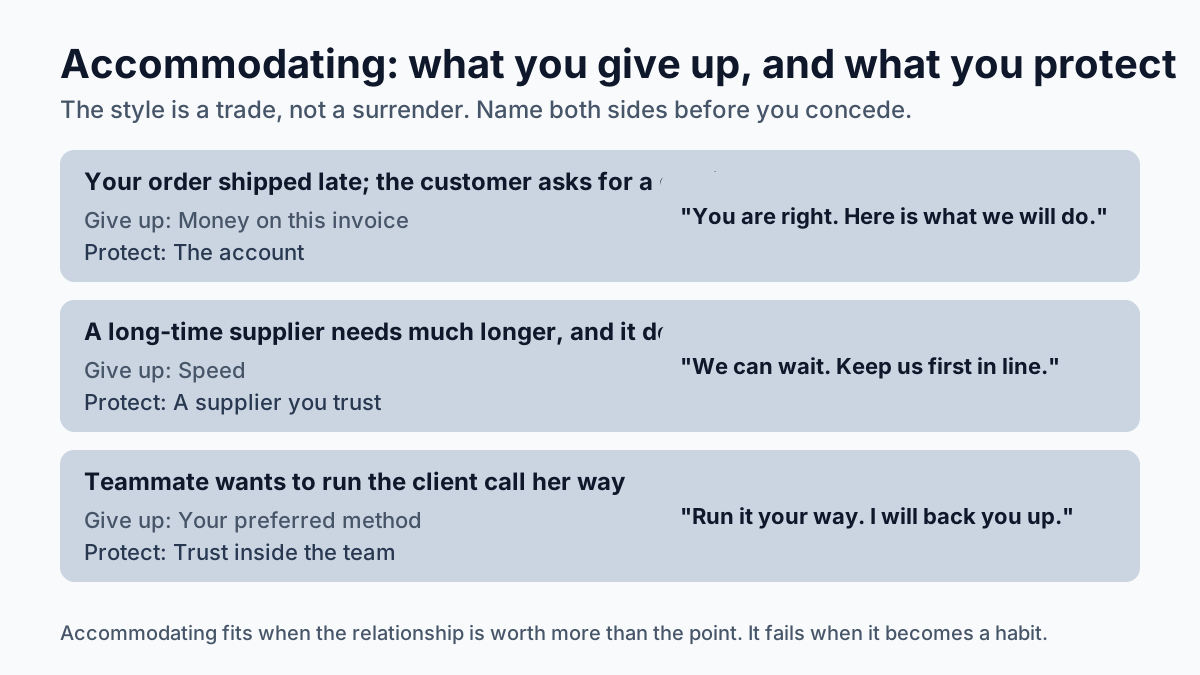
| Situation | What you give up | What you protect | What you say |
|---|---|---|---|
| A supplier you have used for years says delivery will take five months instead of two, and the delay does not hurt your project. You stay rather than try an unknown vendor. | Speed | A supplier who has delivered every time | "Five months works for us. Please confirm the date in writing." |
| A teammate wants to run the client call her way, and the difference is small. | Your preferred method | Trust inside the team | "Run it your way. I will back you up on the call." |
| Your company made the mistake and the customer is angry. | Money on this invoice | The account | "You are right. Here is what we will do." |
In each row the trade is visible. You can name what you gave and what you got. That is the test of a deliberate accommodation.
When is accommodating the right choice?
Use it when the point costs you little and matters a lot to them. Use it when your company caused the harm and the relationship is worth repairing. And use it inside long-term partnerships and teams, where Training Industry's guide to negotiating styles describes the style as valuable, with one condition: you keep track of what you are giving, or priorities get overlooked and the outcome tilts one way.
Calum Coburn, a negotiation expert at The Negotiation Experts, makes the same point about information: accommodative negotiators "are generous with information, too," not only with concessions. That is useful when trust is the goal. Just remember that information is a bargaining chip too, and you are handing it over.
When it turns into a habit
The risk is well documented. Harvard's Program on Negotiation warns that people who put others' needs first every time build up frustration and resentment, and that more competitive counterparts learn to take advantage of them.
For a non-native speaker there is a second risk, and it has nothing to do with negotiation theory. It is about the cost of words. Under pressure, "yes" is one syllable, and "no" needs a full sentence around it to sound polite. The cheap word wins.
So the meeting runs like this.
You say yes to the discount. You say yes to the delay. You say yes to the extra clause.
None of those was a decision. That is the difference between a style and a habit, and it is why this style gets a bad name it does not deserve.
The fix is small. Before the meeting, write the one sentence you will use to hold a line, and practice it until it comes out without thinking. Something like: "On that point I cannot move. Here is what I can do." That is the kind of sentence we rehearse at WorldView Training: short, fixed, and ready before the pressure starts. Under pressure, you will not rise to your level of knowledge. You will fall to your level of training.
One line for tomorrow's meeting
Accommodate on purpose, and say so out loud.
We accept this point. We are doing it because this account matters to us.
If you have an important negotiation coming up in English, send me a message. I'd be happy to help you prepare.
Frequently asked questions
What is an accommodating negotiation style?
An accommodating negotiation style is one of the five conflict-handling modes in the Thomas-Kilmann Conflict Mode Instrument. It combines low assertiveness with high cooperativeness: the negotiator gives up their own goal on a point so the other side's needs are met, usually to protect the relationship.
What are the five main negotiation styles?
The Thomas-Kilmann model names five: competing, collaborating, compromising, avoiding, and accommodating. They sit on two scales, assertiveness (how hard you push for your own needs) and cooperativeness (how much you work to meet the other side's needs).
When should you use an accommodating negotiation style?
Use it when the point costs you little and matters a lot to the other side, when your company caused a problem and the relationship is worth repairing, or inside long-term partnerships where goodwill is worth more than one win. It works as a decision made before the meeting, never as a reflex under pressure.
Sources reviewed
- Kilmann Diagnostics — The Distributive Dimension TKI co-creator Ralph H. Kilmann defines accommodating as 'unassertive and cooperative': the other party's needs get met, not yours.
- Kilmann Diagnostics — A Brief History of the TKI The TKI was first published in 1974 by Xicom as a 16-page booklet with 30 item pairs, normed on a sample of 339 middle and upper managers.
- The Myers-Briggs Company — History and Validity of the TKI The Myers-Briggs Company's 2007 TKI renorming study is based on 8,000 respondents (4,000 men, 4,000 women, ages 20-70) drawn from 59,000 cases collected 2002-2005; the TKI has been used for more than 35 years as, in the publisher's words, 'the leading measure of conflict-handling behaviour.'
- Kilmann Diagnostics — Brief Overview of the TKI Assessment TKI's five conflict-handling modes (competing, collaborating, compromising, avoiding, accommodating) are plotted on two independent dimensions: assertiveness and cooperativeness.
- Harvard Program on Negotiation — Conflict Styles and Bargaining Styles Accommodators who consistently put others' needs first risk frustration or resentment over time, and can be exploited by more competitive counterparts.
- Shapiro Negotiations Institute — What Are the 5 Negotiation Styles? CEO/Managing Partner Andres Lares says the accommodating style works best when a company has caused harm and needs to repair a significant relationship.
- The Negotiation Experts — Winning with your Negotiation Styles Profile CEO Calum Coburn says accommodative negotiators are 'generous with information, too,' not just concessions.
- Impact Factory — Avoiding and Accommodating in Negotiation Over-accommodating ('giving away the farm') 'usually just creates one happy negotiator — and it's not you.'
- Training Industry — Understanding Negotiating Styles The accommodating style is valuable in long-term partnerships or team environments, but can lead to overlooked priorities or imbalanced outcomes if not managed carefully.