
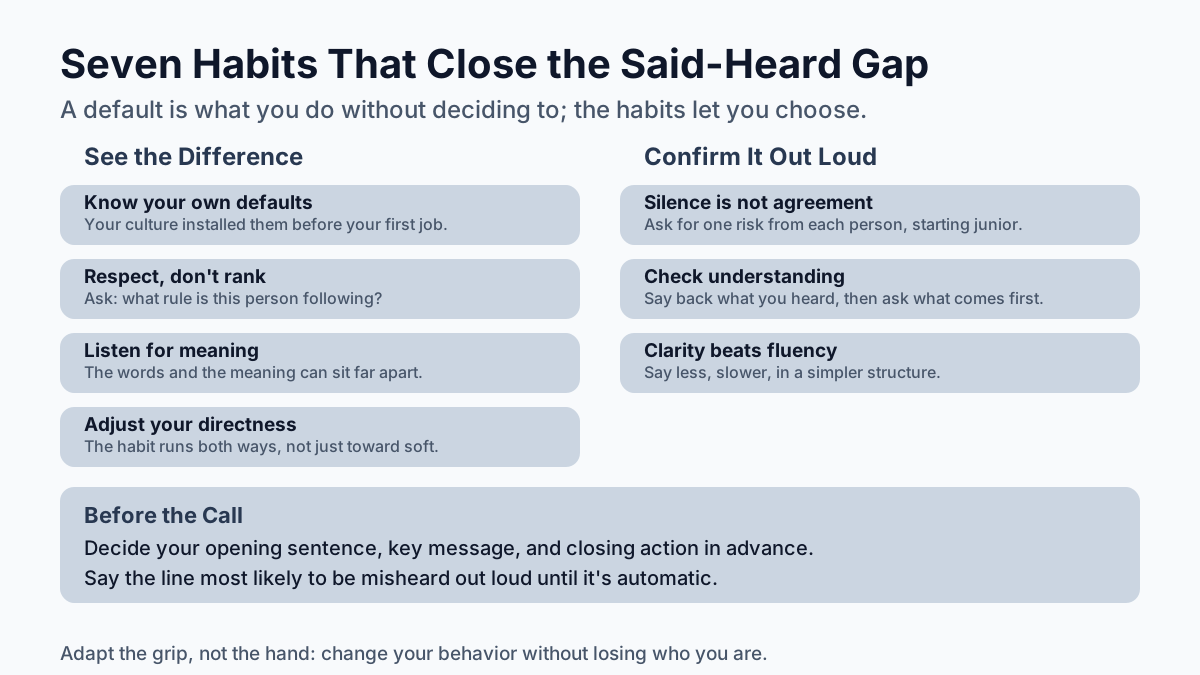
The principles of cross-cultural communication are seven habits: know that your own culture set your defaults; respect other norms without ranking them; listen for meaning, not only words; adjust your directness to the listener; never read silence as agreement; check understanding out loud; and choose clarity over fluency. Together they close the gap between what a speaker meant and what a listener heard.
Picture a Tuesday project call. A manager in Frankfurt, a team lead in Osaka, a sales director in Chicago, one shared screen. The manager says, "This section is wrong. Please redo it by Friday." Chicago nods. Osaka goes quiet. Frankfurt moves to the next slide, sure that everyone agrees.
Nobody on that call made a grammar mistake. The trouble came from correct, confident sentences heard through different rules.
A default is what you do without deciding to. How fast you speak. How you say no. Whether you wait for the senior person to speak first. Whether a deadline is a promise or a hope. Your culture installed most of those defaults before your first job. The seven habits are a way to see them, and then to choose.
Why one sentence lands three different ways
Erin Meyer, who developed The Culture Map at the INSEAD business school, wrote in Harvard Business Review in 2015: "Until recently most of us worked in organizations that were largely local." The same company now holds colleagues who communicate and decide by different rules, and the rules stay invisible until they collide.
Those rules have been measured for decades. Geert Hofstede's 6-D model of national culture scores countries on six dimensions: Power Distance, Individualism, Masculinity, Uncertainty Avoidance, Long-Term Orientation, and Indulgence. Meyer's own Culture Map plots cultures on eight scales, including how people build trust, how directly they give feedback, and how they make decisions.
You do not need to memorize any of those models. What they prove is enough. The differences are real and they follow patterns. They have nothing to do with intelligence or English level. The quiet team lead in Osaka is following a rule. So is the blunt manager in Frankfurt.
Know your own defaults before you judge anyone else's
The first two habits, awareness and respect, travel together.
Awareness means accepting that your way is one way. If you grew up in the United States or Germany, direct speech feels honest, and the meaning sits inside the words themselves. If you grew up in Japan or many Arab countries, meaning sits in the relationship and the situation around the words, and a blunt sentence feels careless. The anthropologist Edward T. Hall gave the two styles their names, low-context and high-context, and neither style is superior. Friction starts when one side treats its own style as the office standard.
Respect is the second half, and it is narrower than people expect. You can disagree with a norm. You just stop ranking it. "They never say what they mean" and "They have no manners" are both rankings. Swap them for a question: "What rule is this person following?"
Awareness of your own words is where this gets practical. In a proposal role-play, a client of mine told the customer, "You are not our only client." He meant: we have experience with this exact problem. The customer hears: you are not that important to us. So we made a small change. "We have other clients who deal with similar issues." Same basic idea, a completely different message.
That is the shape of almost every fix in this post. What you said. What they heard. One small change.
Adjust your directness in both directions
Most advice on directness runs one way: tell the blunt person to soften. The habit works in both directions, and the indirect speaker has as much to gain.
- Said, by a direct manager to an indirect-style colleague: "This is wrong. Redo it."
- Heard: "You shamed me in front of my team, and you do not trust my work."
- The small change: "I'd like us to look at section two together. I think there is a stronger version of it." The instruction has not changed. The colleague keeps their standing.
Now the other direction.
- Said, by an indirect-style colleague to a direct manager: "That may be a little difficult."
- Heard: "Small problem. Still on track."
- Meant: "No. This will not happen by Friday."
- The small change, for the speaker: "I want to be direct, because I respect your time. Friday is not possible. Tuesday is." The small change, for the listener: "Is that a no, or a not yet?"
The indirect speaker did not have to become blunt. One sentence announces the shift, and then the message can be plain. The announcement is the courtesy.
Silence is not agreement
Hofstede defines Power Distance as "the extent to which the less powerful members of organizations and institutions (like the family) accept and expect that power is distributed unequally." In a culture that scores high on it, a junior analyst does not correct a director in an open meeting. She has a view. Speaking first, or speaking against, is simply the director's right and not hers.
So in that room, "Any questions?" works as a courtesy, one the senior person offers and the junior person declines.
- Said: "Any questions? No? Good, we're agreed."
- Heard, by the junior analyst: "The decision is made. My job is to accept it."
- The small change: "Before we close, I want one risk from each person." Then say a name. Ask for one thing. Start with the most junior person, so nobody has to speak after their own boss.
If you are the junior person in that room, you have a move too: "May I add one point for the record?" It asks permission, which respects the rank, and it still gets your point in.
Listen for meaning, then check it out loud
Active listening across cultures has two parts, and most people only do the first.
The first part is attention. Eyes up, and no finishing the other person's sentence. The second part is saying back, out loud, what you think you heard. Across cultures the second part matters more, because the words and the meaning can sit far apart.
The check has to be built with care, or it insults.
- Said: "Do you understand?"
- Heard: "Are you smart enough to follow me?"
- The small change: "Let me check that I explained it well. What will you do first?" The responsibility moves to the speaker. The listener answers with an action, and within ten seconds you both know whether the message arrived.
The reverse check works the same way: "Here is what I heard. You need the numbers by Thursday, and the format matters more than the length. Correct me." Now the other person can fix a misunderstanding without ever saying "you were wrong."
Clarity beats fluency
I used to think being a native speaker was my edge in global business. I don't think that anymore.
Native speakers are often the hardest people on a call to understand. They speak quickly. They interrupt. They assume understanding. They lean on idioms that stop at their own border, and they rarely notice.
The non-native speaker who says less, slower, in a simple structure, is often the clearest voice in the room. That is a communication skill, and it can be trained.
A client from Taiwan hosted a Vietnamese customer in English. Two non-native speakers, one shared language. Her takeaway had nothing to do with grammar. For the first time, she did not compare herself with her colleagues. That is the comparison I ask every client to make: measure yourself against where you were, never against the other people in the room.
Clarity also lives in single words. A client from China asked me when to say "I would like to tell you about" and when to say "I would love to tell you about." The answer is small. Like signals structure: here is the agenda. Love signals enthusiasm: I care about this part. Neither is wrong. One of them is what you mean.
That is the level WorldView Training works at: the English you already have, used with more purpose.
What are the three, five, or seven principles of cross-cultural communication?
Search this topic and you will find lists of three principles, five elements, seven C's, and eight components. The numbers come from different textbooks and training decks. No single body owns the list, so here is how they usually map onto each other.
Awareness, respect, and listening are the three that matter most. They are the first three habits above, and they are the foundation. They are also not enough on their own. A manager can be aware, respectful, and attentive and still hear "that may be a little difficult" as a yes.
Depending on the textbook, the basic model of any exchange has five to eight parts: a sender, a message, a channel (a call, an email, a meeting in person), a receiver, feedback, and the context and noise around all of it. Working across cultures changes one part of that model. The receiver decodes with different rules from the sender. That is why a message can leave one mouth clean and arrive as an insult.
The seven C's are the checklist most business-communication courses teach: clear, concise, concrete, correct, coherent, complete, and courteous. They describe the message on its own. Across cultures, two of them pull against each other. What sounds efficiently concise to a direct-style listener can sound cold to an indirect-style one. Treat the C's as the base, and the seven habits in this post as the adjustment layer on top.
Phrases you can use in tomorrow's meeting
- To announce directness without being harsh: "I want to be direct, because I respect your time."
- To decode a soft no: "Is that a no, or a not yet?"
- To check understanding without insulting anyone: "Let me check that I explained it well. What will you do first?"
- To reflect back: "Here is what I heard. Correct me."
- To bring the quiet people in: "Before we decide, I want one risk from each person." Then a name.
- To speak up across rank: "May I add one point for the record?"
- To name a difference without blame: "Where I work, we tend to say no directly. How does that sound to you?"
- To close so the message survives the time zones: "The decision is this. The owner is you. The date is Friday."
Say each one out loud once before the call. The second time is the one that counts.
How do you flex your style without losing yourself?
There is a fair objection to all of this: if you soften here and sharpen there, are you still you?
In my sessions the skill has a plain name: adapt the grip, not the hand. You change your behavior across cultures without losing who you are. Think of a hand that can hold a pen and then a hammer. The hand does not change. The grip does.
The research field calls this cultural intelligence, or CQ, and treats it as a skill, which means it grows with practice.
The practice is small. Pressure strips you down to whatever is automatic, and knowledge you have not rehearsed does not come with you. So decide in advance. Before a meeting across cultures, answer three questions: What is my opening sentence? What is my key message? What is my closing decision or action? Then take the one sentence most likely to be misheard and say it out loud until it is automatic.
At WorldView Training, that rehearsal is the session: the meeting you actually have next week, practiced until the small change is the one you reach for without thinking.
If you have an important presentation, meeting, or negotiation coming up in English, send me a message. I'd be happy to help you prepare.
Frequently asked questions
What are the three principles of cross-cultural communication?
The three most often named are cultural awareness (your own culture set your defaults), mutual respect (differences are noticed but not ranked), and active listening (checking the meaning, not only the words). They are the foundation, and they work best with a fourth habit: adjusting how direct you are to the person listening.
What are the 5 basic elements of cross-cultural communication?
Five-element lists usually describe the basic model of any exchange: a sender, a message, a channel, a receiver, and feedback, with context and noise added in the longer seven- and eight-element versions. Across cultures the receiver decodes the message by different rules from the sender, which is where most misunderstandings start.
What are the 7 C's of communication?
The seven C's are clear, concise, concrete, correct, coherent, complete, and courteous. They describe the message itself; across cultures, concise and courteous can pull against each other, so the habits of adapting to the listener sit on top of them.
Sources reviewed
- Erin Meyer, "When Culture Doesn't Translate," Harvard Business Review, Oct 2015 Quote: "Until recently most of us worked in organizations that were largely local" — globalization means colleagues now communicate and make decisions differently within the same company.
- Geert Hofstede's official site — 6-D Model of national culture Hofstede's 6-D Model defines six dimensions of national culture: Power Distance, Individualism, Masculinity, Uncertainty Avoidance, Long-Term Orientation, and Indulgence.
- Geert Hofstede's official site — Power Distance definition Power Distance is defined as "the extent to which the less powerful members of organizations and institutions accept and expect that power is distributed unequally."
- The Culture Factor Group (Hofstede's continuing research/consulting organization) The Culture Factor Group has operated for more than 40 years across 60+ countries advising organizations on national-culture differences.
- Cultural Intelligence Center — CQ Assessment reach The Cultural Intelligence Center's CQ Assessment is benchmarked against data from more than 300,000 people in over 100 countries.
- Cultural Intelligence Center blog — direct vs. indirect communication Low-context/direct communication (common in the US and Germany) uses explicit language; high-context/indirect communication (common in Japan and Arab nations) conveys meaning through relationship and context; neither is inherently superior.
- Trompenaars Hampden-Turner — Seven Dimensions of Culture / Riding the Waves of Culture Fons Trompenaars and Charles Hampden-Turner's book Riding the Waves of Culture, which introduced the Seven Dimensions of Culture model, has sold more than 300,000 copies in 20+ languages.
- Andy Molinsky's official site — Global Dexterity / Brandeis affiliation Andy Molinsky is a professor at Brandeis University's International Business School whose research coined "global dexterity" — adapting behavior across cultures without losing authenticity.