
Cross-cultural communication strategies are planned changes to how you speak, write, and listen so your message means the same thing across cultures. Examples include matching your directness to the listener, confirming every verbal agreement in one written line, agreeing on team rules for feedback and deadlines before a project starts, and preparing your opening sentence, key message, and closing action before a high-stakes meeting.
Here is the smallest example I know.
In a proposal role-play, a client of mine said to the customer, You are not our only client. She was trying to reassure them: we deal with problems like yours regularly. We have experience with this. The customer hears: you are not that important to us.
So we made one small change: We have other clients who deal with similar issues. Same basic idea. A completely different message.
That gap, between what you said and what they heard, is the whole subject. It gets wider every time a conversation crosses a language or a culture. Each strategy below closes it a little.
What a misunderstood message costs
Poor workplace communication costs US businesses an estimated $1.2 trillion a year, or roughly $12,506 per employee. That estimate covers every company. Add a second language and a second culture to the meeting and the risk rises.
The reward is just as large. In 2019, companies in the top quartile for ethnic and cultural diversity on their executive teams were 36% more likely to have above-average profitability than companies in the bottom quartile. A mixed team wins when its people understand each other.
Strategy 1: Match your directness to the listener
Erin Meyer, author of The Culture Map, plots national cultures on eight scales, and the first is Communicating. In low-context cultures such as the US, Germany, and the Netherlands, good communication is precise, explicit, and often put in writing. In high-context cultures such as Japan, India, and France, messages are layered and meant to be read between the lines.
Meyer makes the point plainly: what it means to be a good communicator in one culture is different from what it means in another.
Example. You need to tell a colleague that a slide is wrong.
To a Dutch colleague: Slide four has the wrong number. Please fix it before the client call. Short, clear, finished.
To a Japanese colleague, that same sentence can sound like a public correction. Try: Could we look at slide four together before the call? The request is identical. The listener keeps their dignity, and the slide still gets fixed.
The same rule covers what you do not say: how long you pause, and whether you fill a silence or let it sit. Watch the other person, and match them.
Strategy 2: Confirm every agreement in one written line
If I could keep only one strategy, it would be this one.
At the end of any call, write one line: So we agreed: you send the draft on Thursday, I reply with comments on Monday. Put it in the chat or in a two-line email.
Low-context readers expect it; to them, written confirmation is simply what good communication looks like. High-context readers gain even more, because the line removes guesswork without forcing anyone to say "no" out loud. Nobody is embarrassed by a sentence in a chat window.
Strategy 3: Agree on team rules before you need them
Most teams decide how to communicate in the middle of a crisis. Decide it in week one instead.
Four rules cover most of the trouble:
- How we give feedback (in the meeting, or one-to-one afterwards).
- How we say no (a direct "no", or "let me check and come back to you").
- What "urgent" means (today, this week, or "before the client sees it").
- Where a decision lives (the chat, the email, or the shared document).
Write them on one page and read them aloud in the first meeting. A rule everyone agreed to in advance is far easier to follow than a habit one person brought from their own culture.
Strategy 4: If you are the native speaker, you have the most work to do
I used to think being a native English speaker was my advantage in global business. I do not think that anymore.
Native speakers are often the hardest people to understand in an international meeting. They speak quickly. They interrupt. They assume understanding.
Example. Instead of Let's circle back and touch base once we've got the lay of the land, say: Let's talk again on Friday, after we have both read the report. Every word in the second sentence is one an intermediate English speaker already knows.
Strategy 5: Prepare three sentences instead of a script
Pressure changes performance. Under pressure you do not use your best English. You use your most automatic English.
So before an important meeting, decide three things in advance:
- What is my opening sentence?
- What is my key message?
- What is my closing decision or action?
Three sentences you can say without thinking beat a two-page script you cannot find under stress. Openings and closings are what people remember.
Strategy 6: Shift your behavior without losing yourself
Andy Molinsky, a professor at Brandeis International Business School, calls this skill global dexterity: "the ability to adapt or shift behavior in light of cultural differences."
Shift is a small word on purpose. Consider a manager raised in a workplace where junior people wait to be invited before they speak. Geert Hofstede's model measures that expectation as power distance, one of the six cultural dimensions his framework uses to compare more than 90 countries. Placed in a Dutch team, she keeps her calm style and decides in advance to make one comment in the first ten minutes. That is a shift. Her personality is still hers.
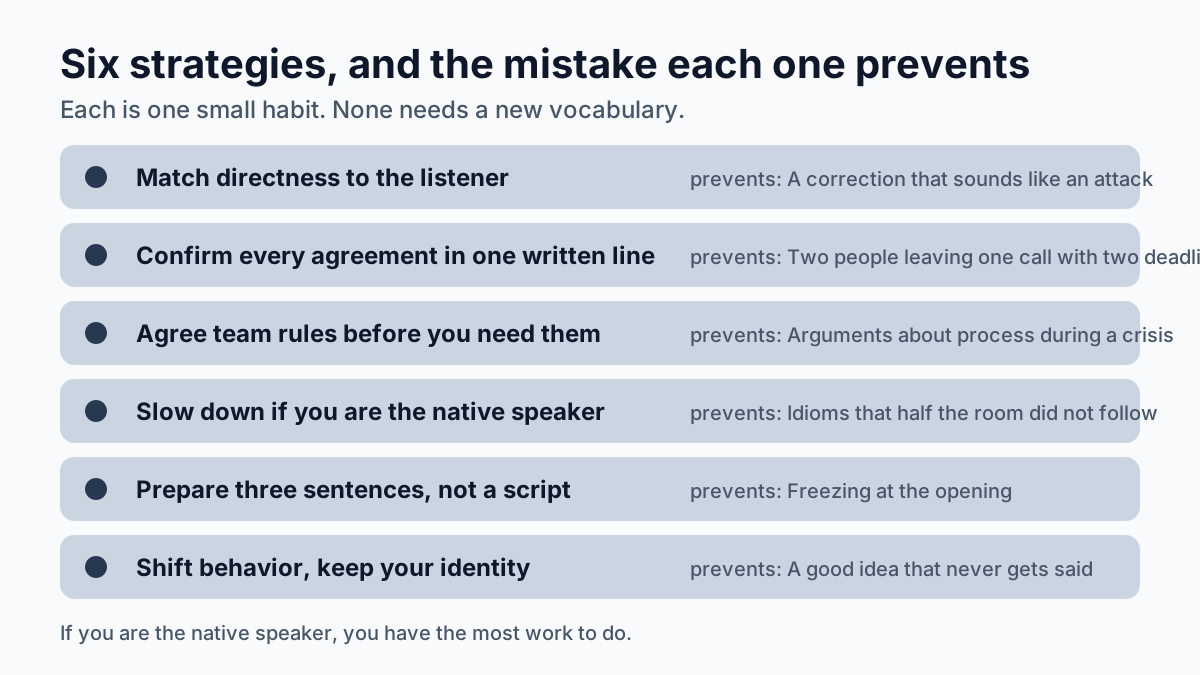
The six strategies at a glance
| Strategy | Example line | What it prevents |
|---|---|---|
| Match directness to the listener | Could we look at slide four together? | A correction that sounds like an attack |
| Confirm agreements in writing | So we agreed: draft Thursday, comments Monday. | Two people leaving one call with two deadlines |
| Agree team rules early | Feedback is given one-to-one, within 24 hours. | Arguments about process during a crisis |
| Slow down if you are the native speaker | Let's talk again on Friday. | Idioms that half the room did not follow |
| Prepare three sentences | My key message today is one number. | Freezing at the opening |
| Shift behavior, keep your identity | I have one point to add before we move on. | A good idea that never gets said |
Which framework should a busy manager learn first?
Start with Meyer's eight scales, because they describe behavior you can see across a table: how people communicate, evaluate, persuade, lead, decide, trust, disagree, and schedule. Turn to Hofstede's six dimensions when you need to understand why a whole office or market behaves the way it does.
Neither framework tells you what to say on Tuesday morning. That is what the examples above are for, and the companion post on real-life cross-cultural communication examples shows what happens when they are missing.
What young staff expect from their employers
A 2025 study in the International Journal of Cross Cultural Management found a significant gap in research on what young professionals, especially Generation Z, expect employers to do to help them build cross-cultural communication skills. In plain words: companies are hiring a generation into global teams without knowing what help they are waiting for.
The help itself is well understood. A good trainer rehearses the actual meeting and the actual email until the clear version is the automatic version. That is the work I do at WorldView Training with managers who have a presentation, negotiation, or difficult conversation coming up in English: the meeting you have next week, in the English you already have.
One line for tomorrow's meeting
Open with this: Before we begin, here is my key message in one sentence.
Then say it. Then stop.
Clarity is a leadership skill, and it is one you can train.
If you have an important presentation, meeting, or negotiation coming up in English, send me a message. I'd be happy to help you prepare.
Frequently asked questions
Can you give me an example of cross-cultural communication?
A manager in the Netherlands messages a colleague in India: "This draft is not good enough, please redo section two." A cross-culturally aware version keeps the same request but adds a reason and a softer frame: "Thanks for the fast draft. Section two needs a second pass, because the client will read that part first."
What are some examples of cross-cultural barriers to communication?
The most common are different expectations of directness (a low-context listener takes a soft answer as a maybe when it was a no), idioms and fast speech from native speakers, different rules about who may speak first in a meeting, and verbal agreements that each side remembers differently because nobody wrote them down.
Sources reviewed
- Hofstede Insights -- official home of Geert Hofstede's cultural dimensions model Geert Hofstede's cultural dimensions framework -- power distance, individualism-collectivism, masculinity-femininity, uncertainty avoidance, long-term orientation, indulgence-restraint -- is the officially maintained tool for comparing national cultures across 90+ countries.
- Erin Meyer -- The Culture Map (author's own site) Erin Meyer's Culture Map framework plots national cultures across eight behavioral scales: Communicating, Evaluating, Persuading, Leading, Deciding, Trusting, Disagreeing, and Scheduling.
- Erin Meyer, "Navigating the Cultural Minefield," Harvard Business Review (May 2014) In low-context cultures (e.g., US, Germany, Netherlands) good communication is precise, explicit, and often put in writing; in high-context cultures (e.g., Japan, India, France) communication is layered and messages are meant to be read between the lines.
- Grammarly Business / The Harris Poll -- State of Business Communication report Poor workplace communication costs US businesses an estimated $1.2 trillion a year in aggregate, or roughly $12,506 per employee per year.
- Andy Molinsky -- Global Dexterity (author's own site) Andy Molinsky, professor at Brandeis International Business School, defines 'global dexterity' as the ability to adapt or shift behavior across cultures without losing personal authenticity.
- Training Industry -- Strategies for Effective Cross-Cultural Communication in the Workplace Practitioner guidance recommends approaching cross-cultural interactions with curiosity, creating explicit team communication norms, and adapting message style to the individual rather than assuming a single 'right' way to communicate.