
Coconut and peach culture is a model from cross-cultural business training that sorts national cultures by how fast people open up to strangers. Peach cultures, like the United States and Brazil, are warm and friendly at first but guard a private core. Coconut cultures, like Germany and Russia, are reserved at first but form slower, longer-lasting relationships once the shell is cracked.
Say you sell software. You have a first call with a buyer in Germany. You open the way you always do: a big smile, "How was your weekend?", first names from the start. The buyer answers in one word and asks for the agenda.
Nothing went wrong. You just met a coconut.
Now flip it. A manager from Germany has a first call with a partner in Texas. The partner asks about her kids, her holiday, her favorite restaurant. She leaves the call sure the deal is close.
It is not. She just met a peach.
Peaches: soft on the outside, hard at the center
In a peach culture, people are friendly with people they have just met from the first minute.
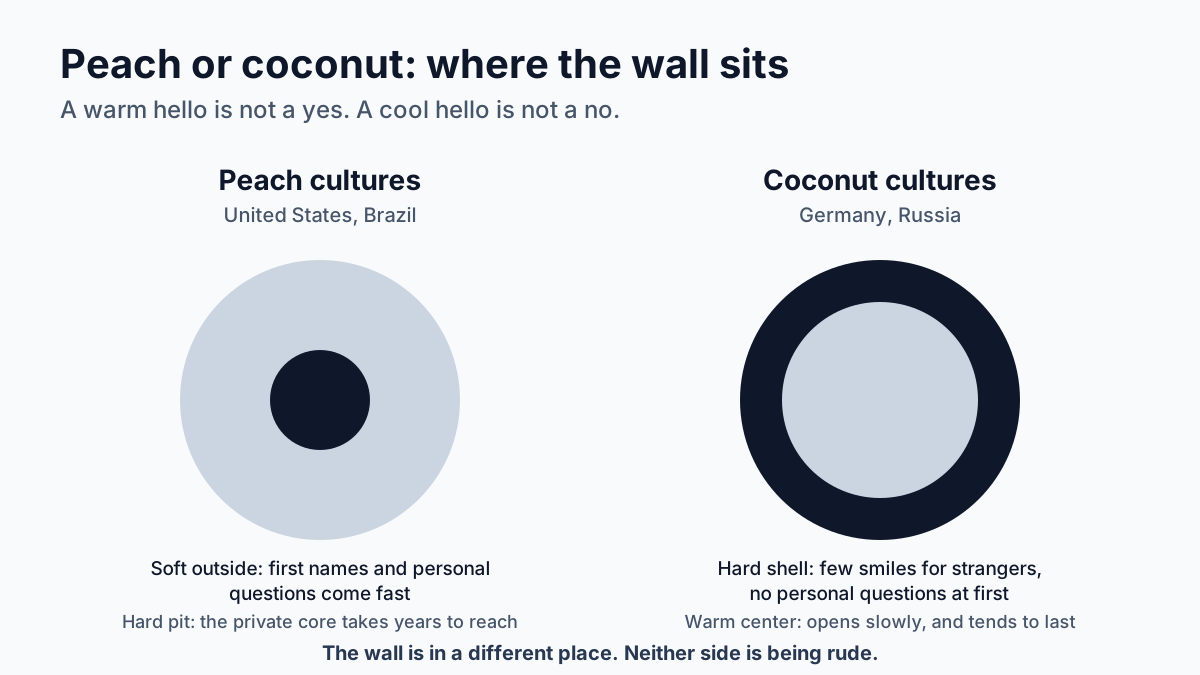
They smile at strangers. They move to first names right away. They ask about your family before they ask about your budget.
Then you reach the pit, the hard stone at the center of the fruit. Erin Meyer, Professor of Management Practice at INSEAD and author of The Culture Map, describes it this way: "after a little friendly interaction with a peach, you may suddenly get to the hard shell of the pit where the peach protects his real self and the relationship suddenly stops."
For a seller, this means a warm first call in the United States is the normal opening, not a sign of progress. Measure progress by actions instead: a second meeting on the calendar, or a colleague added to the email thread.
Coconuts: hard on the outside, warm at the center
In a coconut culture, people are closed at first with anyone outside their circle. They rarely smile at strangers. They do not ask personal questions of someone they have just met, and they do not offer personal details of their own.
Meyer again: "over time, as coconuts get to know you, they become gradually warmer and friendlier. And while relationships are built up slowly, they also tend to last longer."
So a quiet first meeting in Germany tells you very little. The build is slow by design, and the payoff is a relationship that outlasts the contract.
Where coconut and peach culture comes from
Meyer credits the idea to culture researchers Fons Trompenaars and Charles Hampden-Turner. She uses it to explain one specific problem: why small talk between cultures goes wrong so often.
That is the problem that matters most in sales, because small talk is where a first call starts or stalls.
Peach or coconut at a glance
| Peach cultures (United States, Brazil) | Coconut cultures (Germany, Russia) | |
|---|---|---|
| First meeting | Warm and smiling; first names and personal questions come fast | Reserved; few smiles for strangers; personal questions kept for people they know well |
| What early warmth means | A normal opening, not a relationship | Earned slowly, so it means more |
| Where the wall sits | Deep inside, at the private core | At the front door, and it opens with time |
| How the relationship goes | Can stop suddenly at the pit | Built slowly; tends to last longer |
Why does this matter on a sales call?
Because the first five minutes are where you decide what the other person means. And you decide it with your own culture's rules.
I used to think being a native English speaker was my edge in global business. I don't think that anymore. Now I watch non-native speakers lead meetings better than native speakers who talk fast and use slang. Many of those native speakers come from peach cultures, so they read every reserved buyer as a cold buyer.
The skill is to read the room before you judge it. That is a communication skill, and it can be trained.
The small change for a peach meeting a coconut
Say you are from a peach culture and you are writing to a buyer in Germany for the first time.
What you write: Hi! Hope you had a great weekend. Quick question for you.
What a coconut may hear: This person wants to be my friend before we have done any work together.
The small change: Good morning. Thank you for your time on Tuesday. I have one question about the delivery schedule.
Same request. Completely different message.
Then decide in advance. Before the call, answer three questions: What is my opening sentence? What is my key message? What is my closing action? In a coconut culture, your opening sentence carries the whole first impression, so write it down and say it out loud.
The small change for a coconut meeting a peach
Say you are from a coconut culture. An American partner opens the call with: How's it going? Doing anything fun this weekend?
What you say: "Fine." Then silence.
What a peach may hear: He does not want to work with me.
The small change: Good, thank you. And you?
One short answer and one question back. That is all a peach needs to feel the door is open.
And remember the pit. The partner's warmth is normal for them. It is not a promise. Keep asking for the next concrete step, in plain words: "Can we put 30 minutes on the calendar for next week?"
One line to carry into tomorrow's meeting
The advantage on a first call does not belong to the friendliest person in the room. It belongs to the person who knows what the friendliness means.
If you are meeting a coconut, open with structure: Thank you for your time. I have three points, and then I would like to agree on a next step.
If you are meeting a peach, open with warmth and then ask for the action: Good, thank you. And you? And can we agree on a next step before we finish?
Practice the line until it is automatic. Under pressure, you will fall back to what you trained. This is the kind of first-call rehearsal I do with clients at WorldView Training: one opening sentence, said out loud, until it needs no thought.
Compare yourself to where you were last month, not to the native speaker across the table.
If you have an important presentation, meeting, or negotiation coming up in English, send me a message. I'd be happy to help you prepare.
Frequently asked questions
What is the peach-coconut theory?
It is a cross-cultural model, credited by INSEAD professor Erin Meyer to culture researchers Fons Trompenaars and Charles Hampden-Turner, that sorts national cultures by how quickly people open up to strangers. Meyer uses it to explain why small talk between cultures so often goes wrong in global business.
What is a peach personality?
In this model, a peach is a person from a culture such as the United States or Brazil that is warm and open with people they have just met, quick to use first names and share personal details, but with a private core that outsiders rarely reach. The model describes cultures, not individual character, so a reserved person can still come from a peach culture.
What does it mean to have a "coconut personality"?
A coconut is a person from a culture such as Germany or Russia that is reserved with strangers at first, rarely smiles at people they do not know, and keeps personal questions for close relationships. Once the shell is cracked, coconuts become gradually warmer, and the relationships they build tend to last longer.
Sources reviewed
- Erin Meyer's own site - definition and examples of 'peach' cultures In peach cultures like the USA or Brazil, people are friendly and fast to first-name use and self-disclosure with new acquaintances, but protect a 'hard shell of the pit' true self that the relationship can suddenly stop short of.
- Erin Meyer's own site - definition and examples of 'coconut' cultures In coconut cultures such as Russia and Germany, people are initially closed off with strangers and rarely smile at them, but grow gradually warmer over time and build relationships that tend to last longer.
- Erin Meyer's own site - attribution of the peach/coconut distinction The peach/coconut cultural distinction was drawn by culture experts Fons Trompenaars and Charles Hampden-Turner.
- Harvard Business Review - Erin Meyer author bio Erin Meyer is a professor at INSEAD, where she directs the executive education program Leading Across Borders and Cultures.