
Turkish business culture is built on personal trust, respect for hierarchy, and a strong preference for clear procedures. Relationships come before contracts, the most senior person in the room makes the decision, and meetings open with tea and conversation before any agenda. An English-speaking professional earns influence by building the relationship and reading rank before making the ask.
Picture a sales director from Chicago in a meeting room in Istanbul. He has a twelve-slide deck and forty minutes. A tray of tea arrives in small tulip-shaped glasses. He waves it away, opens his laptop, and says, "I know you're busy, so I'll get right to it."
He thinks he has shown respect for their time. The room has heard something else. It has heard that he does not want to know them.
That gap, between what you said and what they heard, is where cross-border business is won or lost. In Turkey the gap has a particular shape. This post is about that shape, and about the small changes that close it.
Trust comes first, and tea is how it starts
In a Turkish office, the deal is between people before it is between companies. Your counterpart wants to know who you are and who introduced you. They also want to know whether you will still answer the phone in two years.
So the first meeting begins with talk. Family. Where you grew up. Which mutual contact made the introduction. Football, if you are lucky. The talk is the meeting. The agenda comes later, sometimes in the second meeting.
Tea (çay) arrives with it, in a small glass on a saucer with sugar cubes on the side. Turkish coffee may follow. Accepting the glass is a small act with a large meaning: you are willing to sit, and you are willing to be a guest.
Here is the first heard-versus-meant fix.
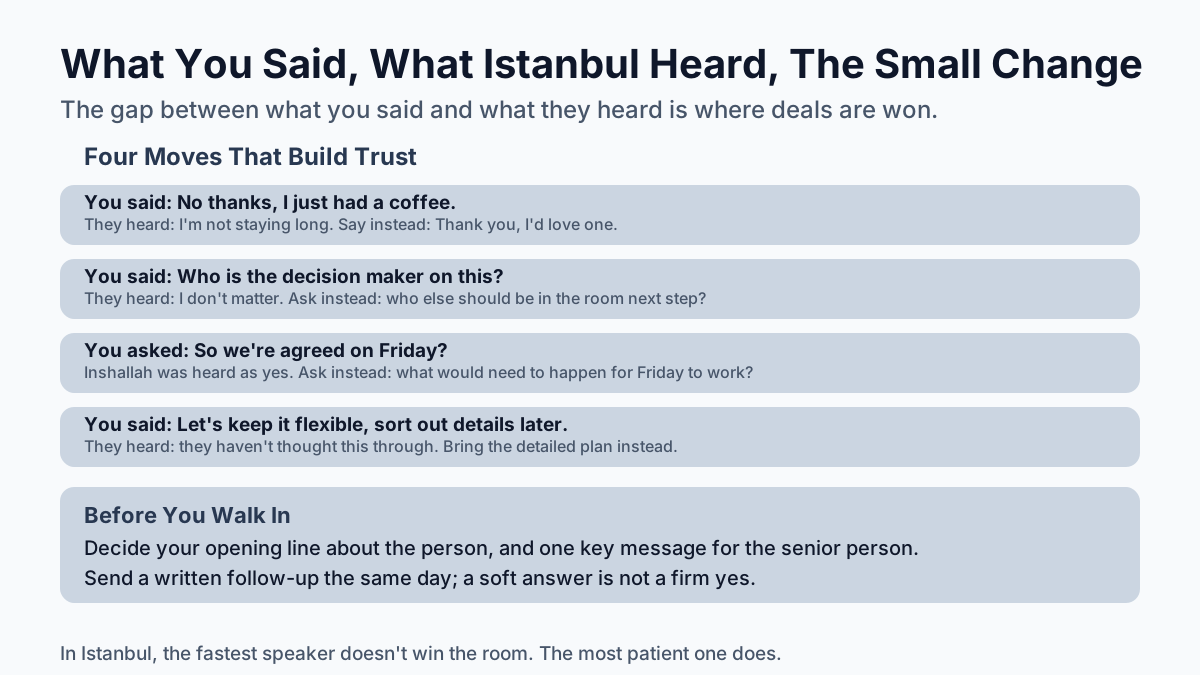
What the visitor said: No thanks, I just had a coffee.
What the host heard: I am not planning to stay long.
The small change: "Thank you, I'd love one." You do not have to finish it. You have to hold it.
I use this three-beat fix with my clients on every kind of sentence, because the middle line is the part that teaches. In a proposal role-play, a client once said, "You are not our only client." True, and reasonable. But it can easily sound like, "You are not that important to us." We changed it to, "We have other clients who deal with similar issues." Same idea, different message.
In Turkey the middle line is louder than in most places, because the listener is reading you as a person before reading you as a supplier.
Rank is visible, and you are expected to read it
The Culture Factor Group, which publishes Geert Hofstede's country scores, puts Turkey at 66 out of 100 on Power Distance, a measure of how far a society accepts unequal authority as normal. In plain terms, people expect authority to sit at the top, and they are comfortable with that. The senior person leads the meeting and makes the call. Everyone else supports.
This changes how you read the room. The person who asks the most questions may be the technical lead. The person who says the least may be the one who signs.
A few habits follow from this.
- Greet the most senior person first. Address people by first name plus a title: Mehmet Bey for a man, Ayşe Hanım for a woman. It is polite, it is expected, and it is easy to do.
- Direct your key message to the senior person, even when a junior colleague is the one translating or taking notes.
- Never correct a junior person in front of a senior one. Never correct a senior person in front of anyone.
What the visitor said: Who is the decision maker on this?
What the host heard: I am not sure you matter.
The small change: When we get to the next step, who else should be in the room? Same information, and nobody has been placed below anyone.
Why a Turkish yes is not always a yes
Turkey scores 46 on Individualism, which places it on the collectivist side of the scale. The group and the long relationship come first. Protecting the other person's dignity in public, their "face," matters more than being exactly accurate in the moment.
The practical effect is that a flat "no" is rare. You will hear softer forms instead.
İnşallah means 'God willing.' Sometimes it means 'yes, I hope so.' Sometimes it means 'probably not, but I do not want to disappoint you.' The timeline that comes with it tells you which. İnşallah, Friday is closer to yes than İnşallah on its own.
"Bakarız" means "we will see." It leaves the door open without walking through it.
There is also a gesture. A quick lift of the chin, eyebrows raised, sometimes with a soft click of the tongue, means no. A visitor who is listening for the word "no" can miss it completely.
What the visitor said: So we're agreed on Friday?
What the host said: "İnşallah."
What the visitor heard: "Yes."
The small change: What would need to happen on your side for Friday to work? Now the obstacle can be named, and nobody has had to say no.
Detailed plans are a form of respect
Turkey scores 85 on Uncertainty Avoidance, a high score on a scale that runs to 100. People prefer detailed plans and written rules, because those reduce the chance of being wrong. Even the state writes this way. Turkey's 2026 net minimum wage is fixed at 28,075.50 lira a month, valid from January 1 to December 31, published to the last decimal.
For a foreign visitor this cuts two ways. The relaxed we'll figure it out as we go style that plays well in a startup pitch reads as unserious here. A printed proposal with dates and a named owner for each step reads as respect. Bring one.
Written follow-up matters for the same reason. After a meeting, send a short email that lists what was agreed and what happens next. In a culture that prefers certainty, that email is reassurance, and it protects your counterpart when they explain the deal upward.
What the visitor said: Let's keep it flexible and sort out the details later.
What the host heard: They have not thought this through.
The small change: Here is the detailed plan. Tell me which parts your team would change. You have offered flexibility inside a structure, which is the kind of flexibility that gets accepted.
What is the Turkish mindset?
Young, ambitious, outward-facing, and respectful of rank. Those four things are easy to state and hard to hold in your head at the same time, so here is the ground under each.
Turkey is young. Half the population is under 34.9 years old, so the team across the table may be closer to thirty than fifty, comfortable in English, and used to international work. The person they report to may not be. Both are in the room, even when only one of them is sitting at the table.
It is ambitious. The economy grew at an average of 5.3% a year between 2003 and 2024, and foreign companies have stayed through that run. Bosch alone invested around EUR 4.2 billion in the country between 2000 and 2023. Turkey's free zones, special areas set up for export businesses, set a record of USD 7.7 billion in exports in the first seven months of 2026.
It is outward-facing on purpose. DEIK, the country's Foreign Economic Relations Board founded in 1985, runs 153 business councils that connect Turkish companies with partners across Europe, the Americas, Asia-Pacific, Africa, the Middle East, and Eurasia. That is formal machinery built to make foreign partners easier to work with. It also tells you something useful: a Turkish company that meets you has very likely met people like you before.
On competition, Turkey sits near the middle, at 45 on the dimension the Hofstede model calls Motivation Towards Achievement and Success (its older name is Masculinity). Winning matters. So does the quality of the relationship after the win. A pitch built entirely on "we are the market leader" lands less well than one that shows what both sides get over five years.
Put the four scores side by side and the meeting room makes sense.
| Dimension | Turkey's score | What you see in the room |
|---|---|---|
| Power Distance | 66 | The senior person decides; juniors support |
| Individualism | 46 | Group loyalty and "face" shape what gets said out loud |
| Achievement and Success (Masculinity) | 45 | Winning matters, and so does the relationship after the win |
| Uncertainty Avoidance | 85 | Detailed plans and written follow-up are welcome |
Do's and don'ts in a Turkish meeting
A searcher who types what is considered rude in Turkey is usually asking one question: how do I avoid giving offense by accident? Most of the answer is ordinary courtesy. A few items are specific to Turkey.
Do:
- Accept the tea or coffee, even if you only sip it.
- Use Bey and Hanım with first names until you are invited to drop them.
- Let your counterpart extend the hand first, especially across genders. Some observant people do not shake hands with the opposite sex, and waiting costs you nothing.
- Bring a small gift from your home country on a first visit. Keep it modest, and skip alcohol unless you know the person drinks.
- Ask before scheduling a working lunch during Ramadan. Many colleagues fast from dawn to sunset.
- Take your shoes off if you are ever invited to someone's home.
Don't:
- Don't open with the agenda. Ask about the person first.
- Don't show the sole of your shoe. Keep both feet on the floor rather than crossing an ankle over a knee.
- Don't criticize anyone in front of their team, and don't push for a decision in the first meeting.
- Don't raise domestic politics, religion, or the country's historical disputes. Your counterpart may hold strong views, and the meeting room is the wrong place to find out.
- Don't take a soft answer as a firm yes. Confirm in writing afterward.
Phrases for tomorrow's meeting
Use the English you already have, with more purpose. These are lines you can say as written.
To open, after the tea has arrived: Before we look at anything on paper, I'd like to hear how the company started.
To respect rank when a junior colleague is doing the talking: Thank you. Mehmet Bey, I'd like to hear your view on this as well.
To ask about a delay without forcing a no: What would need to change on your side for the June date to work?
To confirm a next step warmly: So that I have it right, we will send the revised plan by Monday, and your team will review it before we speak again. Does that fit?
To close a first meeting without pushing: I've enjoyed this. I'll send a short summary tonight, and I'd like to come back with the detailed plan.
A few Turkish words earn a lot of goodwill.
- "Teşekkür ederim" means thank you.
- "Afiyet olsun" is what Turks say before eating, and often after. It is said to the person eating and means roughly "may it do you good." At the end of a meal, "Elinize sağlık" ("health to your hands") thanks the cook.
- "Kolay gelsin," said to someone who is working as you leave their office, means "may it come easy."
The mistake native English speakers make in Istanbul
I used to think being a native speaker was my edge in global business. I do not think that anymore. In a Turkish meeting, native speakers are often the worst communicators in the room.
They open with the agenda.
They skip the tea.
They ask for the decision in the first meeting.
Each of those is efficient at home. Each of them is heard, in Istanbul, as a small refusal of the relationship. The visitor leaves thinking the meeting went fine, and then the follow-up emails go quiet.
The fix is small, and it starts before the meeting. Decide three things in advance. What is my opening sentence? (Something about the person.) What is my key message? (One sentence, plain words, aimed at the senior person.) What is my closing action? (A written follow-up, sent the same day.) Shorter structures beat longer scripts.
This is the work I do with clients at WorldView Training before a high-stakes meeting: the opening line, the one key message, the close. The English is already there. The purpose is what we practice.
In Istanbul, the fastest speaker does not win the room. The most patient one does.
If you have an important meeting, presentation, or negotiation in Turkey coming up in English, send me a message. I'd be happy to help you prepare.
Frequently asked questions
What is considered rude in Turkish business culture?
Waving away offered tea or coffee, opening with the agenda before any personal conversation, correcting someone in front of their team, and showing the sole of your shoe all read as disrespect. Pushing for a decision in a first meeting is not rude in itself, but it signals that you value the transaction more than the relationship.
What do Turkish people value most in a business relationship?
Personal trust built over time, respect for seniority in the room, and certainty in the form of detailed plans and written agreements. A partner who keeps showing up and honors rank is valued more than one who is simply the fastest or the cheapest.
What is the Turkish mindset in business?
Ambitious and internationally connected, with half the population under 34.9 years old and a state-backed network of 153 business councils, yet still hierarchical: authority is centralized, decisions come from the top, and detailed plans are preferred to improvisation.
Sources reviewed
- The Culture Factor Group (Hofstede Insights) - Turkey country comparison Turkey scores 66/100 on Power Distance, indicating a hierarchical society where centralized authority is broadly accepted.
- The Culture Factor Group (Hofstede Insights) - Turkey country comparison Turkey scores 37/100 on Individualism, marking it a collectivist culture where in-group loyalty and family-like workplace relationships override formal rules.
- The Culture Factor Group (Hofstede Insights) - Turkey country comparison Turkey scores 45/100 on the Motivation Towards Achievement and Success (Masculinity) dimension.
- The Culture Factor Group (Hofstede Insights) - Turkey country comparison Turkey scores 85/100 on Uncertainty Avoidance, reflecting a strong preference for detailed planning and formal procedures.
- Presidency of the Republic of Turkiye Investment Office Turkey's economy grew at an average annual GDP rate of 5.3% between 2003 and 2024.
- Presidency of the Republic of Turkiye Investment Office Turkey has a young population, with half of its people under 34.9 years old.
- Presidency of the Republic of Turkiye Investment Office Turkey's free zones set a new export record of USD 7.7 billion in the first seven months of 2026.
- Presidency of the Republic of Turkiye Investment Office - Cost of Doing Business Turkey's 2026 net minimum wage is 28,075.50 Turkish lira per month (33,030.00 TRY gross), valid January 1 to December 31, 2026.
- Presidency of the Republic of Turkiye Investment Office - Cost of Doing Business Employer minimum-wage costs run 39,223.13 TRY/month in manufacturing versus 40,214.03 TRY/month in other sectors, reflecting a reduced social-security incentive for manufacturers.
- Presidency of the Republic of Turkiye Investment Office Bosch invested approximately EUR 4.2 billion in Turkey between 2000 and 2023.
- DEIK - Foreign Economic Relations Board of Turkey DEIK, Turkey's Foreign Economic Relations Board established in 1985, operates 153 bilateral business councils connecting Turkish companies with counterparts across Africa, the Americas, Europe, Asia-Pacific, the Middle East, and Eurasia.