
Negotiating styles are the habits a person falls back on when they bargain. The Thomas-Kilmann model names five: competing, collaborating, compromising, avoiding, and accommodating. Each is a mix of two things: how hard you push for your own goals (assertiveness) and how much you work with the other side (cooperativeness). No single style wins everywhere. The strongest negotiators combine cooperation with clear, steady assertiveness.
That last sentence is the hard part in a second language, because the other side reads your English through their own culture.
In a proposal role-play, a client of mine said: You are not our only client.
What the listener hears: You are not that important to us.
So we made a small change: We have other clients who deal with similar issues. Same basic idea. A completely different message.
The first sentence was a competing style, said in a second language without the softening a first language adds on its own. The grammar was fine. The style was louder than the client meant.
The five negotiating styles, in plain English
The five come from the Thomas-Kilmann Conflict Mode Instrument, a questionnaire built by Kenneth W. Thomas and Ralph H. Kilmann. Kilmann describes it this way: "The Thomas-Kilmann Conflict Mode Instrument (TKI) assesses five conflict modes: competing, collaborating, compromising, avoiding, and accommodating. These five behavioral choices are defined by two underlying dimensions: assertiveness and cooperativeness."
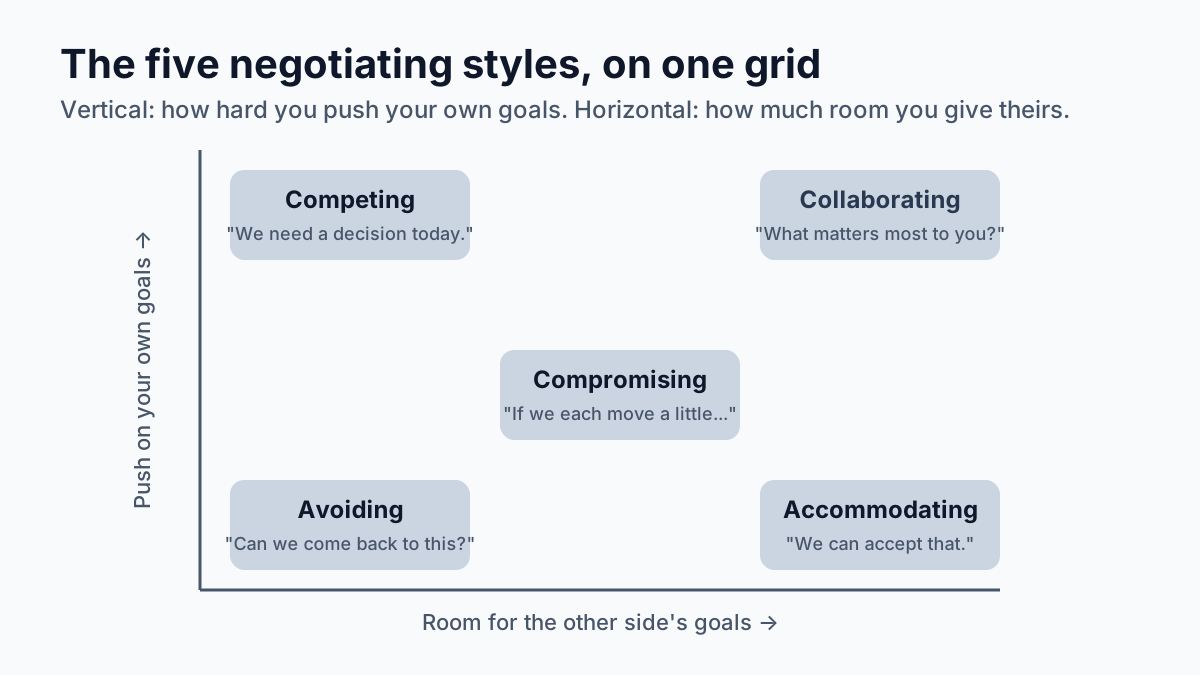
| Style | Your own goals | The other side's goals | What it sounds like in a meeting |
|---|---|---|---|
| Competing | Pushed hard | Set aside | This is our position. We need a decision today. |
| Collaborating | Pushed hard | Pushed hard too | Tell me what matters most to you. Then we can look for a way to get both. |
| Compromising | Half | Half | If we each move a little, we can close this today. |
| Avoiding | Set aside | Set aside | Can we come back to this point later? |
| Accommodating | Set aside | Pushed hard | We can accept that. It matters more to you than to us. |
Accommodating has its own post on this blog. What matters here is the row you live in by default, and the row the other side thinks you live in.
Which style is best?
None of them, on its own. A review of the research by Harvard's Program on Negotiation reports that cooperative negotiators tend to create more value than hard bargainers, but the most effective negotiators combine cooperation with clear, persistent assertiveness.
For a non-native speaker, assertiveness is the hard half. Not because of vocabulary.
You know your price. You know your limit. You know the English word for no.
And still the sentence comes out too hard, like the client above, or too soft, because there was no time to shape it. Confidence is the bottleneck. Grammar is rarely the problem.
Why the same style reads differently across a border
Erin Meyer, the INSEAD professor who wrote The Culture Map, interviewed executives about disagreement in meetings. A French executive described open confrontation as a normal part of French business meetings. An Indonesian executive she interviewed called the same directness, being asked to state an opinion in front of the group, "just an insult."
Same behavior. One culture calls it collaborating. The other calls it an attack.
Meyer's framework for cross-cultural negotiation says to tailor how directly you express disagreement to the other side's culture, because direct disagreement that is normal in one place can end a relationship in another. So the style you bring is only half the picture. The other half is how it lands.
Two ideas from Geert Hofstede's work on national culture explain a lot of this.
The first is power distance: how far the less powerful people in a society accept and expect that power is shared unequally. In a room where power distance is high, the person across from you may not be allowed to push back. What looks like avoiding is respect for a senior person who has not spoken yet.
The second is individualism: how independent people feel, versus how much they see themselves as part of a larger group. A negotiator from a group-first culture may not be able to say yes alone. "Can we come back to this later?" can mean avoiding. It can also mean "I need to check with my team."
In many Asian business cultures (Meyer names Japan, China, Malaysia, Korea, and Thailand), the real decision is often made in one-on-one conversations before the meeting, called nemawashi in Japanese, and the formal meeting mostly confirms what was already agreed. Read a quiet meeting as avoiding and push harder, and you are competing against a decision that was made in the hallway.
Before you judge a style, ask what it means where the other person comes from.
The trap of over-adjusting
There is an opposite mistake: adjusting too much.
A study of 100 experienced Japanese and U.S. negotiators found that when each side expected to face the other culture, their expectations clashed on six of nine measured elements. Each side had over-adjusted toward its own fixed idea of the other culture, and neither realized the other side was doing the same.
The American plays what he thinks is a Japanese style. The Japanese negotiator does the reverse. They pass each other in the middle.
Pressure makes this worse. Columbia University professor Michael W. Morris found that negotiators are more likely to fall back on cultural stereotypes, fixed ideas about how the other side will behave, when they are under time pressure or stress. Under pressure, you get the version of yourself you have practiced. Nothing more.
The fix is simpler than playing another culture, and it is the one thing you can train. A study in the Journal of Applied Psychology found that the quality of communication between negotiators, meaning clarity, responsiveness, and comfort, has a stronger effect on the outcome in cross-cultural negotiations than in same-culture ones. Clear beats clever. And clear is a muscle. It grows with use.
Decide three things before you walk in
I ask clients to prepare shorter structures, not longer scripts. For a negotiation across cultures, the structure is three questions.
- Which style do I bring under stress? Competing when the clock is running, or accommodating when the other side is senior.
- Which style will they read me as? Same sentence, different culture.
- What is my bridge sentence when the two collide?
Write the third one down. Sean Gilbride, an American manager working in Mexico when Meyer quoted him in 2012, found that the softer version was what opened the debate: "I soon learned that if I wanted to encourage team debate it was important to use phrases like 'I do not quite understand your point' and 'please explain more why you think that'."
Those two phrases carry a competing style into a room that reads directness as an insult. Two more, for other collisions:
If you lean accommodating and need to claim your share: I want this to work for both sides. So I need to be clear about one thing.
If you hear what sounds like avoiding and want to know whether it is a group decision: Would it help to take this point back to your team before we continue?
A WorldView Training session rehearses exactly this. One sentence, said three ways, until the softer version comes out on its own, with the pressure on.
Know your style, and read theirs before you speak. Then say the bridge sentence slowly.
If you have an important negotiation coming up in English, send me a message. I'd be happy to help you prepare.
Frequently asked questions
What are the five main negotiation styles?
Competing, collaborating, compromising, avoiding, and accommodating, from the Thomas-Kilmann Conflict Mode Instrument. Each is a combination of assertiveness (how hard you push for your own goals) and cooperativeness (how much you work with the other side's).
Which negotiation style is best?
None wins in every room. Research reviewed by Harvard's Program on Negotiation finds cooperative negotiators create more value than hard bargainers, and the most effective negotiators combine cooperation with clear, persistent assertiveness.
What should you not do when negotiating across cultures?
Do not over-adjust toward your idea of the other culture: a study of 100 experienced Japanese and U.S. negotiators found their expectations clashed on six of nine elements because both sides did exactly that. Under time pressure, negotiators also fall back on stereotypes more often, so practice the softer version of your key sentence before the meeting.
Sources reviewed
- Kilmann Diagnostics - An Overview of the TKI Assessment Tool (by Ralph H. Kilmann, co-creator) The Thomas-Kilmann Conflict Mode Instrument (TKI) assesses five conflict/negotiating modes - competing, collaborating, compromising, avoiding, accommodating - defined by assertiveness and cooperativeness.
- Geert Hofstede's official site - The 6-D model of national culture (Power Distance) Power Distance is the extent to which less-powerful members of a society accept and expect unequal distribution of power, shaping hierarchical vs. egalitarian negotiating norms.
- Geert Hofstede's official site - The 6-D model of national culture (Individualism) Individualism is the extent to which people feel independent versus interdependent as members of a larger group, affecting whether negotiators can decide alone or must defer to group consensus.
- Erin Meyer - 'Managing Confrontation in Multi-cultural Teams' (erinmeyer.com, originally Harvard Business Review, April 2012) A French executive Meyer interviewed described open confrontation as core to French business meetings; an Indonesian executive she interviewed called the same directness 'just an insult.' An American manager in Mexico found softer phrasing ('I do not quite understand your point') got more open debate.
- Erin Meyer - 'Managing Confrontation in Multi-cultural Teams' (erinmeyer.com, originally Harvard Business Review, April 2012) In many Asian business cultures (Japan, China, Malaysia, Korea, Thailand), the real decision-making happens in one-on-one pre-meetings (nemawashi in Japanese); the formal group meeting mainly ratifies what was already agreed.
- Adair, Taylor & Tinsley, 'Starting Out on the Right Foot: Negotiation Schemas When Cultures Collide,' Negotiation and Conflict Management Research (2009) A study of 100 experienced Japanese and U.S. negotiators found intercultural negotiation expectations clashed on 6 of 9 measured elements, driven by each side over-adjusting toward a stereotype of the other's culture.
- Liu, Chua & Stahl, 'Quality of Communication Experience: Definition, Measurement, and Implications for Intercultural Negotiations,' Journal of Applied Psychology, 95(3), 469-487 (2010) - WU Vienna research portal record Communication quality (clarity, responsiveness, comfort) has a stronger effect on negotiation outcomes in cross-cultural negotiations than in same-culture negotiations.
- Program on Negotiation at Harvard Law School - 'Cross-Cultural Communication in Business Negotiations' by Katie Shonk (April 23, 2026) Columbia University professor Michael W. Morris found negotiators are more likely to fall back on cultural stereotypes when under time pressure or stress during a negotiation.
- Program on Negotiation at Harvard Law School - 'Negotiation Skills: Which Negotiating Style Is Best?' (PON Staff, Feb 24, 2026) Most negotiation research indicates cooperative negotiators outperform hard bargainers at generating creative, higher-value agreements, but the most effective negotiators combine cooperation with assertive value-claiming.
- Erin Meyer, 'Getting to Si, Ja, Oui, Hai, and Da,' Harvard Business Review (December 2015) Meyer's cross-cultural negotiation framework advises tailoring how directly you express disagreement to your counterpart's culture, since direct disagreement normal in one culture can read as a relationship-ending insult in another.