Mexican business culture is relationship-first, formal, and hierarchical. Trust between people comes before the contract, senior leaders hold the final decision, and disagreement is voiced indirectly to protect the relationship. Meetings open with personal conversation, business cards are exchanged with the Spanish side facing the recipient, and a deal usually takes several meetings rather than one.
That order is the whole lesson.
A manager who leads with the price list and asks for a signature in the first meeting looks efficient at home. In Mexico he is read as someone who does not want a relationship, and the deal slows down without anyone telling him why.
Below are the moves that matter, in the three beats I use in coaching: what you said, what your Mexican colleague heard, and the small change that fixes it.
Why Mexico is the partner you cannot afford to misread
Mexico was the largest trading partner of the United States in 2025. Total trade in goods and services reached $964.1 billion, up 3.7% from 2024. U.S. goods exports to Mexico were $337.3 billion, goods imports from Mexico were $534.3 billion, and the goods trade gap was a $197 billion U.S. deficit. The rules for that trade come from the USMCA, which replaced NAFTA on July 1, 2020, twenty-six years after NAFTA began in 1994.
Behind the trade numbers is a country of an estimated 131.9 million people with a 2025 GDP of about $1.83 trillion.
So the supplier in Monterrey or the buyer in Mexico City on your video call may sit inside your company's largest market, and a misread meeting with him costs more than a misread meeting almost anywhere else.
The relationship comes first, and the contract records it
Business in Mexico runs on personal trust. People do business with people they know, and the contract records a relationship that already exists.
Ask a mutual contact to introduce you. A cold email from a stranger is easy to ignore. The same email, sent after a call from someone your counterpart already trusts, gets answered.
Plan to visit. Video calls keep a relationship alive, but they rarely start one. The first agreement usually follows more than one in-person meeting, and the long lunch after the meeting is often where the progress happens.
Give the first ten minutes to the person. Family, football, the city, how the flight was. This is work. It is the part of the meeting where your counterpart decides whether to trust the rest of it.
The rule shows up in email before it shows up in a room.
What you wrote to a new supplier in Querétaro: "Hi Carlos, please find the revised pricing attached. Confirm by Friday."
What Carlos hears: "You are a line item. I do not need to know you."
The small change: "Carlos, it was good to meet your team last week. I hope the long weekend with your family went well. I have attached the revised pricing. Would Friday work for a short call to walk through it together?"
Same request. Same date. Now Carlos is reading a note from a colleague.
If you also work with Brazil, the opening move there looks similar, and the post on whether Brazil is collectivist or individualist covers that country.
Hierarchy: who decides, and who should be in the room
Mexican companies are top-down. The senior leader approves the major agreement, and in a meeting the most senior person's opinion carries the most weight, whether or not that person says the most.
So the friendly manager who runs your meetings may not be the person who can say yes. He may be the person who carries your proposal upstairs. Treat him as an ally and give him what he needs to present it well: a one-page summary in plain English, or in Spanish if you can arrange it.
What you said to a mid-level contact: "Can you sign off on this today?"
What she hears: "I do not understand how your company works, and I am asking you to go around your boss."
The small change: "Who on your side would want to review this before we move forward? I would be glad to present it to them, or to prepare a short summary you can share."
Match seniority when it matters. If their director is coming to the meeting, your director should be there too. Sending a junior person to meet a senior one is read as a message about how much the deal matters to you.
Titles are part of hierarchy, and they are used. You will see "Lic." (Licenciado, the holder of a university degree) and "Ing." (Ingeniero, an engineer) before names in email signatures, and "Doctor" for a physician or a PhD. Use the title and the last name until you are invited to use the first name. In Spanish, that also means "usted", the formal "you", rather than the familiar "tú".
How disagreement sounds when nobody says no
Direct criticism in a group is rare in Mexican business culture. Disagreement is signaled softly, and often in private, so that nobody loses face in front of colleagues. Face means a person's standing in the eyes of the people around him, and protecting it is a form of respect that your counterpart expects back.
This is where most misreadings happen, in both directions.
What your Mexican colleague said: "That is interesting. Let me check with my team and get back to you."
What you heard: "Yes, probably."
What was often meant: "I see problems with this, and I do not want to say so in front of everyone."
The small change is on your side. Ask a question that makes an honest answer easy: "What concerns would your team have with this?" or "If we could change one thing about the proposal, what should it be?" Then ask again, one to one, after the meeting.
One word to know: "ahorita". Literally it means "right now". In practice it can mean in a moment, later today, or a polite never. If a date matters, ask for the date, kindly and specifically: "Would Thursday be realistic for the numbers, or is next week better?"
Now the other direction, which is the one you control.
What you said on a team call: "Miguel, your report had three errors. Please fix it."
What the room heard: "Miguel was corrected in front of all of us." Miguel heard the same thing, and a colleague who has lost face in public may go quiet for a long time.
The small change: a private message after the call. "Miguel, I found a few things in the report I would like to go through with you. Do you have ten minutes this afternoon?" Same correction. Nobody loses face.
Softening a blunt line without losing the message is a skill I rehearse with clients in WorldView Training sessions, and it reaches well beyond Mexico. In one proposal role-play, a client told the customer, "You are not our only client." That can easily sound like: you are not that important to us. So we made a small change: "We have other clients who deal with similar issues." Same basic idea. A completely different message.
The first meeting is more formal than the tenth
Formality drops as trust rises. The first meeting is suits and titles. The fifth may be first names and a joke about last night's match. Let your counterpart set the pace and follow one step behind.
Bring business cards, and print Spanish on one side. Hand the card over with the Spanish side facing the person receiving it. Read the card you are given before you put it away; pocketing it unread is a small insult, and reading it is a small act of respect.
Greet everyone in the room one by one, with a handshake and eye contact, and do it again when you leave. Waving at the group from the door is remembered, and not kindly.
Then slow down.
I used to think that being a native English speaker was my advantage in global business. I do not think that anymore. In a meeting in Mexico City, the native speaker who talks fast, uses slang, and fills every pause is the hardest person in the room to follow.
Speak slowly. Drop the idioms. Leave the pause.
Your counterpart is translating in his head, and the pause you find awkward is the space where he understands you.
What do Mexicans value most at work?
Respect for the person. It shows in the titles, in the greeting that includes everyone, and in the time given to conversation before the agenda.
Family is the reference point. Asking about someone's family is a sign that you see the person and not only the role, and being asked about yours is an invitation to answer properly rather than to change the subject.
Loyalty attaches to people more than to organizations. When your contact changes companies, the relationship often moves with him, which is one more reason to invest in the person and not only in the account.
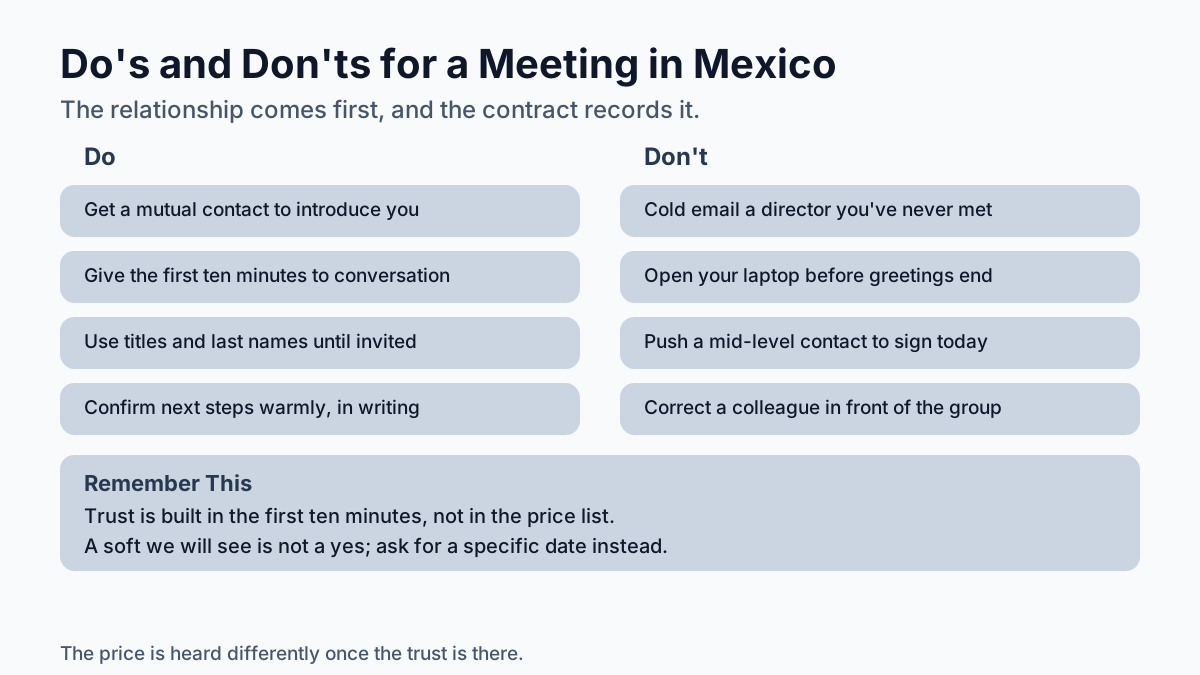
Do's and don'ts for your next meeting in Mexico
| Do | Don't |
|---|---|
| Ask a mutual contact to introduce you | Cold-email a director you have never met |
| Give the first ten minutes to personal conversation | Open the laptop before the greetings are finished |
| Use titles and last names until invited to do otherwise | Use first names with a senior person in the first meeting |
| Ask who else should see the proposal | Push a mid-level contact to sign |
| Give corrections in private | Correct a colleague in front of the group |
| Print Spanish on one side of your card and present that side | Pocket a card without reading it |
| Confirm the next step warmly, in writing, after the meeting | Treat "we will see" as a yes |
What is considered disrespectful, and which topics to avoid
Disrespect in Mexican business culture is mostly a matter of skipped steps. Public correction. A greeting that skips someone. First names before you were offered them. A lunch cut short because you have a flight. A phone checked while your counterpart is telling you about his son's football team.
Then there is language. In Spanish, "americano" can refer to anyone from the Americas, so "the United States" or "the U.S." is the safer phrase, and "American" for a U.S. citizen can land badly with the wrong person.
Keep religion, the country's politics, and crime headlines out of the early meetings unless your counterpart raises them. Never make a joke at Mexico's expense. Mexicans joke about Mexico freely; a foreign guest doing it is a different thing.
Decide in advance: three questions before you walk in
Prepare shorter structures, not longer scripts. Before a meeting in Mexico, I ask clients to answer three questions, out loud.
What is my opening sentence, and is it about the person? "Carlos, thank you for having us. How was the family trip to Oaxaca?"
What is my key message, in one short sentence your counterpart can repeat to his director? "We can cut your delivery time by a third at the same price."
What is my closing action, phrased so that nobody has to say no? "Would it help if I sent a one-page summary for your director this week?"
Openings and closings are remembered. The middle is not. In Mexico the opening is the relationship and the closing is the next meeting, so give those two sentences the most rehearsal.
Phrases you can use tomorrow
To greet: "Mucho gusto" means "pleased to meet you". "¿Cómo está su familia?" is "How is your family?" in the formal form, and it is a safe first question at any level.
To open: "It is good to see you again. How has everything been since we last spoke?"
To move toward business without cutting the conversation short: "Whenever you are ready, I would love to show you what we prepared." A note on that verb: "I would like" is structure, "I would love" is enthusiasm. Both are correct. Choose on purpose.
To check for hidden disagreement: "What concerns would your team have with this?"
To find the decision path: "Who else on your side should see this before we go further?"
To give feedback: "Do you have ten minutes after the call? I want to go through a couple of things with you."
To ask about timing: "Would Thursday be realistic, or is next week better for you?"
To close: "Thank you for your time today. May I send a short summary for your director tomorrow?"
The advantage in a Mexican meeting goes to the person the room trusts. Trust is built in the first ten minutes, in the private message instead of the public correction, and in the card you took the time to read. The price is heard differently once the trust is there.
If you have an important meeting, presentation, or negotiation coming up in English, send me a message. I'd be happy to help you prepare.
Frequently asked questions
What are some unspoken rules in Mexican business culture?
Greet everyone in the room individually and again when you leave, let the most senior person set the level of formality, give corrections in private, and read a business card before putting it away. A soft answer such as "let me check with my team" is often a polite way to signal a problem, so follow up one to one after the meeting.
What is considered disrespectful to Mexicans in a business setting?
Correcting a colleague in front of the group, skipping the personal conversation at the start of a meeting, using first names with a senior person before being invited to, cutting a business lunch short, and jokes at Mexico's expense. Sending a junior employee to meet a senior counterpart also reads as a signal that the deal matters little to you.
How many meetings does it take to reach an agreement in Mexico?
Usually more than one. The first meeting is formal and mostly about establishing trust, and major agreements are approved by senior leaders, so expect a proposal to travel upward between meetings and plan for several in-person visits before a signature.
Sources reviewed
- Office of the U.S. Trade Representative - Mexico country/region page
- Office of the U.S. Trade Representative - Mexico country/region page
- Office of the U.S. Trade Representative - Mexico country/region page
- World Bank - Mexico country data
- World Bank - Mexico country data
- Commisceo Global - Mexico business culture and etiquette guide
- Commisceo Global - Mexico business culture and etiquette guide
- Commisceo Global - Mexico business culture and etiquette guide
- Commisceo Global - Mexico business culture and etiquette guide