
Yes, relative to the United States. Edward T. Hall, the anthropologist who developed the high-context and low-context idea (his 1976 book Beyond Culture is the one people quote), put Southern Europeans on the high-context side and Germans, Scandinavians, and Americans on the low-context side. Erin Meyer, who built her Culture Map on Hall's scale, writes that the French are high-context communicators relative to Americans, yet more direct in their criticism. So French professionals argue directly, with logic and structure. Treat France as a hybrid.
The label is the easy part.
Picture a sales lead in Jacksonville presenting a rollout plan to a French country director on a video call. It is 9 a.m. for her and mid-afternoon in Paris. Four slides in, the director cuts in: "I see several problems with this timeline."
She hears: he is killing the plan.
He means: the plan is worth arguing with.
That gap is the whole subject of this post. The word "high-context" explains half of it. The other half is the part most guides leave out, and it is the half that decides how your next meeting goes.
What high-context actually means
Hall, an anthropologist, developed the high-context and low-context idea, and Beyond Culture, first published in 1976 by Anchor Press, is the book people quote for it. His question was simple. When two people talk, how much of the message is in the words, and how much is in everything around the words?
In a low-context culture, the words carry the load. You say what you mean. You spell it out. A stranger could read the transcript and get the message.
In a high-context culture, the words are only part of it. Tone. Timing. Who is in the room. How long the two of you have known each other. What was suggested but never said. The listener is expected to fill in the rest from shared background.
Neither style is better. Low-context works well between strangers. High-context works well between people with history. Trouble starts when each side assumes the other is playing by its rules.
Where France sits on Hall's original scale
Hall did not sort countries into two boxes. He gave examples along a range, and his own short list named Japanese, Arab, and Southern European cultures as high-context, and Germans, Scandinavians, other Northern Europeans, and Americans as low-context.
France is not on that list by name. Meyer's reading, below, puts it on the high-context side relative to the United States.
That detail gets lost when people quote him. France is high-context next to the United States, and that is a comparison, not a ranking.
Where France sits on Meyer's Culture Map
The version of this idea most managers meet today comes from Erin Meyer. When she wrote about it for Harvard Business Review in 2014, she was a professor at INSEAD, directing its executive program on leading across borders and cultures. Her Culture Map lines countries up on several scales. The first one is Communicating, which runs from low-context to high-context.
On that scale, in her words, "the French, for example, are high-context (implicit) communicators relative to Americans, yet they are more direct in their criticism."
For a manager, this is the version that matters, because it was built for the office. If your company runs in English with a low-context house style, and your French colleague grew up with a high-context one, you are both using the same words and reading different messages.
Why French meetings still feel so direct
Now the simple answer breaks down.
Country guides written for people doing business in France keep saying the same thing: French communication is direct. The Cultural Atlas, a country-culture reference, calls it "very direct," and gives part of the credit to the language itself. French is precise, and that precision makes indirectness hard. In my sessions the same thing shows up: a French manager asks probing questions and expects a logical, well-built argument in return.
Directness and probing questions are low-context habits.
So which is it? Both. The argument is explicit. The relationship and the reading of the room are not.
Hofstede's country scores, a separate model of national culture, help explain the argument side. The Culture Factor Group's profile of France gives it 86 on Uncertainty Avoidance, which the profile labels high, alongside 68 on Power Distance (fairly high) and 74 on Individualism. A culture that scores that high on Uncertainty Avoidance wants a formal structure and a well-built case before it commits. A culture with fairly high Power Distance expects rank to shape how a decision moves.
Put the two together and you get the hybrid. A French colleague may take your proposal apart with a tight, logical argument, which looks low-context on the surface. Meanwhile the decision itself travels through rank and through what nobody says out loud, which is high-context underneath.
Which countries are high-context, and which are low-context?
The two frameworks give you a short, usable map.
| Position | Countries | Framework |
|---|---|---|
| High-context relative to the United States | France | Meyer, Harvard Business Review, 2014 |
| Low-context reference point | United States | Meyer, Harvard Business Review, 2014 |
| Hall's own examples | Japanese, Arab, and Southern European cultures high-context; Germans, Scandinavians, other Northern Europeans, and Americans low-context | Hall, as summarized in the encyclopedia entry on his work |
Is the USA a high-context culture? No. Hall's own examples put Americans on the low-context side, and Meyer measures the French as high-context relative to Americans. The message is expected to live in the words, and a colleague who leaves something unsaid is assumed to have nothing to say about it.
Is Germany a low-context culture? Yes. Hall's own examples put Germans on the low-context side, which is why a German and a French manager in the same room can both be direct and still misread each other. The German directness is in the words. The French directness is in the argument, with the rest of the message somewhere else.
Which country represents a high-context culture? Japan is the example most people reach for, and it heads Hall's own list. France sits on the same side of the line relative to the United States. It just carries a louder, more explicit debating style than the label suggests.
Every sentence has a heard layer
This gap is bigger than France. French colleagues simply make it easy to see.
In a proposal role-play, a client of mine said, "You are not our only client." It can easily sound like: you're not that important to us. So we made a small change: "We have other clients who deal with similar issues." Same basic idea, but a completely different message.
Every culture has a heard layer under the words. High-context cultures have a thicker one. When you work in English with French colleagues, you are managing both layers at once, often in your second language, on a call where the other side may be near the end of its day.
I used to think being a native English speaker was my edge in global business. I don't think that anymore. I have watched non-native speakers lead meetings better than native speakers who talk fast and use slang. Speed and slang bury the words, and the words are the one layer everybody on the call can check.
What to say in your next meeting with French colleagues
A label is only useful if it changes what you say tomorrow. Here are the moments where the France hybrid catches people, in the shape I use with clients: what was said, what the listener hears, and the small change.
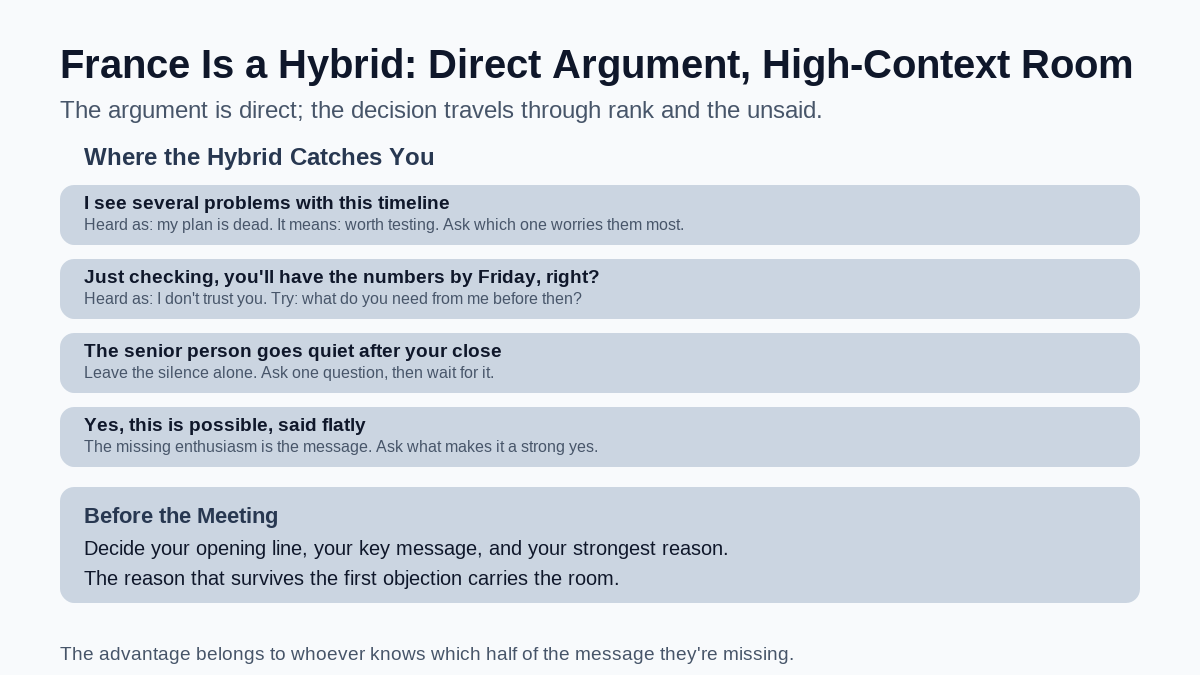
The probing objection. The French director says, "I see several problems with this timeline." You hear: my plan is dead. What is likely meant: your plan is worth testing, and a well-built objection is how a French professional engages with it. The small change is to stop defending everything at once. Say: "Which one worries you most? I'll start there." Then answer with structure: "Two reasons for the March date. First, the supplier contract ends in February. Second, the team is fully staffed from January."
The written check-in. You want to confirm a deadline, so you write: "Just checking, you'll have the numbers by Friday, right?" In a low-context office that is a harmless nudge. Read through a high-context lens, where the relationship carries part of the message, it can land as: I don't trust you to do what you said. The small change: "Thanks for taking the numbers. Friday works well on my side. Is there anything you need from me before then?" Same request. The message underneath moves from "I am watching you" to "we are on the same side."
The silence after your close. You finish, and the senior person says nothing and glances at a colleague. You hear: they hated it. What may be happening: in a high-context room, who speaks first, and whether the senior person speaks at all, is part of the message, and with Power Distance at 68 rank shapes how a decision moves. The small change is to leave the silence alone. Do not fill it with more selling. Ask one question and wait: "What would you need to see to move forward?"
The blunt yes. A French colleague says, "Yes, this is possible," with a flat tone and no follow-up. You hear: approved. What may be meant: the words are true and the enthusiasm is missing, and in a high-context reading the missing enthusiasm is the message. The small change is to check the layer under the words: "Good. What would make it a strong yes rather than a possible one?"
Notice that every fix is one sentence. None of them requires better grammar or a bigger vocabulary. They require using the English you already have with more purpose.
Prepare shorter structures, not longer scripts
Under pressure you will not rise to your level of knowledge. You will fall to your level of training. So decide the shape of the meeting in advance, with three questions.
What is my opening sentence?
What is my key message?
What is my closing decision or action?
With French colleagues, add one more: what is my strongest reason, in one sentence? Because the argument will be tested, and the reason that survives the first probing question is the one that carries the room. This is the exact drill we run in WorldView Training sessions before a client's big meeting: four questions, answered out loud, until the answers are automatic.
You do not need a script for the middle. The middle is rarely remembered. The opening, the closing, and how you handled the first objection are.
So, is France a high-context culture? Yes, relative to the United States, on both major frameworks. And French professionals will still argue with you openly, in structured, logical sentences, because that is how they take an idea seriously. The advantage in that room belongs to whoever knows which half of the message they are missing.
If you have an important presentation, meeting, or negotiation coming up in English, send me a message. I'd be happy to help you prepare.
Frequently asked questions
What are high-context cultures?
High-context cultures are ones where much of a message is carried by tone, timing, relationship, and shared background rather than by the words alone. Edward T. Hall developed the idea; Japanese and Arab cultures head his own examples, and Erin Meyer measures the French as high-context relative to Americans.
Is the USA a high-context culture?
No. Hall's own examples put Americans on the low-context side, and Erin Meyer measures the French as high-context relative to Americans, so the message is expected to be in the words themselves.
What type of culture is France?
France is best treated as a hybrid: high-context relative to the United States on Meyer's reading of Hall's scale, yet direct and logic-driven in argument. Its Hofstede scores of 86 on Uncertainty Avoidance and 68 on Power Distance help explain the preference for formal structure and rank in how decisions move.
Sources reviewed
- Open Library -- 'Beyond Culture' by Edward T. Hall, work record
- Wikipedia, 'High-context and low-context cultures' (citing Hall, Beyond Culture 1976 pp.68-69)
- Wikipedia, 'High-context and low-context cultures' (citing Hall, Beyond Culture 1989 ed. pp.15-16)
- Harvard Business Review, 'Navigating the Cultural Minefield' by Erin Meyer (May 2014)
- Shortform summary of Erin Meyer's 'The Culture Map'
- The Culture Factor Group (Hofstede Insights) -- France country profile
- Cultural Atlas (SBS / Western Sydney University) -- French culture, communication
- Commisceo Global -- France country guide