
A good out-of-office message has four parts: the dates you are away, the day you return, one named person to contact for urgent work, and a short sign-off. Example: "Thank you for your email. I am out of the office until Monday, October 5, and I will not read messages before then. For urgent questions, contact Anna Berg at anna.berg@example.com. Best regards, Ryle."
Your out-of-office message is the shortest piece of leadership writing you will do this year.
It goes to everyone. Your boss, a customer in the middle of a deal, a supplier in another country, a new colleague who has never met you. Many of them read it in a second language. Many read it at a different hour than you sent it. None of them can ask you what you meant.
So the message has one job. It must be understood the first time, by a tired reader on a phone, in a language that is not their own.
That is a clarity problem, and clarity is a leadership skill. The habits that make a manager clear in a meeting make an automatic reply clear too: a real date and a named person.
There is a second reason to write it well. Michelle Gielan, a positive psychology researcher and the author of Resilient Optimism, wrote in Harvard Business Review in August 2018 that disconnecting, "especially from email," can make us "significantly less stressed and more productive". A clear message is what lets you stop checking. If people know who to call, you can close the laptop.
What a good automatic reply says
Four things, in this order.
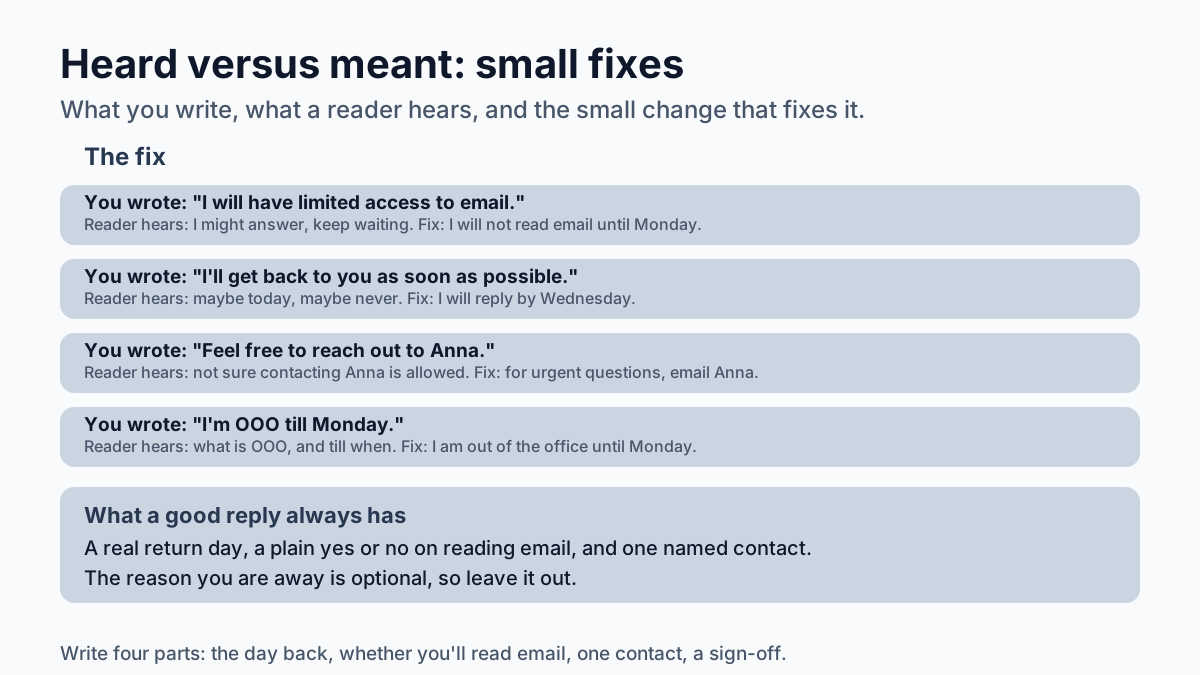
- The day you return. Write the weekday, the month, and the number: Monday, October 5. Next week depends on the day the reader opens your email.
- Whether you will read email while you are away. Yes or no. "Limited access" is neither.
- One person to contact, with an email address and what that person can help with.
- A one-line sign-off with your name.
The reason you are away is optional. "On vacation," "on leave," or "traveling for work" is enough. Nobody needs the name of the beach.
Before you write, decide in advance. Three questions, not a script:
- When am I back, and in which time zone?
- Who covers for me, and for what?
- What counts as urgent?
If you cannot answer the third question, your colleague will receive every "urgent" email in the company. Define it inside the message: "Urgent means a customer is waiting today."
Heard versus meant: eight small fixes
A sentence can be correct and still land wrong. In a proposal role-play, a client of mine once said, "You are not our only client." It was true, and it was polite in the speaker's mind. To the listener it can easily sound like: you are not that important to us. We made a small change: "We have other clients who deal with similar issues." Same basic idea, completely different message.
Automatic replies are full of sentences like that. Here is what the sender writes, what a reader in a second language hears, and the small change that fixes it.
| The sender writes | The reader hears | The small change |
|---|---|---|
| I will have limited access to email. | I might answer. Keep waiting. | I will not read email until Monday, October 5. |
| I'll get back to you as soon as possible. | Maybe today. Maybe never. There is no date, so the reader keeps checking. | I will reply by Wednesday, October 7. |
| Feel free to reach out to Anna. | An idiom (reach out) plus a soft permission (feel free). The reader is unsure whether contacting Anna is allowed or expected. | For urgent questions, email Anna Berg: anna.berg@example.com. |
| I'm OOO till the 5th. | Three unknowns. What is OOO? The 5th of which month? Is till a typo? | I am out of the office until Monday, October 5. |
| Apologies for any inconvenience this may cause. | Something went wrong. The filler also makes the message longer than the useful part. | Delete it. If you want warmth: Thank you for your patience. |
| Please expect delays in my response. | There is a problem with my work. Delays sound like a shipment problem. | I will answer messages in the order I receive them, starting Tuesday, October 6. |
| If it's urgent, call my cell. | Everything is urgent to the person sending it. Cell is American. And during which hours? | If a customer is waiting today, call Anna Berg at [phone number] between 9 a.m. and 5 p.m. Central European Time. |
| I will respond to your email upon my return. | Upon is formal, and the reader still does not know when you return. | I return on Monday, October 5, and I will reply that week. |
None of these fixes needs better grammar. They need a date, a name, and a plain verb. Use the English you already know, with more purpose.
The automatic replies that confuse global teams most are often written by native speakers. They use idioms. They abbreviate. They assume everyone knows which month it is.
Copy-and-adapt examples for six situations
Each of these is an automated reply. You paste the words into Outlook or Gmail, and the software sends them for you. Change the names and dates, keep the shape.
The classic message
This is the classic out-of-office message. It works for almost everyone, inside and outside the company.
Subject: Out of office until Monday, October 5
>
Hello,
>
Thank you for your email. I am out of the office until Monday, October 5, and I will not read messages before then.
>
For urgent questions, contact Anna Berg at anna.berg@example.com.
>
Best regards,
[Your name]
The short internal message
For colleagues only. One line is enough, because they already know you.
I am out until Monday, October 5. Anna Berg covers my projects. For anything else, I will reply that week.
The sales message
A customer in the middle of a deal may be reading this. The customer wants to know the deal keeps moving.
Hello,
>
Thank you for your message. I am away until Monday, October 5.
>
If you need a quote, a contract, or an answer about an open order before then, contact Anna Berg at anna.berg@example.com. She has access to your account and can act for me.
>
I will follow up with you personally on Monday, October 5.
>
Best regards,
[Your name]
The sentence that does the work is "can act for me." Without it, the customer waits.
The long-leave message
For parental leave, medical leave, or a sabbatical. Give the year, because the reader may be looking at it months from now.
Hello,
>
I am on leave until Monday, March 1, 2027, and I will not read email during this time.
>
Please contact Anna Berg (anna.berg@example.com) for all questions about [project or region]. She will make decisions in my place.
>
Best regards,
[Your name]
She will make decisions in my place tells the reader that Anna has authority as well as access. On a long leave, that sentence saves your colleague weeks of "let me check with him first."
The travel message
You will read email, but slowly, and at strange hours. Name your time zone. "In the evening" is a different hour for a reader in Frankfurt or Singapore.
Hello,
>
I am traveling for work until Friday, October 9, and I check email once a day, in the evening, US Eastern Time.
>
For anything that cannot wait a day, contact Anna Berg at anna.berg@example.com.
>
Best regards,
[Your name]
The office-closure message
For a storm, a public holiday, or a power cut. Where I live on the Florida coast, a September storm warning can close an office for a day or two on short notice, and when that happens, customers with delivery questions all write at once. A team-level reply keeps that calm.
Hello,
>
Our office is closed on Thursday, September 24, and Friday, September 25, because of a storm warning. Email will be answered again from Monday, September 28.
>
If you have an urgent delivery question, contact our operations line at [phone number].
>
Thank you for your patience,
[Team name]
How do you professionally say you will be out of office?
Say it before the automatic reply says it for you.
In the meeting, one sentence: I will be out next week, from Monday, October 5, to Friday, October 9. Anna covers my projects. Please send me anything you need by Thursday.
In an email to a customer, two sentences: I will be away from October 5 to October 9. Anna Berg will handle your account that week, and I will contact you personally on Monday, October 12.
To your own team, add the standard you expect: While I am out, Anna makes the call. Do not wait for me.
The pattern is the same each time. Dates first. The name second. What you need from them third.
For a manager, this is the whole point. The automatic reply informs. The sentence in the meeting leads. This is the kind of sentence we rehearse in a WorldView Training session: short, dated, and said out loud once before you send it.
What to say instead of "out of the office"
"Out of the office" is fine. It is plain, and almost everyone knows it. But there are moments when another phrase is clearer.
- "On leave" when the absence is long and you will not read anything.
- "Traveling for work" when you will read email, but slowly.
- "Away from my desk" for a few hours, never for a week.
- "Unavailable until" when the reason is private.
- "Our office is closed" when the whole team is out.
Avoid OOO inside the message. It is common in American offices and unknown in many others. Do not worry about "on holiday" versus "on vacation." Both are understood, so pick one and move on.
One more. Do not write I am currently out of the office. The reader is looking at an automatic reply. They know it is current.
Do funny automatic replies work in a global company?
Sometimes, and the price of a miss is high.
A joke needs shared references. A line that gets a laugh in Chicago can read as strange, or even rude, to a reader in Seoul who is translating it word by word. Sarcasm is the biggest risk. "I'm on a beach ignoring you" is a joke to one reader and an insult to another.
If you want the message to feel human, use warmth instead of humor. Warmth translates. Jokes often do not.
A warm version that is safe anywhere:
I am with my family this week and my phone is in a drawer. I will read your email on Monday, October 5. Until then, Anna Berg (anna.berg@example.com) can help.
That message has personality. It also has a date and a name. The reader smiles and still knows what to do.
If you lead a team that writes in a second language, this is one place to lower the pressure. Tell them a plain message is the standard. Nobody is scored on wit.
Outlook and Gmail settings that change what your message does
The words are half of the job. The settings decide who receives them and when.
| Setting | Outlook | Gmail |
|---|---|---|
| When it runs | You can choose to send replies only during a time period, with a start time and an end time. | The reply runs from 12:00 AM on your start date to 11:59 PM on your end date, unless you end it earlier. |
| Who receives it | You can limit replies to people in your Contacts with send replies only to contacts. Replies sent outside your organization go to every email you receive, including newsletters, advertisements, and possibly junk. | In most cases a sender gets one reply, and a second one if they write again after four days while the responder is still on, or if you edit the reply. |
| What is skipped | See the note on external replies above. | Messages that land in spam, or that are sent to a mailing list you subscribe to, get no reply. |
| Account types | Outlook's automatic replies are not supported for Gmail, Yahoo, or other POP or IMAP accounts; those need a rules-based workaround. | Built in. |
A few practical results follow from that table.
Set the Gmail end date to the day before you return. The responder runs until 11:59 PM on the end date, so if you enter your first day back as the end date, colleagues who write that Monday morning still get "I am away."
Keep the external Outlook version shorter than the internal one. It goes to every newsletter and advertising sender on your list, and possibly to junk senders, so leave your mobile number out of it. Put the number in the internal version, which only colleagues see.
Expect a Gmail sender to see your reply twice if they write on Monday and again the next Monday. That is the four-day rule working as designed.
Set the reply before you leave, then send yourself a test email from another account. Ten seconds, and you know the date is right.
One line to carry out of the room
An automatic reply is a small test of the skill you use in every meeting: say the important thing first, then tell people what to do next.
Write it today, before you need it. Read it once out loud. If it takes longer than ten seconds to read, cut a sentence.
If you have an important presentation, meeting, or negotiation coming up in English, send me a message. I'd be happy to help you prepare.
Frequently asked questions
What is the best auto reply message?
The best automatic reply is one a stranger can act on in ten seconds: a return date written with the weekday and month, a plain yes or no on whether you will read email, and one named contact with an email address. The reason for your absence is optional; the date and the name are not.
What to say instead of "out of office"?
Use "on leave" for a long absence with no email, "traveling for work" when you will read email slowly, "unavailable until" when the reason is private, and "our office is closed" when a whole team is out. Avoid the abbreviation OOO, which many readers outside American offices do not know.
What is a classic out of office message?
The classic form is four lines: thanks for the email, the return date, one named contact for urgent questions, and a sign-off. For example: "Thank you for your email. I am out of the office until Monday, October 5. For urgent questions, contact Anna Berg at anna.berg@example.com. Best regards, [Your name]."
Sources reviewed
- Outlook automatic replies can be scheduled to a start/end time period and restricted to Contacts-only recipients Outlook lets a user select 'Send replies only during a time period' with start/end times, and 'Send replies only to contacts' to limit automatic replies to people in Contacts.
- Outlook warns sending automatic replies outside the organization goes to every inbound sender including newsletters/junk Sending Outlook automatic replies outside the organization sends the reply to every email received, including newsletters, advertisements, and potentially junk email.
- Outlook's automatic-reply feature does not work for Gmail/Yahoo/other POP or IMAP accounts Automatic replies (Outlook's built-in feature) are not supported for Gmail, Yahoo, or other POP or IMAP accounts; those account types need a rules-based workaround.
- Gmail vacation responder's exact active window Gmail's automatic reply starts at 12:00 AM on the chosen start date and ends at 11:59 PM on the chosen end date, unless the user ends it earlier.
- Gmail vacation responder resend behavior after repeat contact In most cases Gmail's vacation responder sends a given sender the automatic reply only once, but sends it again if that person emails again after 4 or more days while the responder is still active.
- Gmail vacation responder skips spam and mailing-list mail Emails that land in the spam folder, or are addressed to a mailing list the user subscribes to, do not receive Gmail's automatic vacation-responder reply.
- Grammarly's 6-part structure for an effective out-of-office message Grammarly's guide (by Matt Ellis) recommends six components for an out-of-office message: a clear subject line noting the return date, a professional greeting, a brief reason for the absence, a specific return date, a point of contact for urgent matters, and a professional sign-off.
- HBR: disconnecting from email reduces stress and raises productivity Michelle Gielan, positive psychology researcher, writes that research shows disconnecting from email specifically can make people significantly less stressed and more productive, and argues a thoughtful out-of-office message helps make that disconnection possible.