
Cultural negotiation, usually called cross-cultural negotiation, is the process of reaching an agreement between people whose cultural backgrounds shape how they read authority, how they carry meaning in words and silence, how they use time, and what they treat as a binding commitment. The goal is the same as in any negotiation. The rules for getting there are not shared, so both sides have to find them.
Picture a sales director from Germany and a buyer from Brazil on a video call. She sent a twelve-point term sheet (the short list of the deal's main terms) the day before and expects to work through it in order. He opens with twenty minutes about his daughter's graduation, then asks about point seven.
Neither of them is being difficult. They are running two different rulebooks for the same meeting, and nobody wrote either rulebook down.
That gap is what the term describes. Same language on the call. Different ideas about what the call is for.
What culture changes at the table
Two frameworks give the field most of its vocabulary. You do not need to memorize them. You need the ideas behind them.
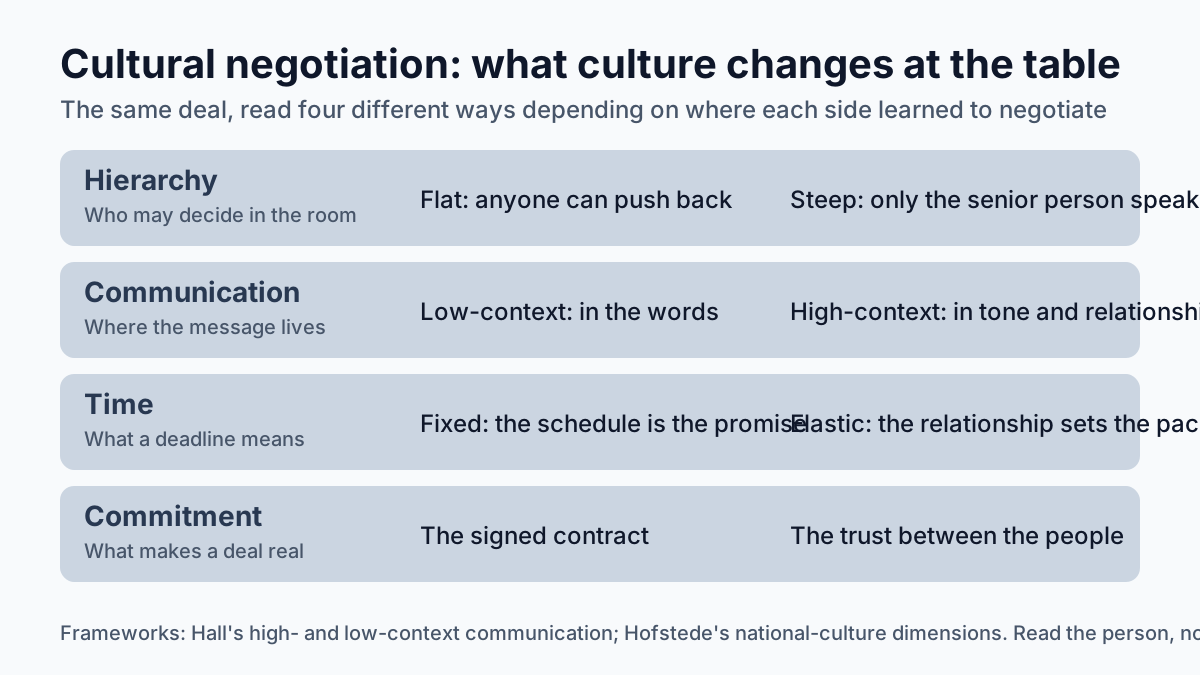
The first comes from the researcher Geert Hofstede, whose model scores national cultures on six dimensions: power distance, individualism, masculinity, uncertainty avoidance, long-term orientation, and indulgence. Power distance is the one that shows up first in a negotiation. It measures how far the less powerful members of a group accept and expect that power is shared out unequally. In a high power distance culture, the most senior person in the room may be the only person who can say yes. In a low power distance culture, a junior analyst can push back on the CEO and nobody is surprised.
The second comes from the anthropologist Edward T. Hall, who introduced the idea of high-context and low-context communication in his 1976 book Beyond Culture. In a high-context negotiating culture, meaning rides on implicit cues, on nonverbal signals, and on the trust already built. In a low-context culture, meaning sits in the words themselves and in the detailed written agreement.
Time is a third difference. Cultures common in the United States, Germany, and Japan are described as monochronic: time is a line, and a deadline is a deadline. Cultures common in the Mediterranean, Latin America, and some African cultures are described as polychronic: time stretches, and the relationship sets the pace. What reads as stalling on one side of the table is simply a different clock on the other.
Silence works the same way. Research collected in the same essay found that Japanese negotiators use the most silence at the bargaining table and Brazilian negotiators use almost none.
Why deals across cultures go worse on average
Harvard's Program on Negotiation reports that dealmaking across cultures tends to produce worse outcomes than dealmaking inside one culture. Bad faith is rarely the reason. Different communication norms leave more room to misread intent, and a misread on Tuesday becomes a concession on Friday.
Erin Egan, then Microsoft's director of strategy and business development, told Harvard Business School Online where the cost lands: "When you're dealing with someone that you don't communicate with perfectly, it's challenging to build that trust."
In the same piece, Ric Lewis, then chief executive of Tristan Capital Partners, put the gap in one sentence: "In America, basis points matter. And in Europe, relationships matter." A basis point is a tiny fraction of one percent, the unit people use when they argue over a rate. Neither side is wrong. Each is negotiating the thing its culture says the deal is.
Here is how the gap sounds in one sentence. A low-context speaker says: Let's skip the small talk and get to the numbers. To a relationship-first listener, that can easily sound like: You are not worth twenty minutes of my time. So make a small change: "I'm looking forward to the numbers. First, tell me how the quarter has been for your team." Same numbers, a completely different message.
The native English speaker in the room often makes this worse without meaning to.
They speak fast. They skip the warm-up. They treat the term sheet as the relationship.
Those are habits, and habits can be trained. James Baker, the former U.S. secretary of state, was negotiating the Gulf War coalition when he grew frustrated, closed his notebook and prepared to leave. His interpreter told him to wait: the frustration had moved his counterpart. A native English speaker at the top of his profession still needed someone who could read the room. That is the advantage in a negotiation: knowing what your words did on the other side of the table. It has nothing to do with vocabulary size.
Is culture the same as nationality?
No. The people who negotiate for a living are the first to say so.
Michael Wheeler, then a professor at Harvard Business School, warned in the same interview against treating culture as destiny: "It's dangerous to pigeonhole people and to assume that they'll behave in a particular way. Individuals differ in temperament, values, and needs. We need to adapt our approach depending on the individual." His example: "the negotiation style of a particular manager in a Shanghai-based corporation might be closer to that of a particular Icelandic business owner than to her own next-door neighbor."
Michael McIlwrath, former global chief litigation counsel at GE Oil & Gas, made the same point from the other direction. Culture "isn't only determined by where people are born and raised, or by the passport they carry." Engineers from different countries, solving one technical problem, can have more in common with each other than with people from their own country who do not share that problem-solving habit.
This is the half of the definition I care about most as a coach.
Culture tells you what to expect. The person across the table tells you what is true.
Read about the country to prepare. Then put the reading down and watch the person.
Sometimes the fix is the format
At the 2015 Paris climate talks, negotiators reportedly adopted South Africa's consensus-building "indaba" format to bridge different cultural approaches to reaching agreement. They changed the shape of the meeting, not only the words inside it.
If you want one book that pulls these frameworks together, Erin Meyer, professor of management practice at INSEAD, wrote The Culture Map.
What to do in each moment of the meeting (the opening, the silence, the meaning of a yes, the contract) is a post of its own on this blog, and so is the map of which negotiating style each country tends to open with. This post is the definition underneath both.
One line you can use tomorrow
If I did not yet know which rulebook the other side was using, this is the sentence I would open with:
Before we get into the numbers, I would like to understand how your team usually makes a decision like this.
It tells a deadline-first counterpart that the numbers are coming, and a relationship-first counterpart that you are interested in them before the price. The answer also tells you who can say yes, before you have given anything away to find out.
This is the preparation I do with international managers at WorldView Training before a negotiation in English. The vocabulary is usually already there. The work is deciding, in advance, what the other side will hear.
If you have an important negotiation coming up in English, send me a message. I'd be happy to help you prepare.
Frequently asked questions
What is negotiation culture?
Negotiation culture is the set of shared habits a group brings to bargaining: how directly it speaks, how it treats time and deadlines, how much it relies on written terms, and who is allowed to say yes. Cultural negotiation is what happens when two of these sets of habits meet at one table.
Does nationality predict how someone will negotiate?
Only loosely. Michael Wheeler, then a professor at Harvard Business School, cautioned that individuals differ in temperament, values, and needs, and that a manager in Shanghai may negotiate more like a business owner in Iceland than like her own neighbor. Use national patterns to prepare, then adapt to the person in front of you.
Sources reviewed
- Program on Negotiation (Harvard Law School) — cross-cultural deals underperform same-culture deals Dealmaking across cultures tends to lead to worse outcomes compared with negotiations conducted within the same culture, because differing communication styles and norms raise the risk of misunderstanding.
- Program on Negotiation (Harvard Law School) — cross-cultural rapport example President Obama dancing tango at a Buenos Aires state dinner is cited as an example of cross-cultural rapport-building that had an immediate, significant impact on the relationship between the two countries.
- Program on Negotiation (Harvard Law School) — Paris Climate talks 'indaba' process At the 2015 Paris Climate talks, negotiators adopted South Africa's consensus-building 'indaba' framework to bridge different cultural approaches to reaching agreement.
- Program on Negotiation (Harvard Law School) — interpreter reliance example Former U.S. Secretary of State James Baker relied on a trusted interpreter rather than his own language ability while building the Gulf War coalition — cited as a model for cross-cultural negotiation.
- HBS Online — Michael Wheeler on national-culture stereotyping Harvard Business School Professor Michael Wheeler: a manager's negotiating style may be shaped more by individual temperament and role than by national culture, so treating culture as destiny is a mistake.
- HBS Online — Ric Lewis on basis points vs. relationships Tristan Capital Partners CEO Ric Lewis: in American dealmaking 'basis points matter,' while in European dealmaking 'relationships matter' more.
- HBS Online — Erin Egan on trust and imperfect communication Microsoft Director of Strategy and Business Development Erin Egan: building trust is harder when you don't communicate perfectly with your counterpart.
- HBS Online — Michael McIlwrath on culture beyond nationality Former GE Oil & Gas Global Chief Litigation Counsel Michael McIlwrath: culture 'isn't only determined by where people are born and raised, or by the passport they carry' — professional culture (e.g., a shared engineering mindset) can unite negotiators across nationalities.
- geerthofstede.com — the official Hofstede six-dimension model Geert Hofstede's six national-culture dimensions are Power Distance, Individualism, Masculinity, Uncertainty Avoidance, Long-Term Orientation, and Indulgence, each defined on the official Hofstede site (e.g., Power Distance = the extent to which less powerful members of institutions accept and expect unequal power distribution).
- Beyond Intractability (Michelle LeBaron, Peter A. Allard School of Law, UBC) — time orientation in negotiation Monochronic cultures (common in the U.S., Germany, Japan) treat time as linear and sequential; polychronic cultures (common in Mediterranean, Latin American, and African contexts) treat time as simultaneous and elastic — a difference that shapes negotiation pacing and deadline expectations.
- Beyond Intractability (Michelle LeBaron) — silence in negotiation Cultural research cited in this essay finds Japanese negotiators make the heaviest use of silence at the bargaining table, while Brazilian negotiators use almost none.
- MIT Professional Education — high/low context applied to negotiation expectations In high-context negotiating cultures, meaning rides on implicit cues, nonverbal signals, and established trust; in low-context negotiating cultures, clarity comes from explicit direct speech and detailed written agreements.