
Yes. Egypt is a high-context culture. Much of the meaning in an Egyptian business conversation is carried by the relationship, the rank of the people in the room, tone, and setting, rather than by the literal words. A direct "no" is rare, titles matter, and personal trust comes before business. If you listen only to the words, you will miss the message.
And if you walk into Cairo expecting a wall of polite hedging, you have the picture backwards. Egyptian indirectness lives somewhere else. The rest of this post is about where to listen for it.
What "high-context" means in plain words
The anthropologist Edward T. Hall gave us the term in his 1976 book Beyond Culture.
In a high-context culture, the words are only part of the message. The rest sits in the context: who is speaking, how well you know each other, who is senior, what was agreed last month, and what is left unsaid.
In a low-context culture, the message is in the words. Say it clearly, and you are done.
(I cover the general direct-versus-indirect split, and where other business cultures sit on it, in a separate post. Here I stay on Egypt.)
Egypt sits at the high-context end. Guides written for people working there describe the style plainly: Egyptians generally communicate in an indirect manner, and much of the message travels in the relationship and the setting rather than in the explicit words.
Why Egyptian indirectness does not sound indirect
Americans stack up softeners when saying no: reasons, apologies, an alternative, a "maybe next time." In Egypt the softening happens somewhere else. The relationship and the rank of the two people talking carry it. Extra words do not. When the relationship is right, a short answer is not rude. When the relationship is not there yet, careful phrasing will not rescue you.
For a manager from a low-context culture, this is the trap. You prepare more polite words. The other side is reading the room.
How do you hear a "no" in an Egyptian meeting?
You will rarely hear the word.
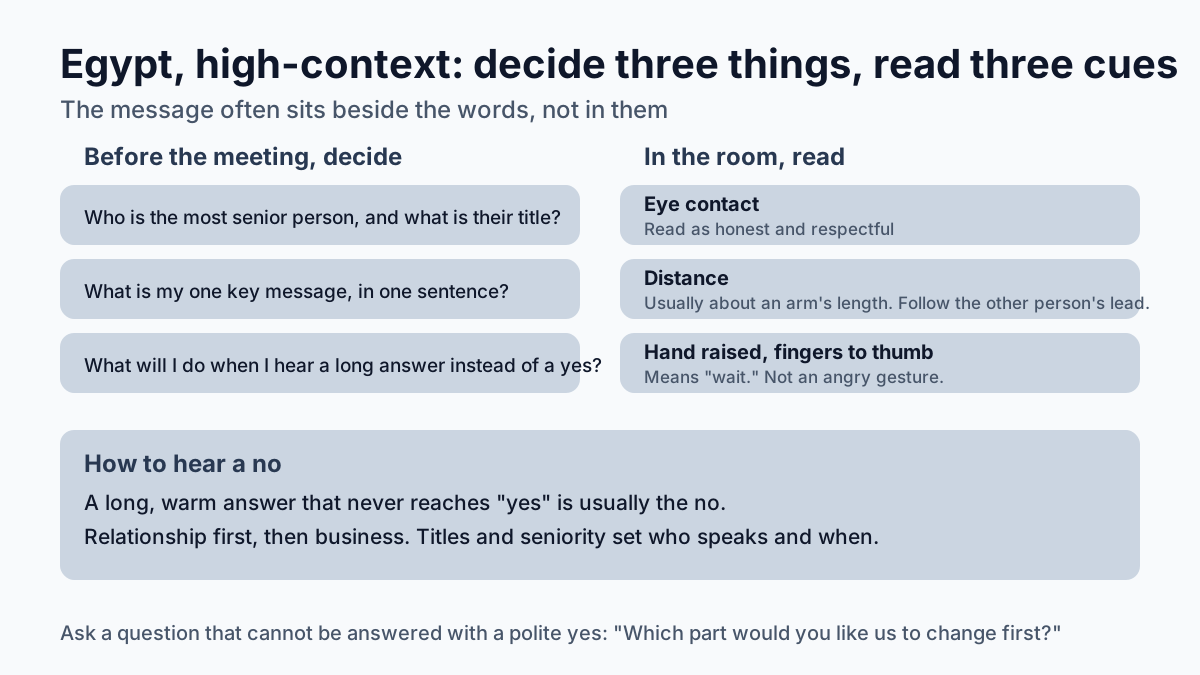
Egyptians generally avoid a direct "no." What you get instead is a longer reply that may not answer your question at all.
Here is how that plays out. You ask whether their team can sign by Friday. You get a warm, three-minute answer about the project, the good work so far, the team, and the timing over the next month.
What you heard: interest, probably a yes.
What you were told: the answer to your question is not yes.
The small change is in what you ask next. Do not repeat the question, and do not repeat it louder. Ask a question that lets them tell you what is possible:
Ask which part of this is comfortable for their team right now.
Or ask what would need to be true for Friday to work.
Both lines give the other side a way to say "not this" without saying "no." That is the whole skill.
Rank, titles, and the clock
Hierarchy is part of the context, so it changes how you speak and when you arrive.
Dr. Mohammed Omran, a professor of finance at the Arab Academy for Science, Technology and Maritime Transport, put it plainly while speaking as a Rooney International Visiting Scholar at Robert Morris University, in a seminar reported in October 2025: "If you are going to meet with people of higher authority... You need to be ahead of time with a meeting."
On titles, he said: "Title is very important. Even now, when I'm walking and, in my jacket, I have my business card."
So use the title, every time, until you are asked to drop it. Arrive early for anyone senior to you. Both are small. Both are noticed.
Decisions tend to sit with the most senior person, and staff do not question those decisions in front of others. So the person who talks the most in the meeting may not be the person who decides. Watch who the others glance at before they answer.
The nonverbal cues that carry meaning
In Egypt, eye contact, distance, and gesture all carry set meanings:
- Eye contact is generally read as honest and respectful. Gaze conventions vary by gender in some settings, so follow the lead of the person in front of you.
- People usually keep about an arm's length of distance, and women often stand closer to each other than to men. Follow the other person's lead.
- Four fingers pressed to the thumb, hand raised, means "wait." It is not an angry gesture.
Tone and silence do work too. A pause is not always an invitation to fill it.
Relationship first, then business
The pattern behind every point above is the same. Egyptian communication is indirect and runs on the relationship, so the relationship is the meeting, and the contract comes after.
They will not rush you.
They will not say no to your face.
They will not skip the relationship to get to the contract.
Skip it yourself and you lose the context that would have told you what they meant.
Prep for a meeting like this is three questions, not a longer script:
- Who is the most senior person in the room, and what is their title?
- What is my one key message, in one sentence?
- What will I do when I hear a long answer instead of a yes?
Decide these in advance, and you will not have to work them out under pressure.
Preparing a manager for one specific conversation like this is most of what I do at WorldView Training: one real meeting, one opening line, one closing decision, practiced until it is automatic.
Take this question into your next meeting in Cairo. Ask which part of this works for them right now. Then be quiet and read the room.
If you have an important meeting or negotiation coming up in English, send me a message. I'd be happy to help you prepare.
Frequently asked questions
What type of culture is Egypt?
Egypt is a high-context, relationship-oriented, and hierarchical business culture. Meaning is carried by the relationship, rank, tone, and setting as much as by the words, and a direct 'no' is uncommon.
What culture is considered a high context culture?
A high-context culture is one where most of a message sits in shared context (relationship, status, setting, and nonverbal cues) rather than in the explicit words, a distinction Edward T. Hall introduced in 1976. Guides for people working in Egypt describe Egyptian communication as indirect and relationship-driven, which puts it at the high-context end.
What are the unspoken rules in Egypt?
In business, arrive early for anyone senior to you, use professional titles, expect about an arm's length of distance, and treat a long answer that never says yes as a soft no. Build the relationship before you push for a decision.
Sources reviewed
- Edward T. Hall, Beyond Culture (1976) -- originating source for the high-context/low-context framework Anthropologist Edward T. Hall introduced the concepts of 'high-context' and 'low-context' culture in his 1976 book Beyond Culture.
- Feghali, E. (1997). Arab cultural communication patterns. International Journal of Intercultural Relations, 21(3), 345-378. Peer-reviewed research applying Hall's framework to the Arab world finds Arab cultural communication is marked by indirectness, elaborate/rhetorical language, and heavy reliance on context over explicit code -- placing Arab societies, including Egypt, in the high-context category.
- Nelson, G.L., Al-Batal, M., & El-Bakary, W. (2002). Directness vs. indirectness: Egyptian Arabic and US English communication style. International Journal of Intercultural Relations, 26, 39-57. In a comparative study of refusal speech acts, Americans averaged 5.4 indirectness strategies per refusal versus 3.2 for Egyptians, and Egyptian speakers showed even less verbal indirectness toward higher-status listeners -- evidence that Egyptian high-context communication relies on relationship/status context rather than verbal hedging.
- RMU Sentry Media, 'Business Communication Seminar Explores Egypt's High Context Culture' (Oct. 16, 2025) Dr. Mohammed Omran said of meeting punctuality with Egyptian counterparts: 'If you are going to meet with people of higher authority... You need to be ahead of time with a meeting.'
- RMU Sentry Media, 'Business Communication Seminar Explores Egypt's High Context Culture' (Oct. 16, 2025) Dr. Omran said professional titles are used constantly in Egyptian introductions: 'Title is very important. Even now, when I'm walking and, in my jacket, I have my business card.'
- Commisceo Global, Managing In Egypt -- Management Style & Workplace Culture Egyptian workplace communication is described as typically indirect, high-context, and relationship-oriented, and Egyptians place great emphasis on building and maintaining personal relationships before business.
- Commisceo Global, Managing In Egypt -- Management Style & Workplace Culture Decision-making in Egyptian workplaces tends to sit with senior managers acting as figureheads, and employees do not publicly question a manager's decisions.
- Cultural Atlas (SBS / Western Sydney University), Egyptian Culture -- Communication Egyptians generally avoid replying with a direct 'no,' instead giving a lengthy reply that may not directly answer the question.
- Cultural Atlas (SBS / Western Sydney University), Egyptian Culture -- Communication Nonverbal cues carry set meaning in Egyptian communication: eye contact is generally read as respectful and honest (with gaze conventions varying by gender in some contexts), conversational distance runs closer than typical US norms, and specific gestures (e.g., four fingers to the thumb) signal 'wait.'