
Brazil is collectivist. On Hofstede's Individualism scale, the measure most people mean when they ask this question, Brazil scores 36 out of 100, well inside the collectivist range. Brazilians grow up inside strong, close groups, above all the extended family of grandparents, uncles, aunts and cousins, and those groups protect their members in exchange for loyalty. In business, this shows up as relationships first, then the deal.
That number is the short answer. The long answer is what a 36 does to a Tuesday morning call.
Picture a video call between a project manager in the United States and a new supplier in Brazil. The American opens with the agenda. The Brazilian opens with a question about the American's weekend. Ten minutes later, the American is checking the clock, and the Brazilian is wondering why this person is so cold.
Neither of them is rude. They are working from two different definitions of a good meeting.
What a score of 36 means
Hofstede's model is the standard scorecard for national culture. It rates each country it measures on six dimensions, each from 0 to 100. On the Individualism dimension, a high score means people see themselves as "I" first: my goals and my performance. A low score means people see themselves as "we" first: my family and my people.
Brazil's 36 sits clearly on the "we" side.
The source of that "we" is the extended family. The model's own description of Brazil says people belong from birth to strong, cohesive groups, above all the wider family of uncles, aunts, grandparents and cousins, and that those groups protect their members in exchange for loyalty. That one sentence is the key to almost everything else in this article.
In an individualist culture, the ideal is to leave home young and build a life of your own. In a collectivist one, you never really leave the group. You add to it.
So the question a Brazilian colleague is quietly asking in those first ten minutes is simple. Are you inside the group, or outside it?
The extended family is the model for every other group
Once you see the family as the template, Brazilian working life gets easier to read.
The same description says loyalty flows through those groups. In practice, personal networks built through family and friends shape professional connections in Brazil, and trust built through those networks sits at the centre of a business partnership. A warm introduction from someone inside the circle carries more weight than a strong CV from someone outside it.
This is why a first meeting so often feels like it has no agenda. The agenda is you.
They ask about your family. They remember your answer. They expect you to remember theirs.
An American or a German would call this small talk. In Brazil it is the work. The Brazilian side is deciding whether you are a person they can rely on, because in a "we" culture a deal is a relationship with a contract attached.
If you grew up in the United States, Britain, or northern Europe, this is the hardest adjustment. You were probably raised to keep work and private life separate, and to see the fast, agenda-first meeting as a sign of respect for everyone's time. In Brazil, that same meeting can read as distance.
How a Brazilian counterpart hears an individualist
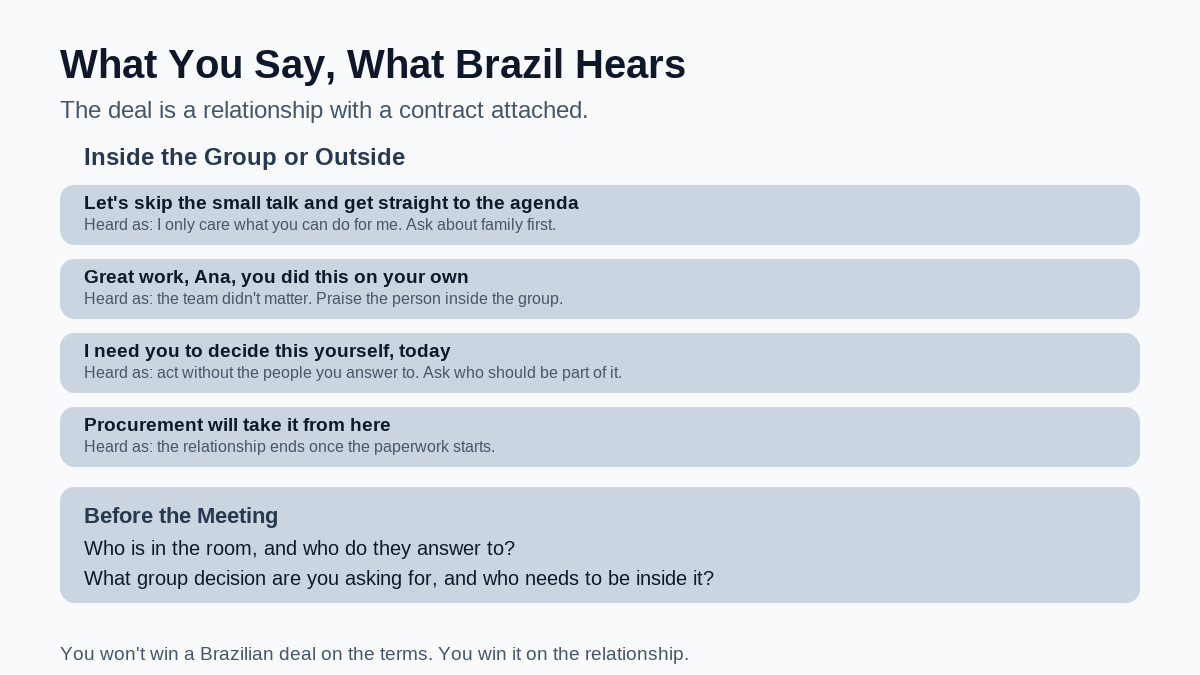
I coach people to think in three beats: what you said, what the other person heard, and the small change that fixes it. Here are four for Brazil.
You said: "Let's skip the small talk and get straight to the agenda." They heard: "I am not interested in you as a person, only in what you can do for me." The small change: "Before we start, how have you been? How is the family?" Then the agenda, which will now move faster, not slower.
You said: "Great work, Ana. You did this one on your own." Ana's colleagues heard: "The rest of you did not matter." And Ana may have heard: "You are being separated from your team." The small change: "Ana led this, and the whole team carried it. Thank you, all of you." Praise the person inside the group, never instead of it.
You said: "I need you to decide this yourself, today." They heard: "I am asking you to act without the people you are responsible to." The small change: "Who should be part of this decision? Take the time you need to bring them in, and let's decide together on Thursday." You will still get your answer. You will get it with the group behind it, which means it will hold.
You said: "Procurement will take it from here. They'll handle the contract." They heard: "Now that the paperwork has started, our relationship is over." The small change: "Procurement handles the paperwork. I stay your contact, before and after the signature."
Notice the pattern. In every case the English was correct. The problem was where the sentence placed the other person: outside the group.
Jeitinho: the network is the tool
There is a phrase every foreigner working in Brazil learns early: jeitinho brasileiro. It describes the Brazilian habit of using personal connections to get things done, often with little regard for the formal rule, the state, or anyone outside one's own circle or family. Two classic works of Brazilian social thought trace the idea: Sérgio Buarque de Holanda's Raízes do Brasil and Roberto DaMatta's Carnavais, Malandros e Heróis.
Read it through the collectivist lens and it stops looking strange. If the group is where safety comes from, then the group is also where solutions come from. When a rule blocks the path, the first instinct is to ask who you know, because in a "we" culture, loyalty is exactly what you use when a rule is in the way.
A Brazilian colleague said: Don't worry, I know someone at the agency. Let me talk to him. You heard: "We are about to cut a corner." What was meant: "I am spending my own relationship capital to solve your problem. This is how I show you I am on your side." The small change, for the listener: "Thank you. Tell me what you need from me, and I'll keep our side clean and on time."
Keep your company's compliance rules; those do not change. What changes is how you hear the offer, so you do not insult a person who is trying to help you.
The rest of Brazil's cultural profile
Individualism is one of six dimensions. The same country comparison tool gives Brazil five more scores, and each one adds a detail to the same picture.
| Dimension | Brazil's score | What it means at work |
|---|---|---|
| Individualism | 36 | "We" before "I"; the extended family is the model for every group |
| Power Distance | 69 | Hierarchy is respected and inequality is accepted; the senior person's word carries weight |
| Uncertainty Avoidance | 76 | A strong need for rules and detailed legal systems, like most of Latin America |
| Motivation Towards Achievement | 49 | No clear preference: the drive to succeed lives alongside warmth, relationships and quality of life |
| Long Term Orientation | 28 | A normative culture: respect for tradition and a concern with absolute truths |
| Indulgence | 59 | People follow their impulses and enjoy life, with an optimistic outlook |
Three of these change how you should read the collectivism.
The 69 on Power Distance means the "we" has a shape. Groups have a head. When you ask a Brazilian team for a decision, you are often asking the group to agree and then asking its senior person to say it out loud. Skip the senior person and the decision will not hold.
The 76 on Uncertainty Avoidance explains why jeitinho exists at all. Brazil wants rules, and it has a great many of them. When the rules pile up faster than anyone can follow, the personal network becomes the way through. The two scores look like a contradiction and are in fact partners.
The 49 on Motivation Towards Achievement (the dimension older tables call Masculinity) matters for anyone who sells. Brazilians want to win, and they also want to enjoy the people they win with. A pitch built only on numbers is talking to half of the room.
Collectivist does not mean socialist
People who ask whether Brazil is collectivist often ask a second question next: is collectivism a political idea? Some pages tie the word to Marx, or to fascism, or ask what "the problem with collectivism" is.
Those are questions about political philosophy, and they use the word in a different sense. In Hofstede's cultural model the word means something narrower. It measures whether people define themselves first through their group, above all the family, or first as individuals.
Brazil's 36 describes family loyalty. It says nothing about government.
So when you read that Brazil is collectivist, read it this way: Brazilians bring their people with them. Nothing more political than that.
Decide in advance: three questions before a Brazil meeting
I tell clients to prepare shorter structures, not longer scripts. Before a meeting with a Brazilian team, answer three questions.
Who is in the room, and who do they answer to? What is my relationship sentence, the one line that shows I remember them as people? What group decision am I asking for, and who needs to be inside it?
If you can answer each in one line, you are ready. That is the whole preparation, and it is the same preparation we build in a WorldView Training session, with the real meeting on the table.
Phrases you can use tomorrow
Plain English, short sentences, in the order you will need them.
To open: Before we look at the numbers, tell me how things are with you. How is the family?
To introduce yourself through the network: Your colleague suggested I contact you. She and I have worked together, and she thought we should talk.
To praise without separating: Ana led this, and the team carried it. Thank you, all of you.
To ask for a decision the right way: Who else should be part of this? I'd like to make it easy for you to bring them in.
To keep the relationship after the paperwork: Procurement handles the contract. I stay your contact, before and after the signature.
To close: It was good to spend this time with you. When can we talk again?
Read the last one twice. In an individualist culture, a meeting ends with an action item. In Brazil it ends with the next meeting, because the relationship is the action item.
The line to carry out of the room
You will not win a Brazilian deal on the terms. You will win it on the relationship, and the terms will follow.
That is a communication skill, and it can be trained like any other skill.
If you have a meeting, presentation, or negotiation with a Brazilian team coming up in English, send me a message. I'd be happy to help you prepare.
Frequently asked questions
What is jeitinho brasileiro?
Jeitinho brasileiro is the Brazilian practice of using personal connections and improvised workarounds to get things done when a formal rule is in the way. It is widely read as the in-group-first, collectivist side of Brazilian culture in action, and the idea is traced in classic Brazilian social thought by Sérgio Buarque de Holanda and Roberto DaMatta.
Does being collectivist mean Brazilians are not competitive?
No. Brazil scores 49 out of 100 on Hofstede's Motivation Towards Achievement dimension, which means the drive to succeed sits alongside a strong value on relationships, warmth and quality of life, with no clear preference either way.
Is collectivism part of fascism?
In Hofstede's cultural model, collectivism measures how people define themselves, through their group (above all the family) or as individuals. It describes everyday identity and loyalty, not a political ideology or a form of government, so Brazil's collectivist score says nothing about its politics.
Sources reviewed
- Hofstede Insights / The Culture Factor Group - Brazil Country Comparison Tool
- Hofstede Insights / The Culture Factor Group - Brazil Country Comparison Tool
- Hofstede Insights / The Culture Factor Group - Brazil Country Comparison Tool
- Hofstede Insights / The Culture Factor Group - Brazil Country Comparison Tool
- Hofstede Insights / The Culture Factor Group - Brazil Country Comparison Tool
- Hofstede Insights / The Culture Factor Group - Brazil Country Comparison Tool
- Commisceo Global - Brazil Country Guide
- Wikipedia - Jeitinho