
To deal with cultural differences in negotiation, slow your pace to match the other side, build personal trust before you push on terms, ask open questions instead of yes/no questions, and adjust how directly you disagree. Learn the logic behind behavior that looks strange to you, and treat the person across the table as an individual before you treat them as a nationality.
Most preparation for an international negotiation goes into the words.
The pace and the silences get almost no time. Neither does the way the other side says no. Those are the parts that go wrong.
Start with your own culture
Erin Meyer, Professor of Management Practice at INSEAD and author of The Culture Map, says the first step is to identify what is typical in your own culture but different from others. Her reason: "Just as a fish doesn't know it's in water, people often find it difficult to see and recognise their own culture."
So write down what you do in a negotiation without thinking. How fast you answer. How you say no. Whether the price goes on the table first or last. How long you can sit in silence.
Those defaults are your culture. The other side has a different set, and neither set is wrong.
Find out whether the other side runs tight or loose
Michele Gelfand, a professor of cross-cultural management at Stanford Graduate School of Business, was the lead author of a 33-nation study published in Science that sorted national cultures by how strong their social norms are and how much rule-breaking they tolerate. Tight cultures, such as Japan, India, and Turkey, have strong norms and little tolerance for breaking them. Loose cultures, such as the United States, Brazil, and the Netherlands, have weaker norms and more room to improvise.
For a negotiator this is a practical filter. In a tight culture the agenda matters, and so does the order of speakers and the title on the business card. Skip a step because it feels slow, and the other side reads it as disrespect.
In a loose culture the same formality can read as distance.
Gelfand's point is that these norms can be negotiated too. "Once you realize that tight-loose is negotiable it opens up a lot of creative potential in any social setting," she said in an interview. You can name it out loud: "I want to respect how you usually run this. Tell me how you would like to start."
Slow down. Impatience has a price.
Gelfand's research also found that the more impatient U.S. negotiators are in cross-cultural talks, the worse their financial results tend to be. The negotiators who slowed down to match the pace of the person across the table gave away less and built stronger relationships.
From the other side of the table, impatience looks like this.
You speak fast.
You fill every silence.
You ask a yes/no question and believe the yes.
Here is a fix that takes less than one minute. When the other side goes quiet:
- Close your mouth and take three slow breaths through your nose.
- Ask a question before you make an offer.
Silence feels like pressure to you. To many people it is thinking time. Rush to fill it and you usually fill it with a concession, something you give away for nothing.
How do you disagree without losing the deal?
In her Harvard Business Review article "Getting to Si, Ja, Oui, Hai, and Da," Meyer lays out five adjustments for cross-cultural deals: change how you express disagreement, know when to show emotion and when to hold it in, learn how the other culture builds trust, avoid yes/no questions, and be careful about what you put in writing.
The first one is where English speakers get hurt, because a direct English sentence often lands harder than you intend.
In a proposal role-play, a client of mine told the customer that they were not her only client.
What the customer hears: you are not that important to us.
The idea was reasonable. The sentence was the problem. So we made a small change. Now she tells the customer that she has other clients who deal with similar issues. Same basic idea, completely different message.
Now the yes/no problem. In many cultures a direct no is hard to say, especially to a guest or to someone senior. So you ask, "Can you deliver by March?" and you hear yes. Then March comes and nothing arrives.
Ask the open version instead. Ask what would need to change on their side for March to work. That answer is the one you can plan around.
Build the trust before the terms
Meyer's adjustment on trust changes your calendar more than your vocabulary. In some places trust comes from the contract and the track record. In others it comes from time spent together and from personal questions that have nothing to do with the deal. If you treat the dinner as a delay, you are skipping part of the negotiation.
Two more habits protect you when the gap is wide.
Take the sensitive issues one at a time. Bundle price, timing, delivery, and payment terms into one proposal and you invite a polite yes that covers none of them.
And if the deal runs through an interpreter, do not rely only on the other side's. Bring your own, or have the key sentences checked by someone who works for you.
Do not over-correct
Research by Wendi Adair at the University of Waterloo found that negotiators often over-adjust toward what they assume is the other side's cultural style, and create new misunderstandings in the process. A manager who has read one article about a country and then performs it for the whole meeting is as confusing as one who ignores it.
Adjust one behavior at a time. Slow your pace, or change how you say no. Watch what happens, then adjust again.
The person across the table has a boss, a deadline, a budget, and a mood today. Those matter as much as the passport.
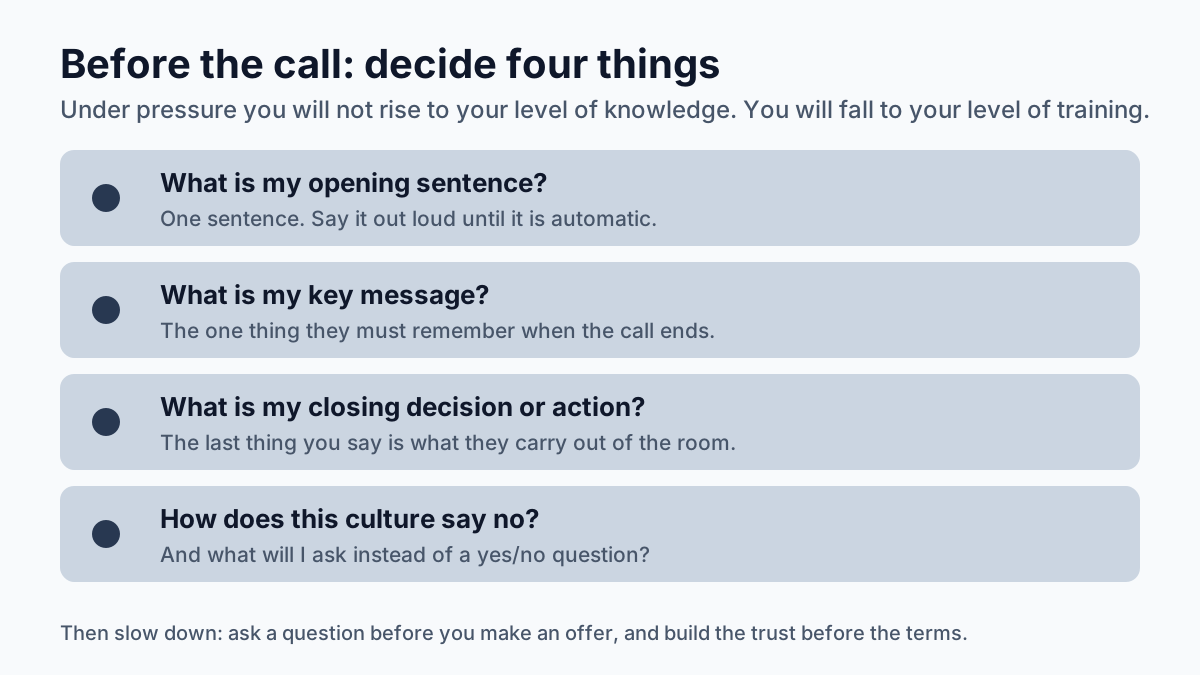
Decide four things before the call
Spend ten minutes with Geert Hofstede's six-dimensions model of national culture, which scores each country from roughly 0 to 100 on six dimensions, including how much hierarchy people expect (power distance). It shows you where the gaps are likely to be. The person shows you the rest.
Then prepare shorter structures, not longer scripts. Four questions:
- What is my opening sentence?
- What is my key message?
- What is my closing decision or action?
- How does this culture say no, and what will I ask instead of a yes/no question?
Under pressure you fall back on what is automatic. Make the open question automatic. This is the same preparation I use with clients at WorldView Training before a negotiation in English.
Culture tells you where to look. The person tells you what to do.
If you have an important negotiation coming up in English, send me a message. I'd be happy to help you prepare.
Frequently asked questions
How would you respond to cultural differences in the workplace?
Start by writing down your own defaults: how fast you answer, how you say no, how you show disagreement. Then change one behavior at a time and watch the reaction instead of performing a whole national stereotype. Erin Meyer's advice to first identify what is typical in your own culture applies to teams as much as to deals.
What is the difference between a tight and a loose culture?
In Michele Gelfand's 33-nation study published in Science, a tight culture has strong social norms and little tolerance for people who break them, and a loose culture has weaker norms and more tolerance. In a tight culture, follow the agenda, the hierarchy, and the formal steps; in a loose culture, expect more improvising.
Is it rude to disagree directly in a cross-cultural negotiation?
It depends on the culture, which is why Erin Meyer's first adjustment for cross-cultural deals is to change how you express disagreement. In English, a direct sentence often lands harder than the speaker intends, so soften the wording, keep the point, and check what the listener heard.
Sources reviewed
- PON (Harvard Law School) -- How to Negotiate in Cross-Cultural Situations Recommends negotiating culturally sensitive issues one at a time and cites the 2015 Paris climate talks' use of the South African 'indaba' consensus-building process as a real precedent for a non-Western negotiation format succeeding internationally.
- PON (Harvard Law School) -- How to Negotiate in Cross-Cultural Situations Cites former Secretary of State James Baker's Gulf War coalition negotiations, where his own interpreter told him to wait at a critical moment, as a caution against relying on the other side's interpreter without independent verification.
- PON (Harvard Law School) -- In Cross-Cultural Negotiations, Improve Your Awareness Reports psychologist Michele Gelfand's finding that the more impatient U.S. negotiators are in cross-cultural talks, the worse their financial outcomes tend to be, and that adapting to a slower-paced counterpart yields fewer concessions and stronger relationships.
- PON (Harvard Law School) -- Dealing with Cultural Barriers in Business Negotiations Reports Tufts University professor Jeswald Salacuse's caution, from his book 'Negotiating Life,' against overreliance on cultural research or stereotypes when reading an individual counterpart.
- PON (Harvard Law School) -- Dealing with Cultural Barriers in Business Negotiations Reports University of Waterloo professor Wendi Adair's research finding that negotiators often over-adjust toward a counterpart's presumed cultural style, creating new stereotypical misunderstandings rather than better communication.
- Erin Meyer's own site -- Mapping Out Cultural Differences on Teams Meyer states that to work well on a multicultural team, managers should first identify what is typical in their own culture but different from others' -- a first-party statement of her own framework's core method.
- Erin Meyer's own site -- Mapping Out Cultural Differences on Teams Meyer states that people often find it difficult to recognize their own culture ('just as a fish doesn't know it's in water') and that cultural diversity becomes a team's greatest asset only when 'managed with care.'
- Erin Meyer, 'Getting to Si, Ja, Oui, Hai, and Da,' Harvard Business Review, Dec. 2015 Meyer's article lays out five negotiation adjustments for cross-cultural deals: adapt how you express disagreement, know when to speak plainly versus read between the lines, learn how the other culture builds trust, avoid yes/no questions, and be careful about what you put in writing.
- geerthofstede.com -- The 6-D model of national culture Geert Hofstede's six-dimensions model (individualism, power distance, masculinity, uncertainty avoidance, long-term orientation, indulgence) scores each national culture on roughly a 0-100 scale, the original framework's own definitions from Hofstede's official site.
- Behavioral Scientist -- Tight and Loose Cultures: A Conversation with Michele Gelfand Gelfand describes 'cultural intelligence' (CQ) as a skill to cultivate alongside IQ and EQ, and says that once negotiators realize tight-loose norms are negotiable, it opens creative potential in a social setting.
- Stanford Graduate School of Business faculty page -- Michele J. Gelfand Michele Gelfand's official title is The John H. Scully Professor in Cross-Cultural Management and Professor of Organizational Behavior at Stanford Graduate School of Business.