
Direct communication puts the message in the words: the speaker says what they want, think, or decide, and the listener does not have to guess. Indirect communication puts part of the message outside the words, in tone, timing, silence, and shared context, so the listener has to read between the lines. The trouble starts when a speaker uses one style and the listener expects the other.
Here is the whole topic in one sentence from a session.
In a proposal role-play, a client of mine said: You are not our only client. True, and direct. But a customer hears: You're not that important to us. So we made a small change: We have other clients who deal with similar issues. Same basic idea. Completely different message.
The first version says the fact and the feeling out loud. The second still says the fact, and lets the feeling live in the tone instead of the words. That is the difference, and everything below is detail.
Where the two styles come from
The anthropologist Edward T. Hall described the two ends in 1976. In Beyond Culture he called them low-context communication, where the meaning is carried by the words, and high-context communication, where the meaning sits in the shared context and the nonverbal cues, and much is left unsaid. Direct and indirect are the everyday names for the same two ends.
Nobody is born on one end. The people around you train you onto it. Erin Meyer, a professor at INSEAD and the author of The Culture Map, says managers in different parts of the world are conditioned to give feedback in drastically different ways. Her example is a Dutch manager, who criticizes bluntly and in the open, next to a Chinese colleague, who avoids criticizing anyone in public.
Andy Molinsky, a professor of organizational behavior at Brandeis University, describes the indirect end this way: Chinese communicators often prefer to hint at something and let the listener "connect the dots" rather than state the message directly. Chinese workplace communication deserves its own post, so here I stay with the general pattern.
How each style sounds in a meeting
The fastest way to learn the difference is to hear both versions side by side.
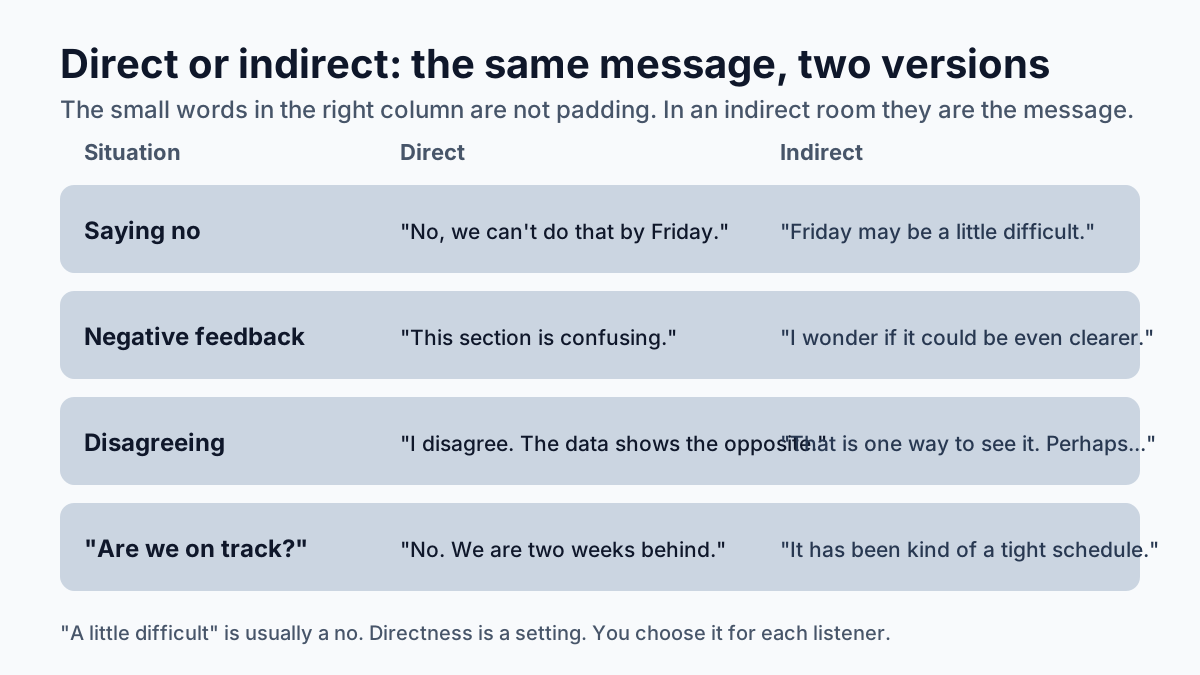
| Situation | Direct version | Indirect version |
|---|---|---|
| Saying no to a request | No, we can't do that by Friday. | Friday may be a little difficult. Let me see what is possible. |
| Giving negative feedback | This section is confusing. Please rewrite it. | This section is interesting. I wonder if it could be even clearer. |
| Disagreeing in a meeting | I disagree. The data shows the opposite. | That is one way to see it. Perhaps we could look at the data again together. |
| Answering "Are we on track?" | No. We are two weeks behind. | It has been kind of a tight schedule, and the team is working very hard. |
Read the indirect column again and watch the small words: may, a little, I wonder, perhaps, kind of. In a direct culture those words are padding. In an indirect culture they are the message. "A little difficult" is usually a no.
That is the trap for a non-native speaker. You learned the English words. Nobody taught you which words carry the real message in which room.
Why "thank you" can mean "we are not happy"
Indirect messages fail in one specific way: the listener hears the words and misses the signal. In a 2015 piece for Harvard Business Review, Molinsky and Melissa Hahn describe an American manager who received a polite thank-you email from a Japanese company about a delayed installation timeline and read it as approval. The company was signaling that it was unhappy with the delay.
The words said thank you.
The message said we are not satisfied.
The manager only heard the words.
In an indirect style, politeness with no enthusiasm is a warning, and a missing yes is a no. If you are the direct one in the exchange, the fix is one question, asked warmly: I want to make sure I understood. Does the new timeline work for you, or do you need us to change it?
Is direct communication always clearer?
Clearer to a direct listener, yes. To an indirect listener, direct speech can land as an attack. Molinsky's term for this is face threatening: direct communication can put someone in an awkward or uncomfortable social position, which can lead to shame or embarrassment. Once that happens, the listener stops working on your content and starts protecting themselves. Your clear message is now the least clear thing in the room.
So each style has a price. Direct speech solves the problem fast and risks the relationship. Indirect speech protects the relationship and risks the problem staying hidden for another month.
Guessing wrong is expensive. Grammarly Business and Harris Poll research estimates that miscommunication costs US businesses $1.2 trillion a year, and $12,506 per employee per year. For people working in a second language, the gap is measurable: in a 2023 Pearson survey of 5,000 non-native English speakers, only 10% of employees with limited English said they can fully express themselves at work, and 72% said their job would be easier with stronger English.
My reading of those numbers: the words are usually there. The missing skill is hearing which style is in the room and answering in a way both sides can use.
Which style should you use?
Match the listener, and decide in advance. Before a difficult conversation, answer three questions:
- What is the fact that must be clear? Say it in one plain sentence.
- What does the listener need to hear about the relationship? Say it in its own sentence, before the fact.
- What is the next action? Say it last, so it is what they remember.
A direct listener will thank you for the first answer. An indirect listener will hear the second and third, and will accept the first because you kept it separate and short.
This is what I use role-play for in WorldView Training sessions: the same message, said in both styles, out loud, until the switch takes no thought. Under pressure you use the style you trained. So train both.
Directness is a setting. You choose it for each listener.
Two lines for tomorrow. If you are the direct one in an indirect room: Before we move on, can I check that I have this right? If you are the indirect one in a direct room: My short answer is no. Here is why.
If you have an important presentation, meeting, or negotiation coming up in English, send me a message. I'd be happy to help you prepare.
Frequently asked questions
What are examples of indirect communication?
Softening words and hints that carry the real message: "Friday may be a little difficult" for no, "I wonder if this could be even clearer" for negative feedback, and a polite thank-you with no enthusiasm for "we are not satisfied." The listener is expected to read the signal, not only the words.
Can you give me an example of direct communication?
"No, we can't deliver by Friday. The earliest date is the following Tuesday." The decision, the reason, and the next step are all stated in the words, so the listener does not need to interpret tone or context.
Sources reviewed
- Edward T. Hall, Beyond Culture (1976) — original text via Internet Archive Hall's 1976 book Beyond Culture introduced the high-context/low-context communication framework distinguishing cultures that encode meaning explicitly in words from those relying on shared context and nonverbal cues.
- Erin Meyer (INSEAD professor), 'How to Say This is Crap in Different Cultures' Managers in different parts of the world are conditioned to give feedback in drastically different ways — Dutch managers favor blunt, transparent criticism while Chinese colleagues avoid public criticism.
- Andy Molinsky (Brandeis University), personal site Chinese communicators are often quite indirect, preferring to hint at something and let the listener 'connect the dots' rather than state a message directly.
- Andy Molinsky (Brandeis University), personal site Direct communication can be 'face threatening' in cultures that value indirectness because it can cause embarrassment or shame.
- Harvard Business Review, 'Learning the Language of Indirectness' (Molinsky & Hahn, 2015) An American manager misread a Japanese company's polite thank-you email as approval, when the company was actually signaling dissatisfaction with a delayed installation timeline through indirect language.
- Grammarly Business / Harris Poll, State of Business Communication research Miscommunication costs US businesses an estimated $1.2 trillion annually.
- Grammarly Business / Harris Poll, State of Business Communication research Poor workplace communication costs $12,506 per employee per year.
- Pearson / PSB Insights, Impact of English research (Oct 2023) Only 10% of employees with limited English skills feel they can fully express themselves at work (survey of 5,000 non-native English speakers globally).
- Pearson / PSB Insights, Impact of English research (Oct 2023) 72% of workers say their jobs would be easier with stronger English abilities.