
Cultural barriers are differences in the unspoken rules of communication (how direct to be, who speaks first, what silence means, how feedback is framed) that make a correct sentence land as something the speaker never meant. Examples: American positive feedback heard as praise in France, an unspoken Japanese no heard as a maybe, an interruption heard as disrespect, and a nonnative accent that costs a good idea its audience.
The sentence is usually correct. That is what makes the barrier hard to see.
In a proposal role-play, a client of mine said, "You are not our only client." The meaning was good: we have solved this problem before. The customer would hear: you are not that important to us. So we made a small change. "We have other clients who deal with similar issues." Same basic idea, completely different message.
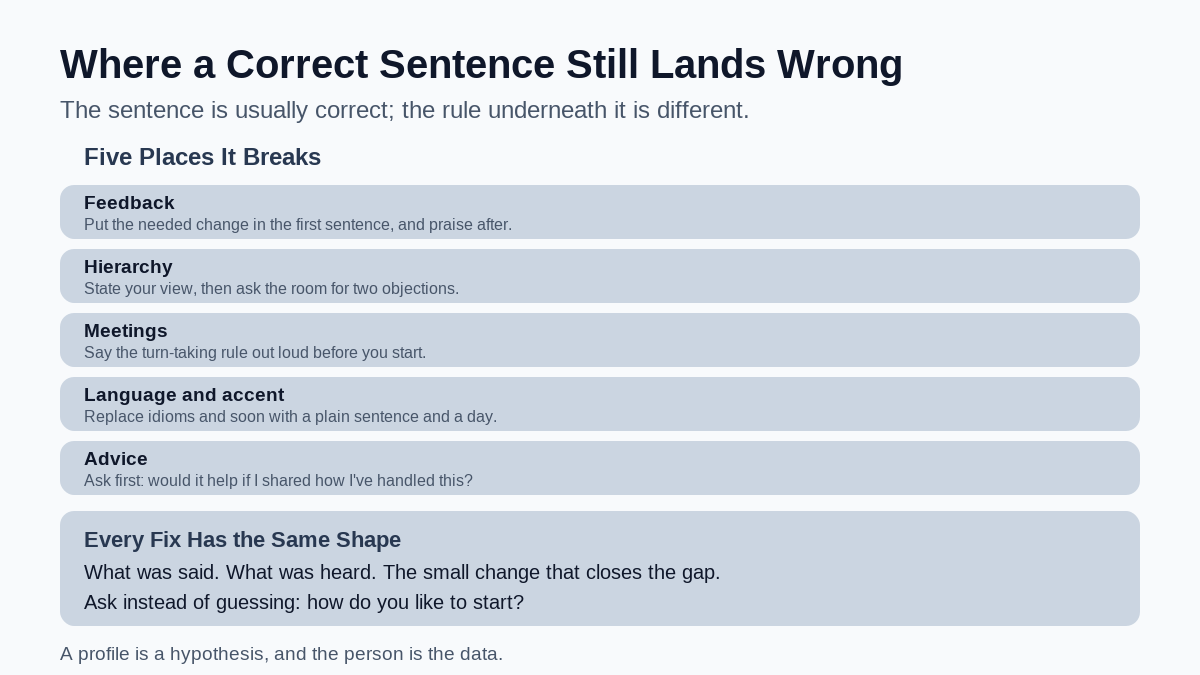
Every example below has that shape. What the speaker said. What the listener heard. The small change that closes the gap.
What a cultural barrier is, and what it is not
Grammar is rarely the barrier. The sentence is fine. The rule underneath it is different: how direct a person may be, whether a junior can disagree with a senior in public, how long a pause is comfortable, whether "yes" means agreement or only "I heard you."
Two well-known maps of those rules exist, and both are useful for the vocabulary. Erin Meyer, a professor at INSEAD who was named one of the fifty most influential business thinkers in the world by Thinkers50 in 2023, built The Culture Map around eight scales for decoding how culture shapes international collaboration. Geert Hofstede's six-dimension model of national culture is the other: Power Distance, Individualism, Masculinity, Uncertainty Avoidance, Long-term Orientation, and Indulgence.
Both maps tell you where two cultures sit. Neither tells you what to say on Tuesday at 9 a.m. That is what the examples are for.
Feedback: the compliment that was a warning
Meyer's book contrasts American feedback, wrapped in positive framing, with French feedback, which delivers the criticism directly, and names the pair as a documented source of workplace miscommunication. In a review, it sounds like this.
An American manager says: "This is strong work. I love where you took the structure. One small thing to look at is the cost section, but overall, great."
A French colleague hears: it is great. The cost section is a detail.
What the manager meant: fix the cost section before this goes anywhere.
The small change is the order. Put the thing you need changed in the first sentence, on its own: "The cost section needs to be rebuilt before Friday. The structure around it is strong, keep that." The praise is still there. The instruction can no longer hide behind it.
Now run it the other way. A French manager says: "This does not work." An American colleague hears: I have failed, and my manager is angry. What the manager meant: the draft is wrong, and I expect a better one, which is normal.
The small change for the French speaker: name the target before the verdict. "The goal is a two-page version. This one does not get there yet." Same judgment. The listener now knows what to do instead of how to feel.
Hierarchy: the boss who asked, and the team that worried
Meyer also notes that a Danish leader's egalitarian style can be read negatively by Russian counterparts. The leader who asks the room for direction is trying to include people. The room may be hearing something else.
A Danish leader says: "I don't have a fixed view on this. What do you all think we should do?"
A team used to strong hierarchy hears: this person has no plan.
The small change keeps the openness and adds a spine. "My direction is option B. Before I lock it in, I want two objections from this table." Now the leader has a position, which the room expects, and has still asked for the room's thinking, which the leader wants.
Meetings: the interruption and the silence
Meyer's book describes a meeting norm gap you can watch on any global call: American participants are more likely to interrupt, while Chinese participants are more likely to wait for their turn.
An American colleague jumps in halfway through a sentence. Meant: I'm engaged, I'm building on your point. Heard, by the person who was speaking: my turn is over, and it did not matter much.
A Chinese colleague waits for a clear opening that never comes. Meant: I will speak when it is my turn. Heard, by the Americans: no opinion on this one.
Two small changes, one for each side. If you chair the meeting, say the rule out loud at the top: "I will go around the table. Everyone gets one uninterrupted minute, then we discuss." If you are the one waiting, take the floor with a sentence that is polite and impossible to talk over: "Before we move on, I have one point to add."
Japan adds a second layer. Meyer's book cites the Japanese expectation of reading the air, which means picking up what was not said, and which Takaki, in the book, has to explain to his multinational colleagues. A pause, a slight tilt of the head, "we will consider it." A listener who cannot read the air hears a maybe. What was meant may have been a no.
You cannot learn to read the air in a week. You can change the question. Instead of "Is that OK?", which invites a polite yes, ask "What would need to change for this to work?" A no can now be said as a list.
Language: the word "soon" and the idiom that did not travel
The example that ranks everywhere is the word "soon." It deserves its place. "Soon" can mean this afternoon to one person and next quarter to another, and both people leave the call satisfied.
Idioms are the same problem in a nicer suit. "Let's circle back on that." "I'll take a stab at it." "We're not quite there yet." Each one is normal to the person saying it and a small puzzle for everyone else, who is now solving the puzzle instead of listening to the next sentence.
This is where I changed my mind. I used to think being a native English speaker was my advantage in global business. I don't think that anymore. The people who struggle most in global meetings are often the native speakers.
They speak fast. They use idioms. They assume understanding.
The small change for anyone, native or not: replace the idiom with the plan, and replace "soon" with a day. "I will send you the revised numbers by Thursday." One sentence, nothing to decode.
Accent: the idea that was heard but not listened to
This one has been measured. A study by researchers at UMass Amherst, ESSEC Business School, and Arizona State University, written up in Harvard Business Review in March 2026, found that at American firms, listeners pay less attention and engage less with speakers who have a nonnative English accent, even though expertise, evidence, and originality should in principle decide whose ideas get attention.
The four authors, Aliah Zewail, Amir Sepehri, Reihane Boghrati, and Mohammad Atari, put it plainly in Harvard Business Review: "In principle, expertise, evidence, and originality should objectively determine whose ideas garner attention. In practice, however, influence often depends on something far less visible: a speaker's accent."
Read that as a manager with a meeting on Thursday. The barrier is in the listener's ear, and you cannot rebuild the listener's ear before then. You can make your idea easier to hold.
Say how many points you have before you make them: "I have two points. The first is cost." Slow down by about ten percent for the first minute, then let the pace return. Pause at the full stop. Put your key sentence at the beginning and again at the end, because openings and closings are what people remember and the middle is not. Send a three-line summary afterward, in writing, where there is no accent.
Most of my coaching at WorldView Training is with managers whose English is already good. The work is what the listener hears: structure, order, the first sentence and the last.
Advice: "let me help" heard as "you can't"
Namrata Goyal of Esade Business School and Krishna Savani of Hong Kong Polytechnic University, writing in Harvard Business Review in August 2026 about research Goyal ran with colleagues across the United States, China, and India, report that people from different cultures hold different assumptions about what makes workplace advice helpful, respectful, and supportive.
A senior colleague says: "Here is how I would run that client call." Meant, in the giver's culture: I care about your success. Heard, in the receiver's: you do not trust me to run my own call.
The small change costs four seconds. Ask first. "Would it help if I shared how I have handled a call like this?" A yes makes the advice welcome. A no tells you something about the person that no country profile could.
Gestures and faces: the channel that video calls cut anyway
A gesture that means "good" at home can mean something rude on another continent, and the amount of eye contact that reads as honest in one room reads as a challenge in another. Most lists of cultural barriers include this, and it is true.
It is also less useful than it looks for a manager who works on video. A camera crops your hands. A grid of nine faces hides most of the eyes. The safe rule, on a call or in person, is to put the meaning into words. "I agree with that." "I have a concern." "Please go ahead." The listener no longer has to decode your face.
The barrier you build yourself: adjusting to a stereotype
There is a barrier that no country profile predicts, because it comes from the profile.
Harvard's Program on Negotiation, summarizing research by Wendi L. Adair of the University of Waterloo on American and Japanese negotiators, describes the pattern as a mutual adjustment that goes too far, and illustrates it with a Brazilian and a German: the Brazilian expects the German to skip the small talk, while the German, having read that Brazilians want relationship-building first, is left feeling rebuffed when she hurries the talks. Each side adjusts to a stereotype of the other. Neither meets the person in the room.
It gets worse under pressure. Michael W. Morris of Columbia University found that negotiators under time pressure and other demands on their attention are more likely to fall back on cultural stereotypes instead of reading the individual across the table. And guidebooks such as Frank L. Acuff's How to Negotiate Anything with Anyone Anywhere Around the World (Amacom, 3rd edition, 2008) supply exactly those country generalizations, Germans reserved and hard-bargaining, Mexicans expressive and slow to get down to business, which is why newer research warns that negotiators may give too much weight to cultural factors and misjudge the one German or the one Mexican they are talking to.
In a sentence: a profile is a hypothesis, and the person is the data.
The small change is to ask instead of guess, before the agenda: "How do you like to start? Straight into the numbers, or a few minutes first?" The answer takes five seconds and replaces the stereotype with a fact.
Why working through the barrier pays
The cost of ignoring all this is measurable, and so is the reward. Negotiation research summarized by the same Harvard program found that cross-cultural pairs with poor communication reach worse outcomes than same-culture pairs. The smaller group of cross-cultural pairs who got past the communication problem reached better and more creative agreements than the same-culture pairs did.
Two people who share a culture agree quickly and stop. Two people who had to explain themselves to each other end up with more on the table. The barrier, worked through, becomes the advantage.
How many types of barriers are there?
Search for it and you will find lists of five types and lists of twelve. The number depends on who is counting.
For a working manager, the type matters less than the moment. Barriers bite in four places: in feedback, in the meeting itself, in the small talk before the agenda, and in the listener's ear. Every example above sits in one of those. If you know which moment you are walking into, you know which small change to bring.
What to say tomorrow
Prepare shorter structures, not longer scripts. Before a cross-cultural meeting, answer three questions: What is my opening sentence? What is my key message? What is my closing decision or action?
Then carry these in your pocket.
- To open with a culture you do not know: "How do you like to start? Straight into the agenda, or a few minutes first?"
- To give feedback that cannot hide: "The cost section needs to be rebuilt by Friday. Everything around it is strong."
- To take the floor without interrupting: "Before we move on, I have one point to add."
- To let a no be said: "What would need to change for this to work?"
- To offer advice without insulting: "Would it help if I shared how I have handled this?"
- To replace "soon": "You will have it by Thursday."
Under pressure, people fall to their level of training, and the line you have said twenty times is the one that comes out. Pick one line from that list and use it this week until it is automatic.
If you have an important presentation, meeting, or negotiation coming up in English, send me a message. I'd be happy to help you prepare.
Frequently asked questions
What are some examples of cultural boundaries?
A cultural boundary is a line a culture draws around what is acceptable: which topics are fine in a first meeting, whether a junior person may disagree with a senior in public, how much silence is comfortable, and how direct a no can be. A barrier appears when two people bring different lines into the same conversation and neither knows it.
What are the five types of barriers?
Lists online count barriers in fives or twelves, and the number depends on the author. For a working manager the useful split is by moment rather than type: feedback, the meeting itself, the small talk before the agenda, and the listener's ear, and most misunderstandings mix two of those at once.
What is a culture barrier?
A culture barrier is a mismatch in unspoken communication rules (how direct to be, who speaks first, what silence means, how feedback is framed) that makes a correct sentence land as something the speaker never meant. Both people usually leave the conversation believing it went fine, which is why the barrier is hard to spot.
Sources reviewed
- Erin Meyer / INSEAD — The Culture Map (book page)
- Erin Meyer / INSEAD — The Culture Map (book page)
- Erin Meyer / INSEAD — The Culture Map (book page)
- Erin Meyer / INSEAD — The Culture Map (book page)
- Erin Meyer / INSEAD — The Culture Map (book page)
- Erin Meyer's own site — author bio
- The Culture Factor Group (Hofstede Insights) — organization site
- Harvard Business Review — "Research: How the 'Accent Penalty' Determines Who Gets Heard" (Zewail, Sepehri, Boghrati, Atari; Mar 17, 2026)
- Harvard Business Review — "What to Consider Before Giving Advice on a Global Team" (Goyal & Savani, Aug 3, 2026)
- Harvard Program on Negotiation — "Cross-Cultural Communication in Business Negotiations"
- Harvard Program on Negotiation — "Managing Cultural Differences in Negotiation"
- Harvard Program on Negotiation — "Managing Cultural Differences in Negotiation"
- Harvard Program on Negotiation — "How to Overcome Cultural Barriers in Negotiation" (citing Frank L. Acuff)