
Real-life cross-cultural communication examples include Chinese managers who read talkative American colleagues as unprepared, a French employee who missed the criticism hidden behind American-style praise, an Indonesian "yes" that turned out to mean no, and negotiators from Mexico or Thailand softening a firm no to "I disagree a little." In each case the gap comes from a habit, and habits can be trained.
I used to think being a native English speaker was my edge in global business.
I don't think that anymore. The native speakers are often the hardest people in the room to follow. They speak quickly. They use slang. They assume everyone understood. And the non-native speaker who planned one clean sentence often ends up leading the meeting.
Cross-cultural communication is how people from different cultural backgrounds share meaning, in words and in body language. Most articles illustrate it with greetings: a handshake in one country and a bow in another, a compliment accepted with "thank you" in one office and waved away with modesty in the next. Those examples are real. They are also cheap. A wrong greeting costs an awkward second and is forgotten by lunch.
The examples that cost deals and promotions happen once the meeting starts. They come from published research, plus two moments from my own coaching sessions.
Example 1: the meeting where each side thought the other was unprepared
In a February 2025 podcast interview with Adam Grant, INSEAD professor Erin Meyer, author of The Culture Map, described Chinese managers who prepared for hours before meetings with American colleagues, then watched those colleagues take over the room.
The managers put it like this: "We prepare, you know, for hours before these meetings. And then we go into these meetings and our Western colleagues, or our American colleagues, they're just interested in showing off their knowledge."
Now read the same meeting from the American side of the table. The colleagues from China said very little, so the Americans read them as disengaged.
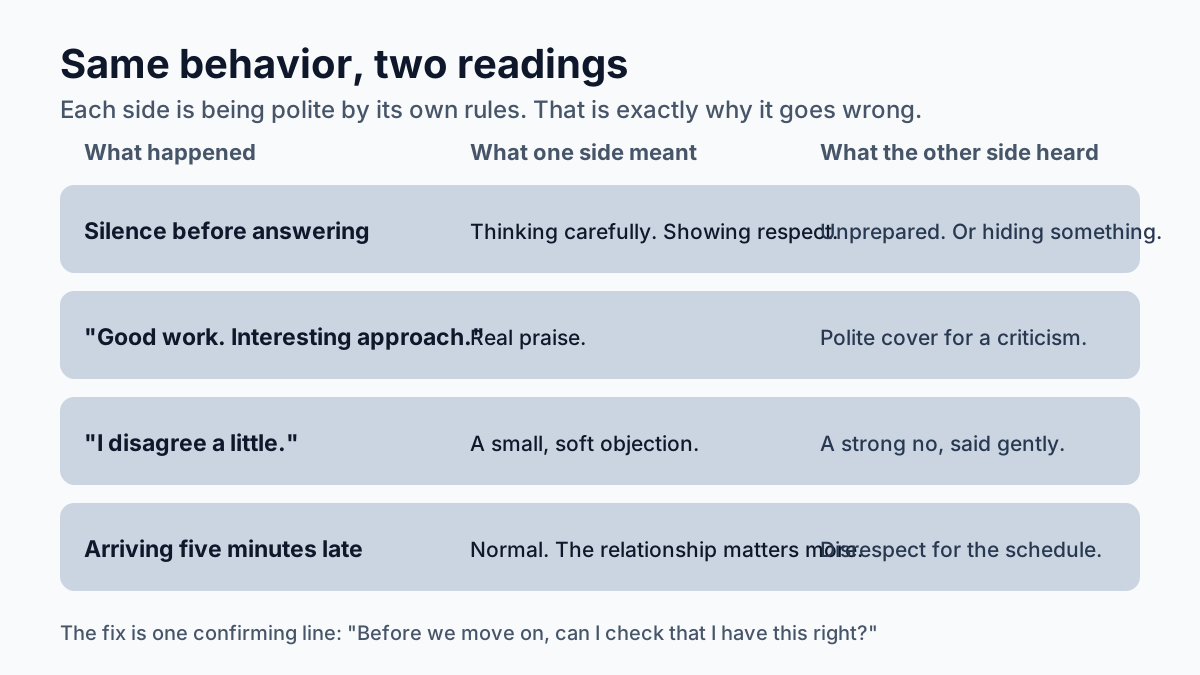
To one group, being prepared looks like listening. To the other, being prepared looks like speaking up. What the Chinese side heard: you did not respect us enough to prepare. What the American side heard: you have no opinion. Neither message was ever sent.
Example 2: the praise that hid the criticism
In the same interview, Meyer described a French employee receiving American-style feedback. The American habit is to open with something positive and put the criticism after it. The French employee took the opening praise as the whole message and missed the part that mattered.
Here is how that sounds in practice. The manager says: Really strong deck, and one thing we could tighten is the pricing slide. The employee hears: Strong deck. The pricing slide never changes, and three weeks later the manager believes the employee ignored feedback.
Nobody was careless. The manager followed an American rule for kindness. The employee followed a French rule for what counts as a message.
Example 3: "I disagree a little" does not mean a little
Meyer's negotiation research in Harvard Business Review found a clear pattern in how people voice disagreement. Negotiators from Russia, France, Germany, Israel and the Netherlands tend to use upgraders, words that strengthen a disagreement, such as "I completely disagree." Negotiators from Mexico, Thailand, Japan, Peru and Ghana tend to use downgraders, such as "I disagree a little bit." Either side can misjudge how firm the other one is.
Picture a Dutch project lead and a Thai supplier on a call about a delivery date. The supplier says: I think maybe this is a little difficult. The Dutch lead hears a small concern and moves on. The supplier meant: this date is impossible.
The same article warns that in some cultures the word "yes" is used when the real meaning is no. Meyer's example is an Indonesian supplier who told a Danish executive, to his face, that a deadline was feasible, then wrote a few days later that it was not. Her rule: avoid yes/no questions, and when you must ask one in Southeast Asia, Japan, or Korea, watch for the extra beat of silence or the "we will try" that means no.
Why does the same behavior read so differently on each side?
Two frameworks explain most of the examples above.
The first is context. Meyer sorts cultures by how much of the message lives in the words themselves. Low-context cultures such as the U.S., Germany and the Netherlands treat good communication as precise and explicit, understood at face value. High-context cultures such as Japan, India and France expect the listener to read between the lines. Put one of each in a room and both will feel the other is doing it wrong.
The second is hierarchy. Geert Hofstede's model of national culture defines power distance as the extent to which less powerful members of organizations accept and expect that power is distributed unequally. A junior employee from a high power-distance culture may never contradict a manager out loud. A manager from a low power-distance culture reads that silence as agreement.
Neither framework predicts what one person will do. Both tell you what to check before you assume.
Examples 4 and 5: one border, two speeds, and five minutes late
Cultural gaps do not need an ocean between them. Lionel Laroche, then president of MultiCultural Business Solutions, told SHRM in 2016: "In the United States, [line managers] want change quickly, they have a 'go big or go home' mentality. However, Canadian bosses want gradual change." An American manager pitching a full restructure to a Canadian team may hear polite questions and think she is winning. She may be losing.
The same article lists smaller habits that turn into resentment: a grace period SHRM's write-up puts at about five minutes for a meeting start in North American workplace culture, against more flexible timing elsewhere, and eye-contact norms that differ from one culture to the next. Some people were taught to hold eye contact with a senior person. Some were taught to lower it.
Winston Mclean, a cross-cultural awareness consultant quoted in the same article, named the bigger risk: "Racism does exist [in the workplace], and you have to deal with it. More often than not, it is profound miscommunication." The wrong diagnosis leads to the wrong fix. If a team reads a timing habit as disrespect, no grammar course will repair it.
Two examples from my own sessions
A client from China once asked me when to say I would like to tell you about… and when to say I would love to tell you about…. Small question, big difference. "Would like" signals structure: here is my agenda. "Would love" signals enthusiasm: I care about this. The client was choosing how warm the opening should be, which is a leadership decision, and making it in a second language.
A second client, preparing a proposal, said in a role-play: You are not our only client. That can easily sound like: you are not that important to us. So we made a small change: "We have other clients who deal with similar issues." Same basic idea, but a completely different message.
What these examples cost, and what they pay
Grammarly Business and The Harris Poll estimated that poor communication costs U.S. businesses about $1.2 trillion a year, or $12,506 per employee. The examples above are the expensive kind, because each one hides for weeks before anyone notices.
The upside is measurable too. In a 2018 BCG survey of more than 1,700 companies across eight countries, leadership teams with above-average diversity reported 45% of revenue from innovation, against 26% for teams with below-average diversity. That gap only pays if the people in the room can understand each other when they disagree.
This is the work WorldView Training does in live sessions: take one meeting a manager has next week and rehearse the two or three moments where one of the patterns above could go wrong, until the sentences are automatic. The phrase-by-phrase techniques live in the companion post on cross-cultural communication strategies. Here, one line is enough to start.
One line to carry into tomorrow's meeting
If you are the fluent speaker, or the senior person, say this before you give your view: I'd like to hear your thinking first.
Then wait. Count to five if you have to. The prepared, quiet side of the table finally gets to speak, and you get the information you were about to talk over.
If you have an important presentation, meeting, or negotiation coming up in English, send me a message. I'd be happy to help you prepare.
Frequently asked questions
Can you give me an example of a cross-cultural experience?
A manager from China presenting in English to an American team is a cross-cultural experience even when everyone speaks English well, because each side follows different rules for how much to say, how to disagree, and how to give feedback.
Can you give me an example of culture that is learned?
How you voice disagreement is learned. Negotiators from Russia, Germany and the Netherlands tend to strengthen it ("I completely disagree") while negotiators from Mexico, Thailand and Japan tend to soften it ("I disagree a little bit"), and both habits can be adjusted for a specific meeting.
Sources reviewed
- Erin Meyer, "Navigating the Cultural Minefield," Harvard Business Review, May 2014 Low-context cultures (U.S., Germany, Netherlands) treat good communication as precise, simple, explicit and understood at face value; high-context cultures (China, India, France) treat it as layered, with reading between the lines expected.
- Erin Meyer, interviewed on "Decoding cross-cultural communication with Erin Meyer," ReThinking with Adam Grant / WorkLife (TED Audio Collective), Feb 25, 2025 Real example: Chinese managers described preparing for hours before meetings, then watching American colleagues dominate discussion by showing off their own knowledge, which each side read very differently.
- Erin Meyer, interviewed on "Decoding cross-cultural communication with Erin Meyer," ReThinking with Adam Grant / WorkLife (TED Audio Collective), Feb 25, 2025 Real example: a French employee who received American-style feedback (positive framing before the critique) mistook the opening praise for the whole message and missed the constructive criticism embedded after it.
- Erin Meyer, "Getting to Si, Ja, Oui, Hai, and Da," Harvard Business Review, December 2015 Negotiators from Russia, France, Germany, Israel, and the Netherlands tend to use upgraders when voicing disagreement, while negotiators from Mexico, Thailand, Japan, Peru, and Ghana tend to use downgraders, which can cause either side to misjudge how firmly the other disagrees.
- Catherine Skrzypinski, "How to Bridge Workplace Issues That Arise from Cultural Differences," SHRM, May 2, 2016 -- quoting Lionel Laroche, Ph.D., President, MultiCultural Business Solutions Lionel Laroche, Ph.D., President of MultiCultural Business Solutions, on management style: "In the United States, [line managers] want change quickly, they have a 'go big or go home' mentality. However, Canadian bosses want gradual change."
- Catherine Skrzypinski, "How to Bridge Workplace Issues That Arise from Cultural Differences," SHRM, May 2, 2016 -- quoting Winston Mclean, cross-cultural awareness consultant Winston Mclean, a cross-cultural awareness consultant, on friction that looks like bias: "Racism does exist [in the workplace], and you have to deal with it... More often than not, it is profound miscommunication."
- Catherine Skrzypinski, "How to Bridge Workplace Issues That Arise from Cultural Differences," SHRM, May 2, 2016 SHRM cites everyday friction points such as differing meeting-time norms (a roughly five-minute grace period in North American workplace culture versus more flexible timing norms elsewhere) and differing eye-contact norms across cultures.
- Boston Consulting Group, "How Diverse Leadership Teams Boost Innovation," January 2018 In a survey of roughly 1,700 companies across eight countries, companies with above-average diversity on their leadership teams reported 45% of revenue from innovation versus 26% for companies with below-average leadership diversity.
- Grammarly Business and The Harris Poll, "The State of Business Communication: New Threats and Opportunities," 2023 Poor communication costs U.S. businesses an estimated $1.2 trillion annually, or $12,506 per employee per year.
- Geert Hofstede and Gert Jan Hofstede, "The 6 Dimensions Model of National Culture," official Geert Hofstede site Power Distance is defined as the extent to which the less powerful members of organizations and institutions accept and expect that power is distributed unequally; Individualism is defined as the extent to which people feel independent rather than interdependent members of larger groups.