
A compromising negotiation style is the split-the-difference approach: each side gives up part of what it asked for, so both get part of what they wanted, fast. It is one of the five conflict modes in the Thomas-Kilmann Conflict Mode Instrument. It fits small, time-limited decisions. It is a poor fit for high-stakes deals, because a quick middle number leaves each side's underlying interests untouched.
The simplest picture of it comes from Ralph Kilmann, one of the two people who built the model. One person wants to meet at 9 a.m. The other wants 4 p.m. They agree on noon. Nobody got the time they wanted. The meeting is on the calendar, and both people walk away a little short.
In global work the same thing happens across time zones. The US East Coast wants 9 a.m. That is evening in Ho Chi Minh City. Someone proposes 7 a.m. Eastern, and both sides say yes with a small sigh. That sigh is the sound of compromise.
Where the five styles come from
The model behind the phrase is older than most people in the meeting. Kenneth W. Thomas and Ralph H. Kilmann met at UCLA in 1970, finished their research article in 1973, and in 1974 Xicom published their instrument as a sixteen-page booklet. It became the Thomas-Kilmann Conflict Mode Instrument, usually shortened to the TKI.
The TKI measures how a person handles conflict across five modes: competing, collaborating, compromising, avoiding, and accommodating. Negotiation writers borrowed the five names, and compromising is the one most people recognize from their own behavior.
The list of organizations using the assessment is long. Ralph Kilmann's own company, Kilmann Diagnostics, lists NASA, the Bank of England, and the World Health Organization among its clients. So when a manager at a global company says "I scored high on compromising," this is the test she means.
Each mode has a sentence that gives it away in a meeting. The words are mine; the five names are the TKI's.
| Mode | The sentence you hear |
|---|---|
| Competing | That is the number. Take it or we move on. |
| Collaborating | Before we talk price, tell me what this needs to do for you. |
| Compromising | Let's meet in the middle and call it done. |
| Avoiding | Let's come back to this next quarter. |
| Accommodating | Fine. We will do it your way. |
Collaborating deserves its own post, and it has one in this series. This one stays on the middle row.
What compromising gives each side
Kilmann's definition is short: "Compromising is each person getting PARTIALLY satisfied, but not completely satisfied." The capitals are his. He gives the numbers as a 50/50 or a 75/25 split, and he contrasts both with collaborating, which aims for what he calls 100/100: both sides fully satisfied.
That 75/25 figure matters, because most people assume a compromise means an even split. It does not. A compromise can be lopsided and still be a compromise. Any ratio counts, as long as both sides gave something up and neither got everything.
So when you hear "we split the difference," ask which difference. If you opened at 60,000 and the buyer opened at 40,000, the middle is 50,000. If the buyer opened at 40,000 and you had already come down to 52,000, "the middle" is now 46,000. The other side moved the middle by moving their story of where it started.
That is why I ask my clients to say the two starting numbers out loud before they agree to a middle. In English, the line is plain:
To be sure we mean the same thing: you started at 40 and we started at 60. Halfway is 50. Is that the number we are talking about?
What "let's meet in the middle" sounds like across the table
The math is the easy part of compromising. The hard part is what the sentence tells the other side about you.
The shape I use with clients is always the same: what you said, what they heard, and the small change.
You said: "Let's just split the difference." They heard, in a room where bargaining is the normal way to buy: "My first number had room in it. Push again and there is more." The small change: "I can move to 52 if the payment terms move to 30 days." Now you traded, and a trade cannot be pushed the same way.
You said: "Let's meet in the middle," in the first five minutes. They heard: "I did not want to be here long. I will pay to leave." The small change: "Before we talk numbers, tell me which matters more to you on this order: the price, the date, or the scope." Ask first. Then, if a middle still makes sense, propose it.
You said: "OK, fine. Deal." Fast, flat, no pause. They heard: "She is unhappy and this will be slow to deliver." The small change: "We can accept that price. In return, delivery moves to March." The words "in return" turn a surrender into a compromise, and they take two seconds to say.
One of these is real, from a proposal role-play with a client. The client's line was You are not our only client. It can easily sound like: you are not that important to us. So we made a small change: "We have other clients who deal with similar issues." Same basic idea, but a completely different message.
The pattern in all four is the same. A compromise sounds honest to the person saying it and reads as a signal to the person hearing it. Non-native speakers are often better at this than natives, because they choose their words on purpose instead of reaching for the phrase they grew up with.
Is compromising the most common negotiation style?
You will read online that compromising is the most common style, or the second most common, or the one "most people default to." Kilmann says that ranking makes no sense. In his words: "It doesn't make sense to try to say that one mode is used more frequently than the other modes across the board (as if it's the Number 1 used mode), while another mode is Number 2, etc."
The reason is how the test works. The TKI measures how much you rely on each of the five modes relative to your other four. It does not count how often people in general compromise. So the honest answer to "is this the most common style" is that the instrument cannot tell you, and anyone who says it can is reading a different test.
What you can know is your own pattern. If you reach for the middle number every time a conversation gets tense, that is a habit, and under pressure a habit wins over knowledge every time.
When to compromise, and when it costs you
Compromising earns its place in four situations: when the issue is small, when the clock is short, when a temporary fix is acceptable, and when the two sides are stuck and nothing else has moved them. In each of those, a fast middle is a good outcome. A supplier and a buyer arguing over a 2 percent freight charge on a one-time order should split it and go to lunch.
The cost shows up when the issue is large. Katie Shonk, writing for the Program on Negotiation at Harvard Law School, put it this way: "Although a compromising conflict style can shake things up, the resolution is often short-lived because it doesn't account for the root issues at stake."
The same program lists the common pitfalls: temporary solutions, outcomes that satisfy no one fully, and agreements that ignore the deeper interests on both sides. It also grants the upside, that compromising resolves minor issues efficiently. Both halves are true. The skill is knowing which half you are in.
On a sales floor the downside looks like this. A buyer wants a 15 percent discount. You want full price. You settle at 7.5. Both of you feel reasonable.
You keep the deal. You lose the margin. You get the same call next quarter, and now 7.5 is the new starting point.
None of that means compromising is wrong. G. Richard Shell, in his book Bargaining for Advantage, maps negotiators onto five styles, compromising among them, and argues that no single style is right for every negotiation. The trouble starts when one style gets used in every room.
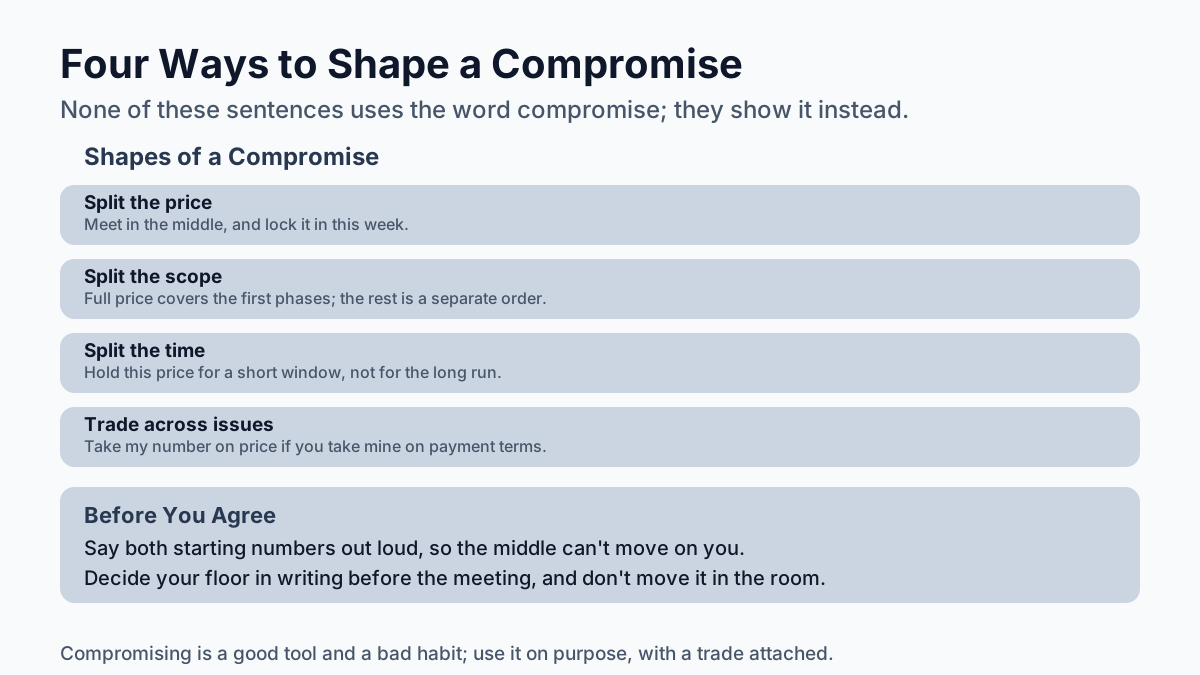
Four shapes a compromise can take
People ask about "types of compromise" as if there were a list in a textbook. There is no such list in the TKI. In practice, though, a compromise takes one of four shapes, and each has its own sentence in English.
Split the price. Halfway between us is 50. I can do 50 if we sign this week.
Split the scope. At that price we deliver phases one and two. Phase three is a separate order.
Split the time. We can hold that price for six months, not twelve.
Trade across issues. I will take your number on price if you take mine on payment terms. This last one is the strongest of the four, because both sides get the thing they cared about most. It is also the door into collaborating, which belongs to the sibling post, so I will leave it there.
Notice that none of these sentences uses the word "compromise." In English, saying I'm willing to compromise is a weaker move than showing the compromise. The word invites the other side to name your concession for you. The sentence names it yourself.
In WorldView Training sessions we run these four sentences as drills, with a partner playing the buyer who keeps pushing, until the reply comes out without a pause. The pause is where the other side hears doubt.
What not to do when you compromise
Do not open with the middle. If your first sentence is let's meet in the middle, you have skipped the part where you learn what the other side wants, and you have told them your opening number was padded.
Do not split before you ask why. Help me understand what is behind the 40,000 costs you nothing and often shows that the number is about cash flow or timing, both of which you can solve without giving up price.
Do not accept with a flat "fine." A flat yes in English sounds like a no you have decided not to say. Add the trade: "Yes, and in return we need the deposit on signing."
Do not compromise below your floor. Decide the floor before the meeting, in writing, and do not move it in the room. The room is the worst place to make that decision, because the pressure changes how you think before you notice it.
If someone asks me for the number one rule of negotiation, that is it. Decide in advance. Before any negotiation in English, I ask my clients to write three lines and nothing more:
What is my opening sentence? What is my floor, the number below which I say thank you and leave? What is the one thing I can trade?
Three lines is enough. A script breaks the moment the other side says something you did not plan for. Three lines survive.
When to walk away, and how to say it
Walk away when the middle is below your floor, when the other side moves the middle after you agreed to it, or when every concession you make is met with a new request and none of yours are returned. Those are the moments when compromising stops being a style and becomes a leak.
The walk-away line in English should be short and final:
Thank you for the time today. This is below what we can do. If the numbers change on your side, please call me first.
Say it, stop talking, and let the silence sit. Non-native speakers often fill that silence with an apology. Do not. The silence is doing the work.
If your jaw tightens before you say a number, that is normal. Try this before you speak:
- Close your mouth and breathe in through your nose for two counts.
- Breathe out through your mouth for four.
- Say the number. Then stop.
It takes ten seconds. The number lands harder when it is not rushed.
Compromising is a good tool and a bad habit. Use it on purpose, for small things, with a trade attached, and it will close deals quickly without teaching the other side to push. Use it by reflex and it will cost you a little every quarter.
If you have an important presentation, meeting, or negotiation coming up in English, send me a message. I'd be happy to help you prepare.
Frequently asked questions
What are the five main negotiation styles?
The Thomas-Kilmann Conflict Mode Instrument names five modes: competing, collaborating, compromising, avoiding, and accommodating. Negotiation writers use the same five names, and G. Richard Shell's Bargaining for Advantage also maps negotiators onto five styles.
What are the four main negotiation styles?
Both the TKI and Shell's framework count five styles: competing, collaborating, compromising, avoiding, and accommodating. When you see a four-item list, check it against those five so you know which one is missing before you use it.
What not to do when negotiating?
Do not open with "let's meet in the middle," do not split a difference before asking what is behind the other side's number, and do not move your floor inside the room. Decide the floor in writing before the meeting.
When should you walk away from a negotiation?
Walk away when the middle is below the floor you set in advance, when the other side moves the middle after you agreed, or when your concessions are never returned. Say it briefly ("This is below what we can do") and then stop talking.
Sources reviewed
- Kilmann Diagnostics — A Brief History of the Thomas-Kilmann Conflict Mode Instrument
- Kilmann Diagnostics — Brief Overview of the TKI Assessment
- Kilmann Diagnostics — Brief Overview of the TKI Assessment
- Kilmann Diagnostics — Compromising and Collaborating
- Kilmann Diagnostics — Which Conflict Mode Is Used Most Frequently?
- Harvard Program on Negotiation — Conflict-Management Styles: Pitfalls and Best Practices
- Harvard Program on Negotiation — Conflict Styles and Bargaining Styles