
A collaborative negotiation style is an approach where both sides work on the problem together until they find an agreement that fully meets each side's needs, instead of trading concessions until each gets half. On the Thomas-Kilmann map of five conflict modes, it is the one that is high in both assertiveness and cooperativeness: you push for what you need and work as hard for theirs.
That second half is the part people miss.
Many people hear "collaborative" and think "soft." The opposite is true. Collaborating is the most demanding mode on the map, because you hold your own needs and the other side's needs in your head at the same time, in a second language, while the clock runs.
The good news is that it is a set of moves, and moves can be practiced.
Where the five negotiation styles come from
"Collaborative" is one of five names on a map that most negotiation courses borrow from conflict research. The Thomas-Kilmann Conflict Mode Instrument, usually shortened to TKI, plots five ways of handling conflict on two scales. Assertiveness is how hard you push for your own concerns. Cooperativeness is how hard you work to satisfy the other person's.
| Mode | Assertiveness | Cooperativeness | What it sounds like in a meeting |
|---|---|---|---|
| Competing | High | Low | "That is our number. Take it or leave it." |
| Collaborating | High | High | "Tell me what has to be true for this to work on your side. Then I will tell you mine." |
| Compromising | Middle | Middle | "Meet me halfway." |
| Avoiding | Low | Low | "Can we come back to this next quarter?" |
| Accommodating | Low | High | "Fine. We will do it your way." |
Kenneth W. Thomas and Ralph H. Kilmann began building the instrument at UCLA in 1970, and the publisher Xicom published it in 1974 as a 30-item questionnaire you score yourself. Each item shows two statements and makes you pick one.
The pairs were written to look equally attractive, and that design choice is why the test is trusted. The developers report that earlier instruments carried response bias above 90 percent, because people chose the answer that made them look nicer. Pairing the statements brought it down to 17 percent.
The scoring has been rebuilt since. The U.S. norms were re-based in 2007 on 8,000 respondents, and a 2011 international study covered 6,168 people in 16 countries. The 2007 sample of 8,000 was drawn from the 59,000 people who had taken the TKI online by then.
The map matters because it tells you what collaborating is. The TKI defines it as working with the other party to find a solution that fully satisfies both sides' concerns. Compromising, the mode next to it on the map, only partially satisfies both. Many "four negotiation styles" lists are this same map with one mode left off.
(When to compromise on purpose, and how "let's meet in the middle" lands in different cultures, is a separate post on the compromising style.)
The two moves that make it collaborative
A position is what you ask for. An interest is why you ask for it.
"We need delivery by March 1" is a position. "Our line stops if the parts are late, and a stopped line costs more than the parts" is the interest behind it. Two positions can be impossible to fit together while the interests behind them fit easily.
Maybe the parts ship in two batches. Maybe a loaner stock covers the gap. You only find that out at the second level.
Lawrence Susskind, a professor at MIT and vice chair of the executive committee of Harvard Law School's Program on Negotiation, is direct about what kills that second level. Harvard's Program on Negotiation, summarizing his book, puts it this way: when you communicate one-sided information about a project's merits, you come across as arrogant and oblivious to the other party's concerns.
His answer has two parts.
The first is joint fact-finding. Agree on the facts together, sometimes with an outside expert both sides trust, before anyone argues about what to do with them. The second is to put several trade proposals on the table at once, so the other side reacts to a menu instead of a single offer they can only accept or refuse.
For a non-native speaker, both moves carry a hidden benefit. Joint fact-finding moves the argument onto numbers and documents, where your English is not the bottleneck. Multiple proposals let you write the language before the meeting, when you have time, instead of building sentences under pressure.
What are the four steps of collaborative negotiation?
People ask for steps. Here are the four I teach, in the order the work happens, each with the sentence that starts it.
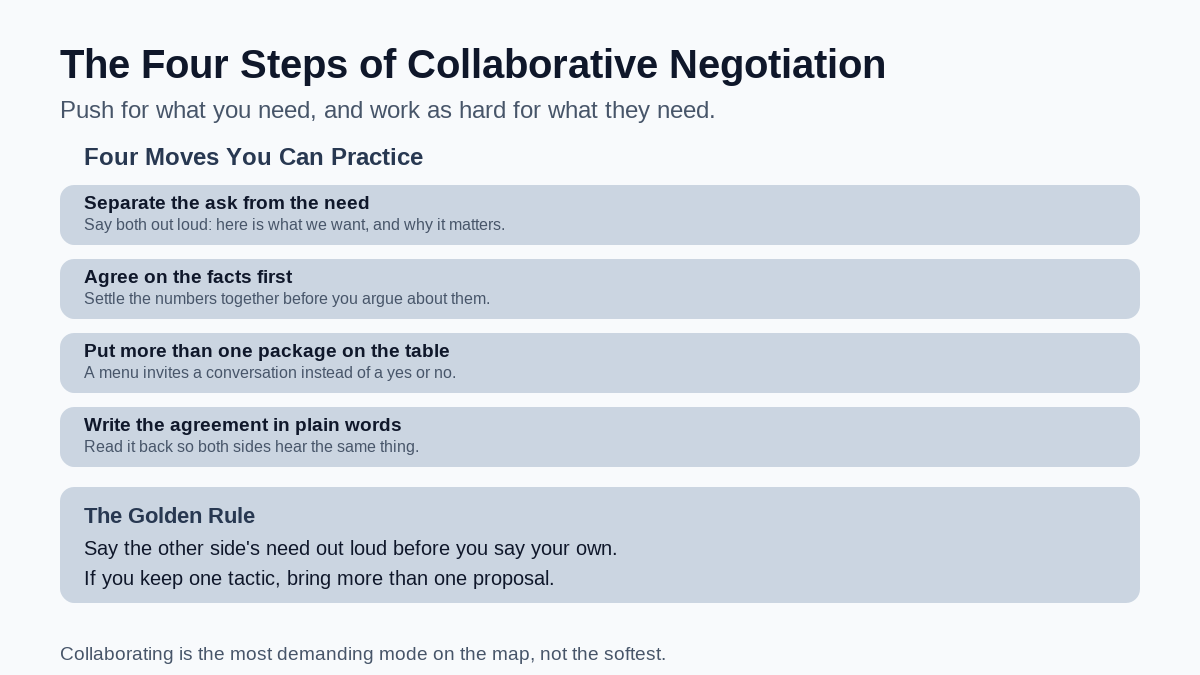
- Separate the ask from the need, and say both out loud. "Here is what we are asking for, and here is why it matters to us."
- Agree on the facts before you argue about them. "Before we discuss price, can we agree on the numbers? Is there someone we would both accept as a check?"
- Put more than one package on the table. "I brought three versions. Tell me which one is closest, and we will work from that one."
- Write the agreement in plain words, and read it back. "Let me read what we agreed, in simple English, so we both hear the same thing."
Step four is where collaborative deals die. Guhan Subramanian, who holds professorships at Harvard Law School and Harvard Business School and chairs the Program on Negotiation's executive committee, points to the matching right, a clause that lets one side match a rival's offer before a deal can go elsewhere. It can give a buyer and a seller each what they want. Then the warning, in the Program on Negotiation's summary of his view: because matching rights are often imprecisely worded in contracts, they can create new problems.
The plainer the sentence, the safer the deal. And plain sentences are exactly the ones you can write well in a second language.
What you said, what they heard, and the small change
This is the drill from my sessions. Three beats: what you said, what the listener hears, the small change. The middle beat is the one that teaches.
A real one first. In a role-play for a proposal meeting, a client of mine said to the "customer": "You are not our only client." What my client meant: we are busy, we have experience, we have seen your problem before.
What the customer hears: you are not that important to us. So we made a small change: "We have other clients who deal with similar issues." Same basic idea. A completely different message.
Now the ones that show up in negotiations.
You said: "That is our final price."
They hear: the conversation is over.
The small change: "That is the price for this scope. If the scope changes, the price can move. What would you take out?"
You said: "We cannot do that."
They hear: a wall.
The small change: "We cannot do it in that form. Here is the form we can do."
You said: "Why do you need it by March?"
They hear: a challenge. A bare "why" in English can sound like an accusation, and over video, with no shared table to soften it, it sounds sharper still.
The small change: "Help me understand what happens on your side if it arrives in April."
You said: "I don't agree."
They hear: we are on opposite sides now.
The small change: "I see it differently. Can I show you the numbers we are working from, and you show me yours?"
You said: "Trust me, this is a fair number."
They hear: no proof.
The small change: "Let's find a number we both trust. Is there a source we would both accept?"
Every small change does the same thing. It keeps your need on the table and adds a door for theirs. That is the collaborative move in one sentence: hold your need, open a door.
These are the lines we rehearse in WorldView Training role-plays before a client's real meeting, because a line you have said out loud ten times is the line that comes out when the other side surprises you.
Win-win does not mean nobody gives anything up
"Win-win" gets misread as "nobody loses anything." That is rarely the deal on the table.
William Mack, a New York attorney with the firm Davidoff Hutcher & Citron, told a reporter, in a line Harvard's Program on Negotiation picked up, that 90 percent of the tenant-landlord disputes he sees end in an agreement where "everyone is sharing the pain", rather than one side losing outright.
The collaborative part is how the pain gets shared. A tenant who needs three months of lower rent to survive and a landlord who needs the space occupied through the winter can each give something and each keep the one thing they cannot live without.
Nobody got everything. Both got the need behind the position. That is what collaborative looks like when money is tight.
Reading the room when English is nobody's first language
Erin Meyer, Professor of Management Practice at INSEAD, wrote in Harvard Business Review in 2015 that the standard rules of negotiation are not enough on their own across cultures. Separate the people from the problem, know your BATNA (your best alternative if there is no deal), and you can still lose the room. HBR's summary of her argument: a negotiator must take stock of the subtle messages being passed around the table.
I used to think being a native speaker was my edge in global business. I don't think that anymore.
Native English speakers are often the hardest people in a negotiation, and for the wrong reasons.
They speak quickly.
They use idioms.
They assume you understood.
The non-native speaker's risk is different. You hear every word and miss the weight. A "yes, we will consider it" can be a yes, or it can be the polite end of the conversation, and the words alone will not tell you which.
Put that sentence on a call that is 7 a.m. for you and 8 p.m. for them, with cameras off, and it gets harder still.
You cannot learn every culture's signals before Thursday's call. You can build one habit that works in all of them: check.
"Can I check that I understood? You are saying the date matters more than the price. Is that right?"
"When you say you will consider it, what would you need to see to say yes?"
Neither line is fancy. Both are impossible to misread, which is the point.
When collaborating is the wrong move
Collaborating is not the right mode every time, and the instrument's own guidance says so. Which mode fits depends on eight things: stress, complexity, importance, time, trust, communication skill, cultural norms, and how much the relationship is worth. The same guidance says that moving through a sequence of modes as a conflict changes usually works better than sitting in one mode from start to finish.
Two of those eight, communication skill and cultural norms, are exactly the dials that move when the negotiation is in your second language. That is why the same person can collaborate well at home and freeze in an English-language call. The mode did not change. Two of the inputs did.
So the practical rules.
When the stakes are low and the clock is short, collaborate less. A ten-minute call about a delivery slot does not need joint fact-finding.
When trust is near zero, collaborate in small doses. Agree on one fact together. That is how trust gets built, one shared number at a time.
When the other side only competes, keep your need on the table and keep the door open, but decide in advance what you will not trade. (How to walk away, and how to say it in plain English, is covered in the compromising post.)
And what not to do, from the sources above: do not sell one-sided facts, do not leave the final wording vague, do not hear the words while missing the signals, and do not make the other side guess what you need.
What is the 70/30 rule, and does it work in a second language?
The 70/30 rule is a rule of thumb you will meet in most sales training, and I treat it as one: listen about 70 percent of the time, talk about 30.
For a non-native speaker that split is good news and a trap at the same time. Good news, because listening is usually the stronger skill when you work in a second language.
The trap is that silent listening is not collaborative. In some rooms silence reads as agreement. In others it reads as absence. Either way, the other side learns nothing about your needs.
So the 70 has to be visible. It is listening plus check-backs.
"So if I follow you, the delivery date matters more to you than the unit price. Is that right?"
"Say more about that."
"What happens on your side if we do nothing?"
"What would make this easy to say yes to on your side?"
Four short questions, all in the English you already have. Each one tells you what the other side needs. A long speech only tells them what you need.
The golden rule, and the one tactic I would keep
People ask me for the golden rule of negotiation. There is no official one. The one I teach is this: say the other side's need out loud before you say your own.
It costs nothing, and it proves you listened. More than that, it turns two positions into one shared problem.
If I could keep only one tactic, it is Susskind's: bring more than one proposal. One offer invites a yes or a no. Three offers invite a conversation about which one, and the answer tells you what they care about without you having to ask.
Decide in advance: three questions before the call
Prepare shorter structures, not longer scripts. Before an English-language negotiation, answer three questions and write the answers on one line each.
What is my opening sentence?
What is the one need I will not trade?
What is the closing action I want agreed before we hang up?
Then, in the last minute before you join:
- Massage the corners of your jaw.
- Open and close your mouth slowly.
- Take two slow breaths through your nose.
It takes less than a minute. A tight jaw makes English worse before your brain is even involved.
Under pressure, you fall to your level of training. So train the lines. Pick one from this post, the "Help me understand what happens on your side" one is a good start, and say it out loud ten times before tomorrow's meeting. Then use it once.
If you have an important negotiation coming up in English, send me a message. I'd be happy to help you prepare.
Frequently asked questions
What are the five main negotiation styles?
The Thomas-Kilmann Conflict Mode Instrument names five: competing, collaborating, compromising, avoiding, and accommodating, plotted on two scales, assertiveness and cooperativeness. Collaborating is the only mode high on both. A list of four styles is the same map with one mode left off.
What are the four steps of collaborative negotiation?
Separate the ask from the need behind it and say both out loud; agree on the facts together before arguing about them; put more than one package on the table at once; and write the agreement in plain words, then read it back so both sides hear the same thing.
What is the 70/30 rule in negotiation?
It is a rule of thumb from sales training: listen about 70 percent of the time and talk about 30. In a second language the listening only counts if you make it visible with check-back questions such as "So if I follow you, the date matters more than the price. Is that right?"
What not to do when negotiating?
Do not sell one-sided facts, which MIT's Lawrence Susskind says reads as arrogance; do not leave the final wording vague, since Harvard's Guhan Subramanian warns imprecise clauses create new problems; and do not hear the words while missing the signals behind them, which matters most across cultures.
Sources reviewed
- Kilmann Diagnostics — TKI overview (the five modes on two dimensions)
- Kilmann Diagnostics — TKI overview (definition of Collaborating vs. Compromising)
- Kilmann Diagnostics — brief history of the TKI (origin, 1970-1974)
- Kilmann Diagnostics — brief history of the TKI (bias reduction design)
- Kilmann Diagnostics — brief history of the TKI (norming and usage stats)
- Kilmann Diagnostics — using the TKI (context determines the right mode)
- Program on Negotiation (Harvard) — Susskind on win-win tactics
- Program on Negotiation (Harvard) — Subramanian on matching rights
- Program on Negotiation (Harvard) — Susskind faculty title
- Program on Negotiation (Harvard) — Subramanian faculty title
- Harvard Business Review — Erin Meyer on cross-cultural negotiation
- Program on Negotiation (Harvard) — NYC lease negotiation example