
Chinese communication style is high-context, indirect, and built to protect relationships and hierarchy. Meaning sits in tone, gesture, rank, and the relationship between the speakers, more than in the literal words. A direct "no" is rare, disagreement is signaled softly, and mistakes are handled without blaming one person. To work well with Chinese colleagues, listen for what is implied, then confirm it out loud.
Picture a sales call with a partner in Shanghai. You propose a six-week delivery. The answer is: We will need to study this carefully. You hang up with a maybe in your notes.
That sentence may have been the whole answer.
The English was fine. The message was somewhere else. Reading that message is a skill, and like any skill, it can be trained.
Where Chinese communication style puts the message
In a high-context culture, the spoken words are only part of the message. The rest is carried by the setting. Ming-Jer Chen, a professor at the University of Virginia's Darden School of Business, wrote in a technical note on cross-cultural communication: "In Chinese (or 'high-context') culture, verbal communication is most accurately interpreted in the context of nonverbal communication (such as gestures, stance and tone), social hierarchy and other background information."
Read that list again. Gestures. Stance. Tone. Who outranks whom. What happened last time.
A low-context speaker puts the message inside the sentence and expects you to take it as said. A Chinese colleague often puts the message around the sentence and expects you to pick it up. Neither is wrong. They are different jobs for the listener. (The general map of direct and indirect cultures, and which countries sit where, is its own post on this blog.)
A client from China once asked me when to say I would like to tell you about… and when to say I would love to tell you about…. My answer was simple: "like" is structure, "love" is enthusiasm. The question itself is the lesson. The client was weighing the emotional temperature of a single word. Your Chinese colleagues are reading you that closely, and they expect you to read them the same way.
Two numbers that explain the meeting room
The Hofstede country comparison tool gives each country a score on a set of work-related cultural dimensions. Two of China's scores matter here.
China scores 80 on Power Distance. That is a high score, and it describes a workplace with a clear ladder, where the distance between a manager and a report is accepted and formal authority carries weight.
China scores 43 on Individualism. That puts it on the collectivist side of the scale, where people act in the interests of the group rather than only for themselves.
Together, these two numbers describe a room where a junior colleague is unlikely to contradict a senior one in public, and where a team is unlikely to push one member forward for credit or for blame.
For a sales manager, this changes who you watch. Read the senior person's reaction, even when a junior person is doing the talking.
Why you rarely hear "no"
A flat "no" is rare because, in Chinese business culture, an outright refusal can signal that the whole relationship is in danger, not only the one request. So the refusal arrives wrapped in vagueness, and the listener is expected to unwrap it.
Erin Meyer, a professor at INSEAD, described this in her book The Culture Map: "When Chinese vaguely express an idea or an opinion, the real message is often just implied. They expect their conversational partner to be highly involved and to take an active role in deciphering messages."
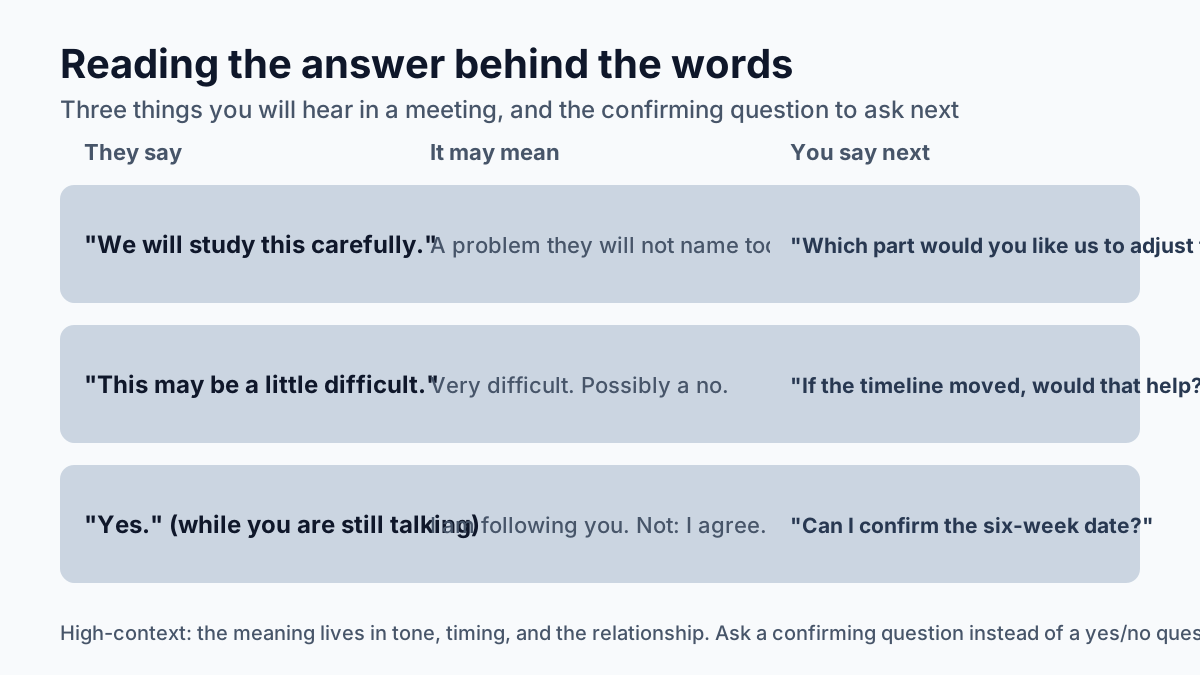
"Take an active role" is the instruction. Here is what that looks like, in the three-beat form I use with clients: what they said, what it may mean, and what you say next.
| They say | It may mean | You say next |
|---|---|---|
| We will study this carefully. | There is a problem they will not name in this meeting. | Thank you. Which part would you like us to adjust first? |
| This may be a little difficult. | This is very difficult, and possibly a no. | I understand. If the timeline moved, would that help? |
| Yes. (while you are still explaining) | I am following you, which is different from I agree. | Good. Can I confirm we are agreed on the six-week date? |
None of these replies push. Each one gives your colleague a way to tell you the truth without saying the hard word.
Harmony, face, and what happens when something goes wrong
The style aims to keep the group in balance. A strong display of anger or frustration is read as damage to that balance, even when the anger is justified.
That is where face comes in. Face is a person's standing in front of other people. When an error happens, the group typically handles it in a nonthreatening, face-saving way rather than blaming one individual in the open.
Now put a Western manager into that room.
You say, in the meeting: "Who missed the deadline?"
They hear: I am about to shame one of you in front of the others.
So make a small change: Where did the timeline slip, and what do we need to recover it?
Same question. A different message.
Guanxi: when the relationship does the contract's job
Guanxi is the network of personal relationships a person builds over time, with people who can be expected to exchange favors, loyalty, and support. In Chinese business it can be a basis for trust alongside a signed contract, and sometimes in place of one.
For a sales professional this means the dinner and the follow-up message are part of the deal. They are how trust is measured.
A 2010 study by Liu, Chua and Stahl in the Journal of Applied Psychology found that negotiator pairs from different cultures had lower-quality communication and worse outcomes, on average, than pairs from the same culture. That gap is the reason to prepare.
What to say in tomorrow's meeting
Decide three things before the call, the way I ask clients to prepare any high-stakes meeting in English:
- What is my opening sentence?
- What is my key message?
- What is the one confirming question I will ask before we end?
The third one matters most with Chinese colleagues. At the end, ask it plainly and warmly: Before we finish, can I confirm what we have agreed today? Then say the agreement back in one sentence, and wait.
I used to think being a native English speaker was my edge in global business. I don't think that anymore. Native speakers talk fast. They use idioms. They assume they were understood. With a high-context colleague, that combination hides the message twice: once in their indirectness, and once in your speed.
Slow down. Then ask the confirming question.
In WorldView Training sessions we rehearse that closing question until it is automatic, because under pressure you will not rise to your level of knowledge. You will fall to your level of training.
If you have an important meeting or negotiation with Chinese colleagues coming up in English, send me a message. I'd be happy to help you prepare.
Frequently asked questions
Is China a high-context culture?
Yes. In Chinese business settings, spoken words are interpreted through nonverbal cues, social hierarchy, and background information, so the listener is expected to read the setting as well as the sentence.
Why do Chinese colleagues rarely say no directly?
An outright refusal can signal that the whole relationship is at risk, not just the one request, so a no usually arrives as a vague or general answer that the listener is expected to interpret and then confirm.
What is guanxi in Chinese business?
Guanxi is a network of personal relationships built over time in which people expect to exchange favors, loyalty, and support. It can act as a basis for trust alongside a signed contract, and sometimes in place of one.
Sources reviewed
- Hofstede Insights / The Culture Factor Group -- China country data: Power Distance = 80 China scores 80 on Power Distance -- a strict hierarchy where the subordinate-superior relationship is sharply defined and formal authority carries weight.
- Hofstede Insights / The Culture Factor Group -- China country data: Individualism = 20 China scores 20 on Individualism, indicating a highly collectivist culture where group interests and interdependence outweigh individual expression.
- UVA Darden 'Ideas to Action' -- excerpted from Prof. Ming-Jer Chen's technical note on cross-cultural communication In Chinese (high-context) culture, verbal communication is most accurately interpreted in the context of nonverbal communication, social hierarchy, and other background information.
- UVA Darden 'Ideas to Action' -- Ming-Jer Chen technical note The Chinese are reluctant to use the word 'no' outright because it can signal that the overall relationship, not just one request, is in jeopardy.
- UVA Darden 'Ideas to Action' -- Ming-Jer Chen technical note Chinese communication style aims to preserve harmony; strong displays of negative emotion are seen as disrupting group balance.
- UVA Darden 'Ideas to Action' -- Ming-Jer Chen technical note When an error occurs, the group typically addresses it in a nonthreatening, face-saving manner rather than blaming an individual outright.
- Program on Negotiation, Harvard Law School -- 'The Importance of Guanxi' Guanxi is the cultivation of personal relationships with people who can be expected to exchange favors, loyalty, and support over time, and can function as an alternative basis for trust to a signed contract.
- Program on Negotiation, Harvard Law School -- 'Cross-Cultural Communication in Business Negotiations' (reporting Liu, Chua & Stahl, Journal of Applied Psychology) A peer-reviewed study found that negotiator pairs from different cultures had lower-quality communication and worse outcomes on average than same-culture pairs.
- Erin Meyer, 'The Culture Map' -- quote located via Goodreads quotes index When Chinese speakers vaguely express an idea, the real message is often just implied, and the listener is expected to actively decipher it rather than have it stated outright.