
Business English course content should be built from the work tasks a professional faces every week: meetings, presentations, email, negotiations, calls, and small talk. Each module is pitched to the learner's actual proficiency level and trains clear phrasing under pressure, not grammar rules. Most of the hours go to practice in those situations, with feedback on how the listener hears each sentence.
Ask a manager what English they need and they will name a meeting, not a tense.
A client from China once asked me when to say I would like to tell you about... and when to say I would love to tell you about.... The answer is small. Like signals structure. Love signals enthusiasm. He already had both phrases. What he needed was the choice, and the confidence to make it in front of a customer.
That question is the whole subject. A good course is a long series of choices like that one, taken from real work and practiced until they are automatic.
The six content areas, and what each one trains
Every serious course covers the same six situations, because those are the places where a career is decided in English. What separates a good course is what it does inside each one.
| Content area | What the course should train | A line you can use this week |
|---|---|---|
| Meetings | Stating the agenda, interrupting politely, asking for opinions, disagreeing without damage, closing on a decision | "Before we move on, can I add one point?" |
| Presentations | Openings and closings, one key message, speaking in pictures, taking questions | "Here is the one number I want you to remember." |
| Email and chat | Tone in short messages, requests with a deadline, saying no, following up | "Could you send it by Thursday noon? That gives me Friday to review." |
| Negotiations and sales calls | Framing a price, holding a position warmly, handling objections, walking through a proposal | "We have other clients who deal with similar issues." |
| Phone and video calls | Opening a call, checking understanding, managing speed and interruptions, ending on an action | "Can I check I have this right?" |
| Small talk and networking | Introductions, greeting a client, the three minutes before the agenda, leaving a conversation | "How has your week been so far?" |
Professional vocabulary and business etiquette belong in the course too, but not as separate modules. The vocabulary for a price discussion is taught inside the negotiation role-play, and the etiquette of who speaks first is taught inside the call practice. A vocabulary list without a situation goes nowhere.
Why good business English course content is organized by task, not grammar
I do not prepare people for exams. But the way a major exam body designed its business qualifications tells you how the field thinks about content. Cambridge English built its Business English Certificates around "everyday work and business tasks", at three levels: B1 Preliminary, B2 Vantage, and C1 Higher. Task first, level second, and grammar nowhere in the title.
Cambridge has since discontinued that suite everywhere except China. That is one more reason to build a course around your own job and a recognized level scale, rather than around any exam.
A course built on tasks changes what a lesson looks like. Instead of conditionals, week four, the plan says the budget meeting on Thursday. The grammar still shows up, inside a sentence you need on Thursday, which is the only place it sticks.
What level should the content be pitched to?
Content only works when it matches the learner's level, and the level has a standard name. The Common European Framework of Reference, or CEFR, is an international standard for describing language ability: a six-point scale from A1 (beginner) to C2 (mastery), and Cambridge aligns its exams to it.
My clients are mid-level managers and executives, and they already have B1 English or better when they arrive. What changes as the level rises is the kind of choice the learner is asked to make.
- At B1, the content is short structures you can deliver without thinking: an agenda in three lines, a request with a deadline, a polite interruption.
- At B2, the content shifts to tone: disagreeing with a senior colleague, softening bad news, holding a price without sounding cold.
- At C1, the content is leadership: opening a meeting with a picture, running questions, handling a native speaker who talks over you.
A one-size course fails in both directions. Too low and the executive is bored by week two. Too high and the B1 learner memorizes phrases she cannot produce under pressure. So a good course places you on the scale first.
That is how I run coaching at WorldView Training: a client brings the meeting, presentation, or negotiation that is coming up, and the session is built around it.
Meetings: the module that pays first
Meetings are where the pressure is, so meetings get the most hours. The content is a set of small phrasing choices, and the fastest way to teach them is to show what the listener hears.
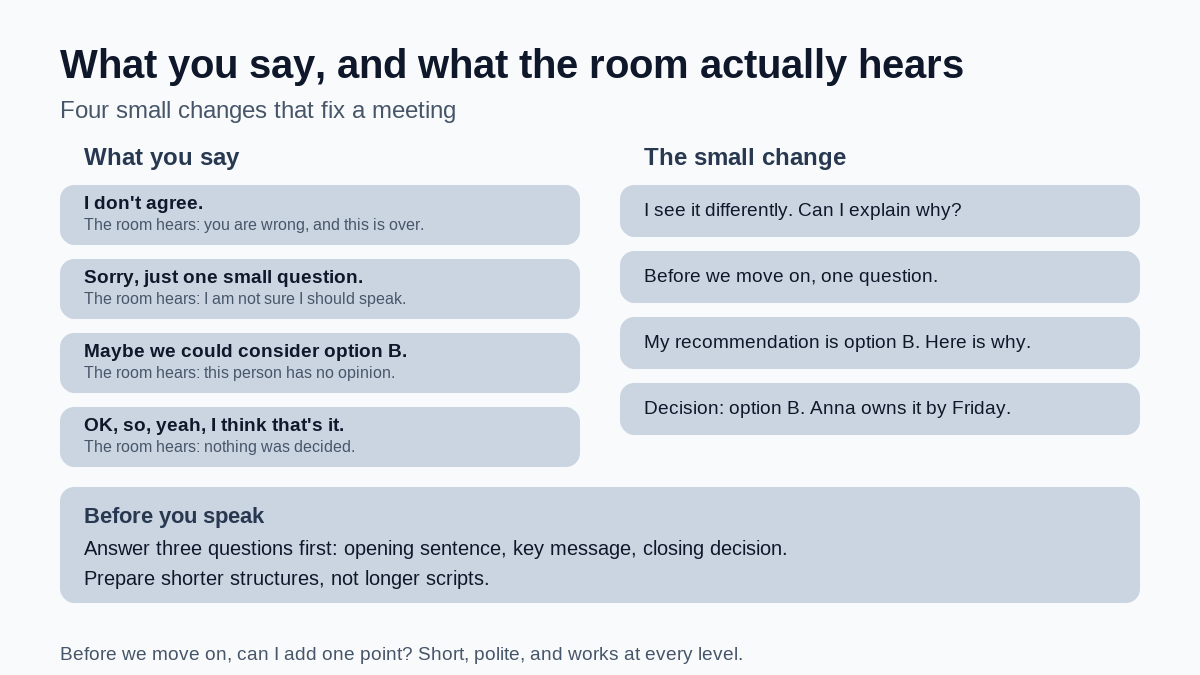
A manager says: "I don't agree." The room hears: you are wrong, and this conversation is over. The small change: "I see it differently. Can I explain why?"
A manager says: "Sorry, sorry, just one small question." The room hears: I am not sure I should be speaking. The small change: "Before we move on, one question."
A manager says: "Maybe we could possibly consider looking at option B." The room hears: this person has no opinion. The small change: "My recommendation is option B. Here is the reason."
A manager closes with: "OK, so, yeah, I think that's it." The room hears: nothing was decided. The small change: "So the decision is option B. Anna owns it by Friday. Is anything missing?"
None of these fixes needs new grammar. Every one of them needs a decision made in advance. Before any meeting that matters, a good course teaches you to answer three questions: What is my opening sentence? What is my key message? What is my closing decision or action? Prepare shorter structures, not longer scripts.
Email and messages: the content most courses under-train
Written English carries no tone of voice, so the reader supplies one. That is why email deserves its own module, and why the module should be about how a short message lands, not formal letter layout.
You write: "Please send the report ASAP." The reader hears: you are late and I am annoyed. The small change: "Could you send the report by Thursday noon? That gives me time to review it before the Friday call."
You write: "As I said in my last email..." The reader hears: you did not read it. The small change: "To confirm the plan from Tuesday:"
You write: "Please advise." The reader hears: cold, and I still do not know what you want from me. The small change: "Which of the two options do you prefer? I can start either one on Monday."
You write: "Unfortunately this is impossible." The reader hears: a closed door. The small change: "We cannot do the 15th. We can do the 22nd, or the 15th with a smaller scope. Which works better for you?"
A deadline, a reason, and a choice. Those ingredients fix most business email, and a course should drill them until they are the default.
Presentations: the opening and the closing are what people remember
A client preparing a presentation for a promotion brought me a middle section that was excellent. Clear data, good structure. The opening and the closing were an afterthought.
The middle gets the hours because the middle has the data. But the audience remembers the first minute and the last minute, and very little in between. So the presentation module spends most of its time on the two ends.
The opening is one sentence the audience can repeat. Apple introduced the first iPod as a thousand songs in your pocket, not as a storage figure. That is what "speak in pictures" means: one image that carries the number.
The closing is a decision or an action, said plainly: I am asking for approval to start on the first of next month. Then stop. Do not add "so, yeah, that's basically everything."
Say the opening line out loud ten times before the day. Say the closing line ten times. The middle can carry some hesitation. The ends cannot.
Negotiations and sales conversations
Sales professionals need this module most, because a sales conversation is where a small phrase moves money. The example comes from a proposal role-play with a client.
The client said: "You are not our only client." The customer hears: you're not that important to us. The small change: "We have other clients who deal with similar issues."
Same basic idea, but a completely different message. The first version defends. The second reassures, and quietly says "we have done this before."
A negotiation module should also cover price.
You say: "The price is not negotiable." The buyer hears: take it or leave it. The small change: "The price reflects this scope. If the budget is fixed, let's look at the scope together."
And it should cover objections. When a buyer says it's too expensive, the trained response is a question rather than a discount: "Too expensive compared with what you budgeted, or compared with another offer?" You learn more, and you sound calm.
Calls, video, and small talk
Video calls compress everything. Picture a sales lead in Seoul joining a 7 a.m. Eastern call, with a colleague in Frankfurt at lunch and a client in Denver still on the first coffee. Nobody has time for a long warm-up, and the audio drops the odd word. So the call module trains four short moves.
Opening: "Thanks for making the time. Two things today: the timeline and the price." Checking understanding: "Can I check I have this right? You need the numbers by the 10th, by region." Slowing a fast speaker: "Could you say that once more? I want to make sure I have it exactly." Ending on an action: "So the next step is the revised quote, from me, by Wednesday. I will send a summary after this call."
Small talk gets its own short block. Two questions about the other person are enough: How has your week been so far? and Are you travelling for this project at all? Then one bridge into the agenda: "Shall we get into it?" People remember whether the first three minutes were comfortable.
Is business English in demand?
Yes, and the demand comes from employers. Harvard Business School professor Tsedal Neeley wrote in a 2012 Harvard Business Review article: "Ready or not, English is now the global language of business. More and more multinational companies are mandating English as the common corporate language." Her article named Airbus, Daimler-Chrysler, Fast Retailing, Nokia, Renault, Samsung, SAP, Technicolor, and Microsoft in Beijing among the companies with an English mandate, and put the number of people who speak English at a useful level at 1.75 billion.
If 1.75 billion people can use English, being in the room is the easy part. Leading the room is the skill.
I used to think being a native speaker was my edge in global business. I do not think that anymore. I now see non-native speakers lead meetings better than native speakers who talk fast and use slang, because the natives fall into the same habits.
They speak quickly. They interrupt. They assume understanding.
A non-native manager who has trained short structures does none of those things. The advantage in a global meeting goes to whoever is clearest, and clarity can be trained.
I coach managers at global companies such as Google, Johnson & Johnson, and Roche through WorldView Training, and the content is the meeting they have next week.
What is the most effective way to learn business English?
Practice the exact situation, under a little pressure, until the response is automatic. That is the most effective method I know, and it is why the content of a course matters more than the number of hours in it.
Under pressure, you will not rise to your level of knowledge. You will fall to your level of training.
Speaking is a muscle. The conversation muscle weakens when you do not use it, and reading business English on a screen does not exercise it. So a good course builds each session around live speaking: a role-play of the actual situation, with the trainer playing the difficult customer or the fast-talking colleague; a stop after the sentence that landed badly, to look at what the listener heard; and a second run with the small change, repeated until it comes out without thinking.
One more piece of content belongs in every session, and it is physical. Tension in the jaw and the breath makes English worse before the brain is involved. Right before a call:
- Massage the corners of your jaw.
- Open and close your mouth slowly.
- Take two slow breaths through your nose.
This takes less than one minute, and it improves the language before you say a word.
The last piece is how you measure progress. A client from Taiwan hosted a Vietnamese customer in English and, for the first time, did not compare herself to her colleagues. That is the scale to use: compare yourself to where you were, and leave the other people in the room out of it.
How to choose lesson topics: from your calendar, not a syllabus
People searching for good business English lesson topics usually want a list. The better answer is your own calendar. Open next week. Every meeting, call, and email thread with a stake in it is a lesson topic, and it beats any generic list because you will use it within seven days.
A few that come up for most managers: the weekly team meeting (opening with a picture, closing with owners and dates), the one-to-one with your boss (asking for a decision without apologizing), the status email to a nervous client, and the presentation of a result that is worse than planned.
People also search for the 100 most important words in business English. A course should not be built on a word list. I answer that question properly in a separate post on what business English is, with worked examples.
One line to carry into tomorrow
If you take one sentence from this post into your next meeting, make it this: Before we move on, can I add one point? It is short and polite, it stops you from being talked over, and it works at every level from B1 up.
If you have an important presentation, meeting, or negotiation coming up in English, send me a message. I'd be happy to help you prepare.
Frequently asked questions
What does business English consist of?
Six workplace situations: meetings, presentations, email and chat, negotiations and sales calls, phone and video calls, and small talk. Vocabulary and etiquette are taught inside those situations rather than as separate lists, and the content is pitched to the learner's CEFR level, usually B1 or above for working managers.
What are some good topics for business English lessons?
Your own calendar for next week: the team meeting, the one-to-one with your boss, the status email to a nervous client, the pricing call, and the presentation of a result that is worse than planned. A topic you will use within seven days beats any generic list.
What is the most effective way to learn business English?
Practice the exact situation you have coming up, under a little pressure, until the response is automatic. A role-play of the meeting, a stop at the sentence that landed badly, and a second run with the small change does more than extra hours of grammar.
Is business English in demand?
Yes. Multinational companies including Airbus, Nokia, Renault, Samsung, and SAP have mandated English as their common corporate language, and Harvard Business School professor Tsedal Neeley put the number of people who speak English at a useful level at 1.75 billion in a 2012 Harvard Business Review article.