
The best questions to ask senior leadership in a town hall are short, forward-looking, and useful to everyone listening: what the one priority is for the next 12 months and how success will be measured, how the strategy is changing as the industry changes, what worries them about competitors, and what concrete steps are planned on culture and people. Ask in one clear sentence, then stop.
A town hall question is the shortest leadership speech you will ever give.
Picture the moment. The CEO has finished the last slide. Four hundred people are on the call, and for many of them it is late evening in Taipei or late afternoon in Frankfurt. The moderator says there is time for a few questions. You unmute. For the next twenty seconds, more senior people are listening to you than in most of the rest of your year.
That is why this post covers two things. Which questions to ask. And how to say them so they land the way you mean them, in English that is not your first language.
Why one question in a town hall matters more than it looks
Most people never unmute, and the reasons are practical.
You are not sure the question is good enough.
You are not sure the grammar is right.
You are not sure anyone wants to hear it.
The numbers say your company needs you to ask. Only three in 10 U.S. workers strongly agree that their opinions count at work. Gallup also estimates what happens if that share doubles: moving it to six in 10 is linked to 27% lower turnover, 40% fewer safety incidents, and 12% higher productivity.
So when you ask a question and a leader answers it in front of everyone, two things happen. You are heard. And four hundred people see that opinions count here.
There is a second reason the moment is rare. Gallup finds that managers account for 70% of the variance in team engagement, which means most of the difference between an engaged team and a disengaged one comes down to the manager. Your manager shapes most of your working life. A town hall is one of the few times you can speak past that layer, directly to the people who set the strategy your manager has to carry out.
The stakes are not soft ones. Business units in the top quartile for engagement (the top 25%) differ from the bottom quartile by 81% in absenteeism, 64% in safety incidents, and 43% in turnover in low-turnover organizations.
Leaders know this. Many still get the format wrong. Valerie Di Maria, principal at The 10 Company when Ragan Communications interviewed her in February 2024, described the biggest problem she sees with her clients: "They say they want questions, but are concerned they won't have answers or they are more focused on their messages rather than two-way communications, so they never leave enough time for questions."
Her example is blunt. "If you're planning a 45-minute conversation with Q&A and everybody's speaking roles time out to 43 minutes, you've got a problem."
Two minutes. That may be the whole space your question has to fit into. Which is the argument for preparing it.
Good questions to ask senior leadership in a town hall
A good town hall question has one test: does the answer help the whole room, or only you? Leaders answer the first kind with energy. They answer the second kind politely and move on.
Here are the questions that pass the test, in words you can use as they are.
| Topic | Ask this | Why it lands |
|---|---|---|
| Priorities | What is the one priority for the next 12 months, and what will we measure in six months to know it is working? | Asks for a number and a date, not a slogan. |
| Strategy | Which part of our strategy is changing because the industry is changing, and which part stays the same? | Lets the leader explain the thinking instead of defending it. |
| Competition | Which competitor move would hurt us most this year, and what is our answer to it? | Native speakers ask this as "what keeps you up at night." This version is clearer and gets a more specific answer. |
| Culture | What concrete steps are planned on [retention / hybrid work / promoting from inside], and what will we see first? | "Concrete" and "first" turn a values statement into a plan. |
| Trade-offs | What did the leadership team decide not to do this year, and why? | Few people ask this. Every leader has an answer. |
| Conditions | What would need to be true for us to [open the second plant / invest more in the Asia team]? | Gives the leader a way to say yes, no, or "here is the number we watch." |
| Reflection | What is one thing you have changed your mind about since the last town hall? | Invites honesty without asking anyone to admit a mistake. |
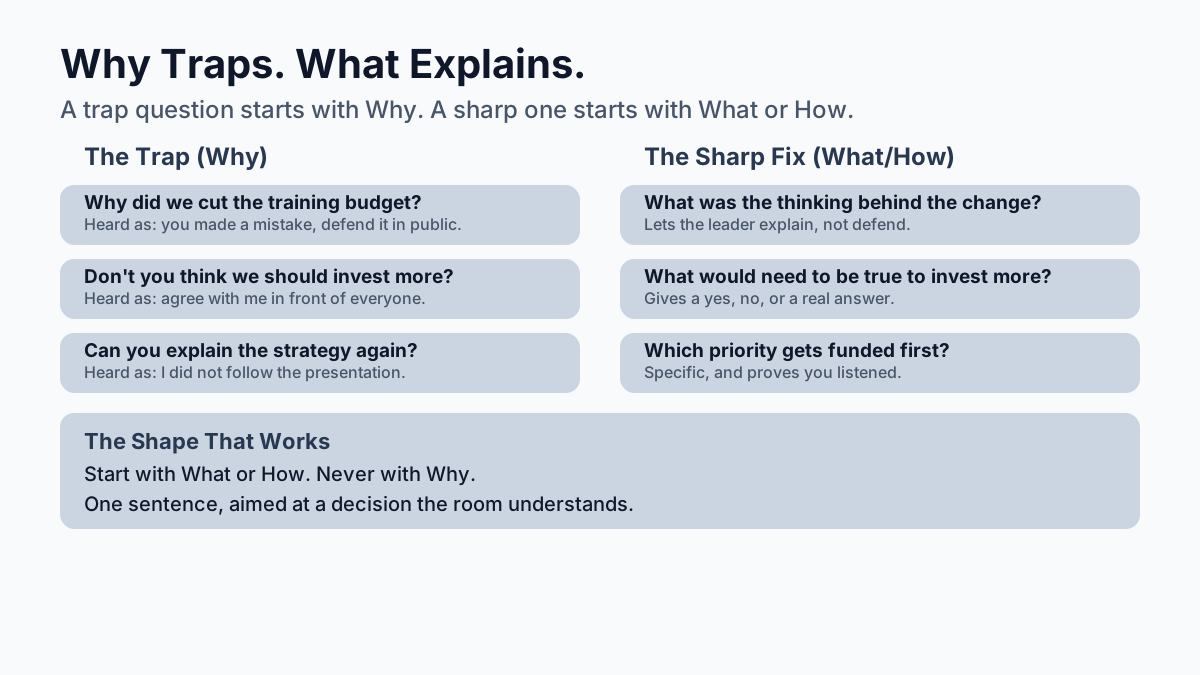
Notice the shape. Every question starts with What or How. None starts with Why.
A Why question asks a leader to defend. A What question asks a leader to explain. Same topic, different job, and the room hears the difference before the leader does.
What the room hears when the words are slightly off
In a practice run for a sales proposal, a client of mine said to the customer: "You are not our only client." That can easily sound like: you are not that important to us. So we made a small change: "We have other clients who deal with similar issues." Same basic idea, completely different message.
Town hall questions fail the same way. The grammar is fine. The message is not the one you meant. Six of the most common are below, each with the small change that fixes it.
Said: "Why did we cut the training budget?"
Heard: You made a mistake. Defend it, in public.
Small change: "What was the thinking behind the training budget change, and what would bring it back?"
Said: "Is my team going to be affected by the reorganization?"
Heard: I am worried about myself.
Small change: "How will the reorganization change the way regional teams work with headquarters?" It is the same worry. Now it is asked for every regional team, and the leader can answer it properly.
Said: "Sorry, my English is not so good, but I have a question about the new pricing."
Heard: Please expect less from me. (And now the room listens for mistakes instead of ideas.)
Small change: Cut the apology. "A question on the new pricing." Then the question. Your English was good enough to ask it. The apology was the only weak part.
Said: "Don't you think we should invest more in Latin America?"
Heard: I already have the answer, and I want you to agree with me in front of everyone.
Small change: "What would need to be true for us to invest more in Latin America?" Now the leader can say yes, no, or "here is the number we watch," and nobody loses face.
Said: "Can you explain the strategy again?"
Heard: I did not follow the presentation.
Small change: "Of the three priorities on slide four, which one gets the first money if we have to choose?" Specific beats broad, and it proves you were listening.
Said: "So first, thank you for the presentation, it was very interesting, and I have a question, well, more of a comment really, because last year in our region we..."
Heard: This will take a while, and I am not sure where it is going.
Small change: Question first. Context second, in one sentence, and only if it changes the answer. "How will the new pricing work for customers still on old contracts? I ask because about a third of our region's accounts are on them."
None of the original questions is wrong. Each one is a reasonable thing to want to know. The fix in every case is a small change in shape, and you already have the words for it.
How to prepare the question before you unmute
Prepare a shorter structure, not a longer script. Answer three questions in advance:
- What is my opening phrase?
- What is my one question?
- Why does it matter to the room?
The opening phrase is four to eight words, said slowly. Pick one and keep it:
- "Thank you. A question on next year's priorities."
- "One question about the competition."
- "I'd like to ask about the reorganization."
- "This is [your name], from the Warsaw office. A question on hiring."
The one question comes from the table above, or is built the same way. What or How. One sentence. If you cannot say it in one breath, cut it.
The reason it matters comes last, in one sentence, and only if the leader might not see it: "I ask because it affects every team that sells on old contracts."
Then test it. Di Maria's advice to leaders is to rehearse with someone who pushes back with "What do you really mean by that?" Use the same test on yourself. Say the question out loud to a colleague, and ask them to reply only with "What do you really mean by that?" If your explanation is longer than your question, the question is not ready. Put the explanation inside it and cut the rest.
Di Maria also tells leaders they "have to share rules of engagement so that questions are constructive and not disrespectful." As an employee you rarely get to hear those rules. So use the shape as your rule: What or How, one sentence, for the whole room. That is what constructive looks like from the leader's chair.
Timing matters because Q&A is the part of the meeting that gets squeezed. Ask early. If the town hall uses a Q&A tool where questions are posted and other people vote for them, post yours before the meeting starts or in the first ten minutes; a question posted at minute forty is rarely read. If questions are live, have your hand up, or your unmute ready, the moment the moderator opens the floor. The first question sets the tone for the rest, and the person who asks it is remembered.
One more thing, and it is physical. Tension in the jaw and the breath makes English worse before the brain is even involved. In the minute before you speak:
- Massage the corners of your jaw.
- Open and close your mouth slowly.
- Take two slow breaths through your nose.
It takes less than a minute, and the first sentence comes out at the speed you meant.
This is the moment I rehearse with clients at WorldView Training before a big internal meeting: not the whole town hall, only the twenty seconds that are theirs.
What is an impressive question to ask a leader?
An impressive question gives the leader something to think about and the room something to remember. The trade-off questions do this best: "What did we decide not to do?", "What would need to be true?", "Which decision from last year would you make differently, knowing what you know now?" They show you understand that leadership is choosing, and they let the leader answer honestly.
People also search for "killer questions." Be careful with that word. A question that kills the conversation, one built to trap the leader in public, impresses nobody, and in a global company people remember who set the trap. Keep the sharpness. Change the shape. A trap question starts with Why and ends with silence. A sharp question starts with What and ends with a decision the whole room now understands.
If the answer you get is vague, you are allowed one follow-up, and it should be shorter than the first question: "Thank you. One short follow-up: what does that look like for a team of ten?" or "Could you give one example?" If the leader misunderstood you, do not say "No, that's not what I meant." Say "Let me ask it a different way," and ask the one-sentence version.
I used to think being a native English speaker was my advantage in rooms like this. I do not think that anymore. The native speakers are often the ones who talk fast, use slang, interrupt, and take ninety seconds to reach the question. A non-native speaker who has prepared one clear sentence is easier to answer and easier to remember. That is a leadership skill, and it has little to do with grammar.
The same shape works after the town hall
A town hall is the loudest version of a moment that repeats all year: a short window with someone senior, where you want the words to land.
In a performance review, ask with the same What or How shape. Six that work:
- "What would make you say this year was a success for me?"
- "Which of my results mattered most to you, and why?"
- "What is one thing you would like me to stop doing?"
- "What would I need to show before you would put me forward for [the next role]?"
- "Where do you want me to spend more of my time next quarter?"
- "How do you prefer to hear from me between reviews: a short weekly note, or a monthly call?"
In a skip-level meeting (a meeting with your manager's manager), the town hall table above works almost unchanged, with "our team" in place of "the company."
In a leadership interview the direction flips: they ask, you answer. The same preparation still holds. Decide your opening sentence, your key message, and your closing action before you walk in, because openings and closings are what people remember, and the middle is not. A client preparing a promotion presentation had a middle that was excellent, and an opening and closing that were an afterthought. The middle is not what the panel remembers.
One question, tomorrow
In that room, the advantage does not belong to the people with the best English. It belongs to the person who asks the clearest question.
So here is the line to carry out of this post. Tomorrow, in whatever meeting you have, ask one question that starts with What or How. One sentence. Then stop talking and let the answer come.
If you have an important presentation, meeting, or negotiation coming up in English, send me a message. I'd be happy to help you prepare.
Frequently asked questions
What are some good questions to ask senior leaders?
Ask about the one priority for the next 12 months and what will be measured to know it is working, which part of the strategy is changing as the industry changes, which competitor move would hurt most, and what concrete steps are planned on culture. Start with What or How, keep it to one sentence, and make it useful to the whole room rather than only to you.
What is an impressive question to ask a leader?
One that gives the leader something to think about rather than something to defend, such as "What would need to be true for us to do X?" or "What did the leadership team decide not to do this year, and why?" It shows you understand that leadership means choosing, and it lets the leader answer honestly without losing face in front of the room.
What are killer questions?
In a town hall, a "killer question" usually means a sharp one that puts a leader on the spot. The trap version, a Why question that demands a public defence, rarely gets a useful answer and is remembered for the wrong reason. Keep the sharpness and change the shape: What or How, one sentence, aimed at a decision the whole room cares about.
Sources reviewed
- Ragan Communications - "Refining your approach to town hall Q&As" (Justin Joffe, Feb 21, 2024) Valerie Di Maria, principal at The 10 Company: leaders often say they want questions but leave too little time for them because they prioritize their own prepared messages over two-way dialogue.
- Ragan Communications - "Refining your approach to town hall Q&As" (Justin Joffe, Feb 21, 2024) Di Maria's practical advice: rehearse with someone who will push back ("What do you really mean by that?"), and set explicit rules of engagement so questions land as constructive rather than disrespectful.
- Gallup - "The Benefits of Employee Engagement" (updated Feb 16, 2026) Managers account for 70% of the variance in team-level engagement, according to Gallup research.
- Gallup - "The Benefits of Employee Engagement" (updated Feb 16, 2026) Top- vs. bottom-quartile business units/teams differ by 81% in absenteeism, 64% in safety incidents, and 43% in turnover (low-turnover organizations).
- Gallup - "How to Create a Culture of Psychological Safety" Just three in 10 U.S. workers strongly agree that at work, their opinions seem to count.
- Gallup - "How to Create a Culture of Psychological Safety" Moving the share of workers who feel their opinions count from three in 10 to six in 10 is linked to a 27% reduction in turnover, a 40% reduction in safety incidents, and a 12% increase in productivity.