
The best business English phrases for meetings are short, plain, and do one job each: opening (Let's begin. We have three items.), giving an opinion (From my side, the risk is timing.), disagreeing (I see it differently, because...), clarifying (Can I check I understood?), and closing (So the decision is X. Anna owns it by Friday.). Learn one phrase per job and repeat it until it is automatic.
The clearest person in the room usually wins the meeting, and it is often not the native speaker.
I used to think being a native speaker was my edge in global business. I don't think that anymore. Now I see non-native speakers lead meetings better than natives who talk fast and use slang.
Native speakers often make the room harder without knowing it.
They speak quickly. They interrupt. They assume understanding.
The phrases below are for the other people in the room: the manager from Taipei presenting to a board in Frankfurt, the sales lead in São Paulo negotiating with a buyer in Chicago. You do not need more English. You need the English you already have, said with more purpose.
Why plain phrases win
Erin Meyer, a professor at INSEAD and the author of The Culture Map, puts it this way: "As today's business world becomes ever-more global and virtual, executives and managers are expected to work harmoniously together with counterparts from a broad array of cultures and backgrounds, often without leaving their desks."
That room is the normal room now. Six people, four first languages, one shared English. In that room a clever idiom costs everyone else time.
The British Council's guide to managing meetings makes the same point: when the meeting language is not everyone's first, do not assume everyone understood each other. Ask for clarification, and summarise each time a point is made.
So every phrase in this post is short and does one job.
The ten business English phrases for meetings I would learn first
If you learn nothing else, learn these. Each works in a boardroom and in a Tuesday team meeting.
| The job | Say this |
|---|---|
| Open the meeting | Let's begin. We have three items and thirty minutes. |
| Name the purpose | The goal today is one decision: the launch date. |
| Give an opinion | From my side, the main risk is timing. |
| Give the reason | The reason is the supplier delay in March. |
| Agree and add | I agree, and I would add one thing. |
| Disagree | I see it differently. My concern is the cost. |
| Interrupt | May I add one point before we move on? |
| Check understanding | Can I check I understood? You want the draft by Friday, not the final. |
| Move on | Let's leave that for now and come back to it at the end. |
| Close | So the decision is the June date. Anna owns it. We review on Friday. |
Look at what is missing. No I was wondering if perhaps. No idioms at all.
The rest of this post follows a meeting from open to close. Most examples come in three lines: what the speaker said, what the listener heard, and the small change. The "heard" line is the part that teaches.
Opening the meeting
Openings are remembered. The middle is not.
Said: So, um, okay, I think we can probably start, if everyone is here?
Heard: nobody is in charge.
The small change: Good morning. Let's begin. We have three items and thirty minutes. The first is the budget.
Same person, same meeting. Now the room has a leader and a clock.
Three more openers:
- To thank and start: "Thank you for making time. Let's start with the numbers."
- To set the purpose: "We are here to make one decision today: which supplier."
- To set the rules: "I will present for ten minutes, then I want your questions."
Giving your opinion without sounding weak or rude
Many non-native speakers soften an opinion so much that it disappears.
Said: I think maybe we could possibly consider moving the date, if that's okay?
Heard: she is not sure, and she does not care much either way.
The small change: I suggest we move the date to June. The reason is the supplier delay.
The opinion is the same. The listener now hears a position and a reason, and can respond to both.
A client from China once asked me when to say I would like to tell you about... and when to say I would love to tell you about... The answer is small and useful. "Would like" signals structure: I am about to present something, step by step. "Would love" signals enthusiasm: I am glad to be doing this. In a meeting, use "would like" for the agenda and "would love" for the result you are proud of.
Phrases for an opinion, from soft to firm:
- "From my side, the timing is the risk."
- "I am convinced the timing is the risk."
- "I strongly recommend June."
Pick the strength you mean. Then say it once.
How do you disagree in a meeting without a fight?
Agreement is easy to say and easy to waste. I agree ends a thought. I agree, and I would add one thing keeps it moving.
Disagreement is where a meeting is won or lost.
Said: "No, that's wrong."
Heard: you are wrong, and I am not interested in why you think it.
The small change: I see it differently. My concern is the cost. Can I explain?
Said: You always send the numbers late.
Heard: an attack on character. The listener starts defending instead of listening.
The small change: The numbers arrived on Thursday twice this month. Can we agree on Tuesday?
That second change follows a plain rule for raising a disagreement at work: use specific, observable examples rather than "you always" or "you never," and stay on the current issue, not past grievances. An absolute word invites a fight about the word. A date invites a fix.
Four ways to disagree that keep the conversation open:
- "I agree with the goal. I don't agree with the timing. Here is why."
- "I see the benefit. I also see a cost we have not discussed."
- "Before we decide, can I offer a different view?"
- "I'm not against it. I want to understand the risk first."
One more thing about disagreement. Trust in a team, as the same British Council series puts it, is built by showing character (caring, fair, open, honest) as well as competence, and by assuming the best intention behind a colleague's words before judging them. When a colleague's phrasing sounds blunt, assume the phrase was the problem and not the person. You will want the same favour next week.
Interrupting, clarifying, and keeping the meeting moving
Non-native speakers often wait for a gap that never comes.
Said: Sorry, sorry, just one small thing, sorry...
Heard: this person does not believe their point deserves the time.
The small change: May I add one point before we move on?
One apology at most. Then the point.
Clarifying is the phrase most people skip, and the one that saves the most money.
Said: "Yes, yes, I understand." (when you did not)
Heard: agreement. Two weeks later, the wrong deliverable arrives.
The small change: Can I check I understood? You want the draft by Friday, not the final version.
The same guide to managing meetings asks you to summarise each time a point is made when the language is not everyone's first. Do it out loud. "So the point is: we delay to June and we keep the budget. Correct?" It costs eight seconds. It can save a week.
If you are running the meeting, four facilitation phrases carry most of the work:
- To hand over: "Anna, what is your view on this?"
- To set a topic aside: "Let's leave that for now and come back to it at the end."
- To stop a loop: "We have heard both sides. I suggest we decide."
- To bring in the quiet person: "Kenji, you have worked with this supplier. What did you see?"
That last one matters most. The quietest person in the room often has the best information and the least willingness to interrupt for it.
Video calls add moments a room never has (a bad line, or breaking in with no body language). Those phrases belong in a separate post on English for online meetings. Everything here works in both rooms.
Negotiating a point in the room
A meeting phrase becomes a negotiation phrase the moment money or a deadline is being decided.
Said: "Our price is final."
Heard: the door is closed, and so is the relationship.
The small change: Before we talk about price, can I ask what matters most to you in this contract?
Good negotiators list their objectives and priorities first, then ask questions to understand the other side's interests before proposing anything, instead of starting from a fixed position. The question comes before the number.
One moment from a proposal role-play shows this. A client said to the customer: You are not our only client.
What that can easily sound like: you're not that important to us.
So we made a small change: We have other clients who deal with similar issues. Same basic idea, completely different message.
Phrases for the negotiation inside a meeting:
- "What matters most to you here: the price, the timeline, or the support?"
- "If we move on the timeline, can you move on the volume?"
- "I can agree to that, on one condition."
- "Let me summarise where we agree, and then where we don't."
Idioms you will hear, and what to say instead
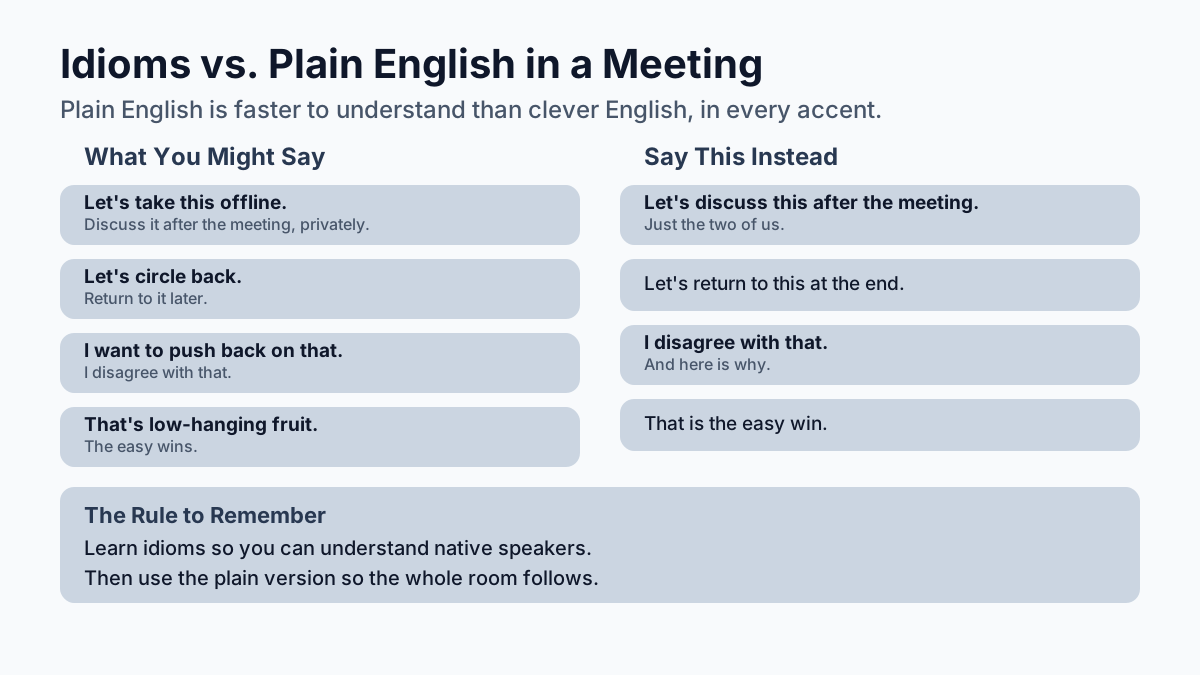
People search for the top ten business idioms so they can use them. My advice is the opposite: learn them so you understand the native speaker across the table, then do not use them yourself. Half the room did not grow up with them.
| What you hear | What it means | Say this instead |
|---|---|---|
| Let's take this offline. | Discuss it after the meeting, privately. | Let's discuss this after the meeting, just us two. |
| Let's circle back. | Return to it later. | Let's return to this at the end. |
| Can we touch base next week? | Have a short check-in. | Can we have a short call next week? |
| Are we on the same page? | Do we understand it the same way? | Do we all understand it the same way? |
| Give me a ballpark figure. | A rough estimate. | Give me a rough estimate. |
| I want to push back on that. | I disagree with that. | I disagree with that, and here is why. |
| That's low-hanging fruit. | The easy wins. | That is the easy win. |
| Let's park that. | Set it aside for now. | Let's leave that for now. |
| I don't have the bandwidth. | I don't have the time or capacity. | I don't have the time this month. |
| We need buy-in from finance. | Agreement and support from finance. | We need finance to agree. |
The right-hand column has no idiom in it. Plain English is faster to understand than clever English, in every accent.
Why the same phrase sounds different in Chicago and Paris
A phrase can be grammatically perfect and still sound wrong, because rooms have habits.
The British Council's business magazine, summarising Erin Meyer's The Culture Map, describes two of those habits. Business cultures in the US, Canada, Australia, and the UK tend to prefer examples first and the conclusion after (inductive persuasion), a distinction that comes from Meyer's own work. French, Italian, Spanish, and Russian business cultures tend to prefer the principle first and the examples after (deductive persuasion).
So Here is what happened with the last three suppliers, and here is what I conclude fits Chicago. Here is the principle, and here are three cases that prove it fits Paris. In a mixed room, do both in miniature: one sentence of principle, one example, then the conclusion. It takes twenty seconds longer and nobody feels ignored.
This is also why I coach phrases and not vocabulary. The managers I work with at companies like Google and Roche already have the words. What they want is the shape: the order that lets a Frankfurt board and a Taipei team hear the same message.
Closing the meeting, and preparing the next one
Closings are remembered as much as openings, and most meetings do not have one. They just stop.
Said: Okay, I think we're done. We need to fix the supplier thing.
Heard: someone else will fix the supplier thing.
The small change: So, the decision: we move to June. Anna sends the revised plan by Thursday. Everyone reviews it by Monday. Thank you.
A closing has three parts: the decision, the owner, and the date. Say all three out loud, in that order, every time.
Phrases to close:
- "Let me summarise what we agreed."
- "So the action is with Anna, by Thursday."
- "Before we close, what is one risk we have not discussed?"
- "Thank you. Same time next week."
Then comes the next meeting. You will find lists online of the five P's of meetings, five preparation words that all begin with P. Whatever your five are, the preparation that survives pressure is shorter than a script. Under pressure, you will not rise to your level of knowledge. You will fall to your level of training.
So I ask clients to decide three things in advance:
- What is my opening sentence?
- What is my key message?
- What is my closing decision or action?
Three sentences, prepared. In a WorldView Training session we then say them out loud, again and again, until they come without thinking. The sentence you have said ten times is the one that survives when the CFO frowns.
Improvise the middle with the phrases above. Never improvise the opening or the closing.
One line for tomorrow
Pick one phrase from this post for your next meeting. If you choose only one, choose this: Can I check I understood? It is the least impressive phrase here and the one that prevents the most damage.
Clarity in a meeting is a leadership skill, and it is available to anyone in the room, in any accent.
If you have an important presentation, meeting, or negotiation coming up in English, send me a message. I'd be happy to help you prepare.
Frequently asked questions
What are the 10 most important phrases in meetings?
One phrase per job: open ("Let's begin. We have three items and thirty minutes."), name the purpose ("The goal today is one decision."), give an opinion ("From my side, the main risk is timing."), give the reason, agree and add ("I agree, and I would add one thing."), disagree ("I see it differently. My concern is the cost."), interrupt ("May I add one point before we move on?"), check understanding ("Can I check I understood?"), move on ("Let's leave that for now."), and close with the decision, the owner, and the date.
What are some effective phrases for facilitating meetings?
Hand over by name ("Anna, what is your view on this?"), set a topic aside ("Let's leave that for now and come back to it at the end."), stop a loop ("We have heard both sides. I suggest we decide."), and bring in the quiet person ("Kenji, you have worked with this supplier. What did you see?"). Summarise each point out loud before moving on, especially when the meeting language is not everyone's first.
What are the top 10 business idioms?
Ten idioms common in English-language meetings are take this offline, circle back, touch base, on the same page, ballpark figure, push back, low-hanging fruit, park that, bandwidth, and buy-in. Learn them so you understand native speakers, then use the plain version yourself (for example "Let's return to this at the end" instead of "Let's circle back") so the whole room follows.
Sources reviewed
- British Council LearnEnglish -- Managing meetings Don't assume everyone understands each other when the meeting language isn't everyone's first language; ask for clarification and summarise each time a point is made.
- British Council LearnEnglish -- Conflict management Use specific, observable examples rather than absolute language ('you always,' 'you never') when raising a disagreement, and stay focused on the current issue rather than past grievances.
- British Council LearnEnglish -- Building trust Trust is built by demonstrating character (caring, fair, open, honest) as well as competence, and by assuming the best intentions behind a colleague's words rather than judging quickly.
- British Council LearnEnglish -- Negotiating Effective negotiators list their objectives and priorities, then ask questions to understand the other side's interests before proposing solutions, rather than starting from a fixed position.
- British Council LearnEnglish -- Influencing across cultures Citing Erin Meyer's The Culture Map, Anglo-Saxon business cultures (US, Canada, Australia, UK) tend to prefer inductive persuasion (examples before conclusions), while French, Italian, Spanish, and Russian business cultures tend to prefer deductive persuasion (theory before examples).
- Erin Meyer (INSEAD professor, author of The Culture Map) -- official site In today's global and virtual business world, executives and managers are expected to work harmoniously with counterparts from a broad range of cultures and backgrounds, often without leaving their desks.