A good presentation has ten qualities: one clear message, content built around what the listener needs to decide, a shape the listener can follow, a planned opening sentence, a closing that names the action, plain words said with intention, slides that support the speaker, a calm body and steady pace, pictures instead of abstractions, and enough practice that the delivery is automatic under pressure.
None of the ten needs a native accent.
A client of mine was preparing a presentation for a promotion. The middle of the talk was excellent. The opening and the closing were an afterthought.
That order is backwards. People remember how you started and how you ended. The middle is where they check their phones.
So here are the ten qualities in the order a listener meets them, with the exact words that change what a listener hears.
1. One message you can say in one sentence
A good presentation is built on a single core message: the one sentence you would still say if the projector died.
If you cannot say your message in one sentence, what you have so far is a topic.
Finish this sentence before you open the slide deck. By the end of this presentation, I want the room to... Approve? Decide? Agree to a date? Change one habit? If the sentence needs the word "and" three times, cut until it needs none.
What the speaker said: Today I want to share some updates on the project and also talk about a few challenges and maybe next steps.
What the listener hears: I am not sure what this meeting is for.
The small change: The project is two weeks behind. I need one decision from you today, and I will show you the two options.
Same speaker. Same project. Now the room knows why it is there.
2. Content built around what the listener needs to decide
Audience relevance means one thing in a business meeting: what does this listener need to decide? What you did, and everything else you know, comes second.
A finance director and an engineering lead can sit in the same room and need different halves of the same story. The finance director needs the cost and the date. The engineer needs the risk and the dependency. If you have both in the room, say which part belongs to whom. "This next part is for finance. Engineering, I will come to your question on slide six."
Knowledge level matters too. In an international company the gap is usually context rather than English: the person in Frankfurt does not know what the team in Taipei agreed last Tuesday. One sentence of background costs you ten seconds and saves the whole room from guessing.
What the speaker said: As you all know, the Q2 numbers came in and we had the situation with the supplier.
What the person who missed last week hears: I have already been left behind.
The small change: Quick background for anyone who missed last week: our main supplier missed two shipments in June. That is the reason for everything I show you next.
3. A shape the listener can follow
Structure is the quality a listener feels but cannot name. When the shape is clear, the listener relaxes, because they always know where they are. A simple structure beats a clever one, and it is far easier to hold in a second language when your brain is already busy with the words.
The shape I use with clients is three fixed points, never a script: the opening sentence, the key message, and the closing decision or action. Everything else hangs between those points, and if you lose your place you walk back to the nearest one.
The named techniques for holding a room inside that shape (signposting, the rule of three, the deliberate pause, and the numbered slide rules) are a subject of their own, and I cover them in a separate post on presentation techniques in English. Here the point is simpler: a listener should be able to answer "where are we?" at any moment without looking at the slide number.
4. An opening sentence you decided in advance
The first sentence is the one you will say with the most adrenaline in your body and the least English available to you. So it should be the one sentence you never have to search for.
Write it down, then say it out loud, standing up. Keep it short, and make sure it already carries the message.
What the speaker said: Okay, so, thank you everyone for joining, I know it is late for some of you, so, um, let me share my screen.
What the listener hears: This is going to take a while.
The small change: Thank you for staying late. In fifteen minutes I will ask you for one decision. Here is the situation.
The small change uses no harder English, only fewer words, and every word has a job.
5. A closing that names the decision or action
Most presentations stop. Very few of them end. The speaker runs out of slides, says so, that's it, any questions? and the room hears I am not sure what I want from you.
A good presentation ends with the action, said plainly, followed by silence. The silence is part of the closing. Let the room answer.
What the speaker said: So yeah, that's basically everything. Questions?
What the listener hears: He is finished and he wants to sit down.
The small change: The decision I am asking for is approval of option B by Friday. What would stop you from saying yes today?
That final question invites the objection while you are still standing, which is the only place you can answer it.
6. Plain words, said with intention
Clarity is the quality that decides whether the other nine get through. Plain words are a choice, and a strong one.
Native speakers are often the least clear people in the room. They speak quickly. They interrupt. They assume understanding. A second-language speaker who chooses short words on purpose is easier to follow than a native speaker running on idioms and speed.
Intention means you know what a word does to the listener. A client from China once asked me when to say "I would like to tell you about..." and when to say "I would love to tell you about...". Like is structure. Love is enthusiasm. Both are correct English. Only one of them tells the room you care.
The same care catches a sentence that is grammatically fine and still lands wrong. In a proposal role-play, a client told the customer, "You are not our only client." True, and reasonable. But what the customer hears is: you're not that important to us. So we made a small change: "We have other clients who deal with similar issues." Same basic idea. Completely different message.
7. Slides that support the speaker
Strong visual design is on every list of presentation qualities, and it earns its place. The test for a slide is simple: does the room look at you, or read the screen?
A slide has one job. It holds the one thing the listener should see while you say the one thing they should hear. When the slide carries every sentence, the listener reads ahead and stops listening. When it carries one number or one line, you are the presentation again.
The largest companies take this seriously enough to pay specialists for it. Duarte, the presentation design firm founded in 1988 by Nancy Duarte and Mark Duarte, quotes Forbes on its own site as saying it has worked with 84% of the top US-based tech companies.
What the speaker said, reading the slide aloud: As you can see on this slide, the three main drivers of the cost increase were raw materials, freight, and labor, which increased by...
What the listener hears: I can read faster than he speaks. I will read, and stop listening.
The small change: put the three drivers on the slide. Say only, Freight is the one that surprised us. Here is why.
8. A calm body and a steady pace
Delivery is where the second-language speaker gets nervous, and nerves start in the body before the brain is involved. A tight jaw and a shallow breath make English worse. Words come out fast and thin. Then you hear yourself, and you get more tense.
So the drill before a presentation is physical, and it takes less than one minute:
- Massage the corners of your jaw.
- Open and close your mouth slowly.
- Take two slow breaths through your nose.
Then the pace. Slow enough that you could stop after any sentence and it would sound finished. A steady pace also gives the room time to process, which matters when half the listeners are working in their second language too.
What the speaker said, in one breath: So basically what we found was that the issue was on the supplier side and not on ours and so what we did was...
What the listener hears: He is nervous. Maybe he is not sure.
The small change: The issue was on the supplier side. Stop. Breathe. Not on ours. Stop. Here is how we know.
Same facts. The pauses did the persuading.
9. Pictures instead of abstractions
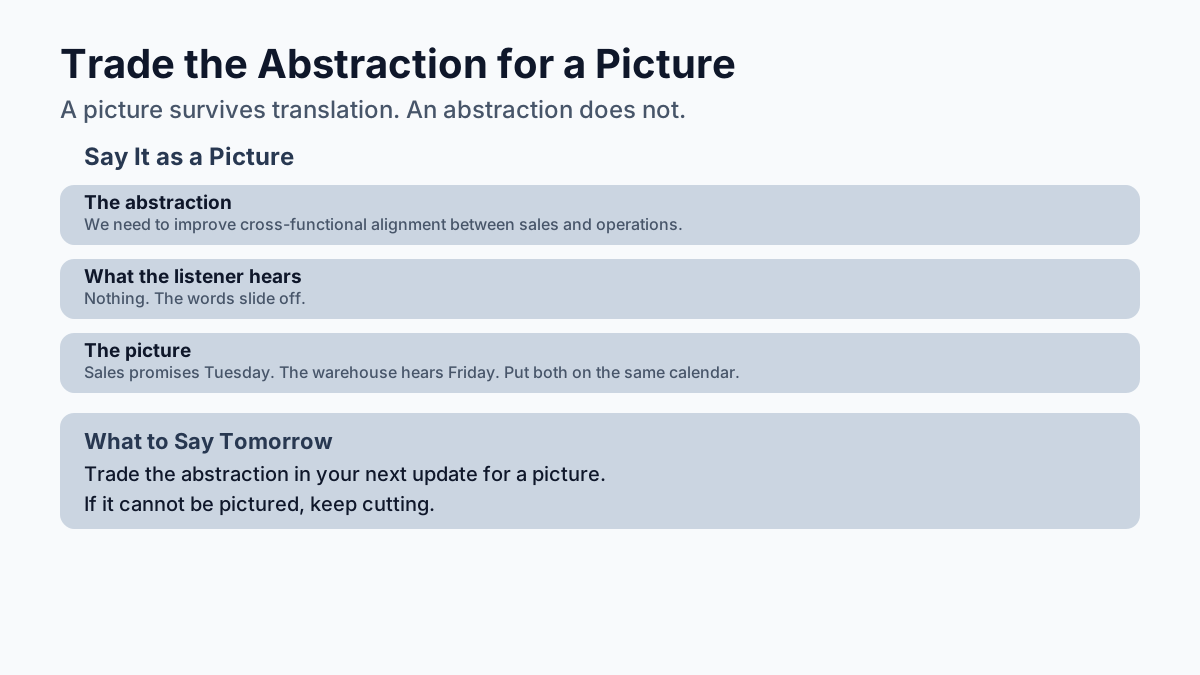
Strong leaders speak in pictures. A picture gives the listener something to hold, and it survives translation in a way that a business abstraction never does.
When Apple introduced the first iPod, its announcement put the whole product in one line: a thousand songs in your pocket. Anyone, in any language, could picture that.
What the speaker said: We need to improve cross-functional alignment between sales and operations.
What the listener hears: nothing. The words slide off.
The small change: Right now sales promises Tuesday and the warehouse hears Friday. I want both teams reading the same calendar by the end of the month.
The second version took no extra vocabulary, only a longer look at the problem.
10. Practiced until it is automatic
Pressure only lets out what you have trained. Everything you merely know stays inside.
The world has been testing that idea for a century. Toastmasters International, founded in 1924, has more than 260,000 members in over 13,800 clubs worldwide, with a stated mission of "empowering individuals to become more effective communicators and leaders." That is a great many people who decided that speaking is a muscle, and a muscle needs a room to work in.
What to practice is a narrower question than most people think. Practice the opening sentence and the closing sentence out loud, standing up, until you could say them while somebody talks over you. Practice the one sentence you will say when a question stumps you: "I do not have that number with me. You will have it by tomorrow morning." The middle can stay looser, because the middle is where you know the most.
The three questions I give WorldView Training clients before any high-stakes meeting are the same three every time. What is my opening sentence? What is my key message? What is my closing decision or action? Answer those out loud, and you have trained the parts that pressure attacks first.
Which of the ten matters most?
Chris Anderson gave a TED talk on exactly this question while he was TED's curator, and the talk's own summary puts it this way on its page: "There's no single formula for a great talk, but there is a secret ingredient that all the best ones have in common."
For a working manager in an international meeting, I would choose quality one. A presentation with one clear message survives a bad slide, a shaky voice, and a question you cannot answer. A beautiful presentation with no message survives nothing.
Clarity is a leadership skill before it is an English skill.
What are the 7 characteristics of a good speaker?
People also ask about the speaker rather than the presentation, and the two lists overlap without being the same. A presentation is a thing you build. A speaker is the person in the room while it happens.
Seven characteristics of a good speaker, in this frame: they know their one message; they look at people rather than the screen; they breathe; and they use plain words on purpose. They also pause instead of filling the gap with "um"; they answer the question that was asked rather than the one they prepared for; and they compare themselves to who they were last month rather than to the native speaker beside them.
That last one is the hardest, and the one I care about most. A client from Taiwan was hosting a Vietnamese customer in English, and for the first time she did not compare herself to her colleagues. That is the shift I want for every client: measured against yourself one month ago, and against nobody else in the room.
Where the 5 C's, the 7 pillars and the 3 P's fit
You will meet other lists: five C's, seven pillars, three P's, ten qualities of good speech. The letters change from trainer to trainer, and no official body owns any of them. Underneath, they all sort into three piles: what you say (message, structure, words), how you say it (voice, body, pace), and what you did before you said it (preparation and practice). The ten qualities above cover all three piles.
A speech and a presentation share every pile. The difference is the ending. A speech ends when the speaker finishes. A business presentation ends when the room decides.
The numbered slide rules (the ones with fives, sevens, and tens in their names) belong with the separate techniques post I mentioned earlier, so I will not repeat them here.
What to say in tomorrow's meeting
Pick one line from this post and use it once.
- To open: "In fifteen minutes I will ask you for one decision. Here is the situation."
- To bring someone up to speed: "Quick background for anyone who missed last week..."
- To close: "The decision I am asking for is X by Friday. What would stop you from saying yes today?"
- When a question stumps you: "I do not have that number with me. You will have it by tomorrow morning."
One line, said clearly, changes what the room hears. That has been the point of all ten.
If you have an important presentation, meeting, or negotiation coming up in English, send me a message. I'd be happy to help you prepare.
Frequently asked questions
What are 5 good presentation skills?
Five skills carry most business presentations: stating one message in one sentence, opening with a line you planned in advance, closing by naming the decision you want, choosing plain words on purpose, and holding a steady pace on a calm breath. Every one of them can be drilled in a second language without changing your accent.
What are the 10 qualities of good speech?
A good speech uses the same ten qualities as a good presentation: one message, listener-first content, a clear shape, a planned opening, a deliberate closing, plain words, visuals that support rather than replace the speaker, a calm body and pace, concrete pictures, and practice until delivery is automatic. The difference is the ending: a speech ends when the speaker finishes, and a business presentation ends when the room decides.
What are the 5 C's of public speaking?
There is no single official list of five C's; trainers use different sets of C-words, and no standards body owns the framework. Whichever letters you meet, they sort into what you say, how you say it, and how you prepared, which the ten qualities above cover in full.
Sources reviewed
- Toastmasters International — About (founding year) Toastmasters International was founded in 1924.
- Toastmasters International — About (mission statement) Toastmasters International's mission is 'empowering individuals to become more effective communicators and leaders.'
- Toastmasters International — About (membership/club count) Toastmasters International has more than 260,000 members in over 13,800 clubs worldwide.
- Duarte, Inc. — About (founding) Duarte, Inc. was founded in 1988 by Nancy Duarte and Mark Duarte.
- Duarte, Inc. — About (client-base stat) Duarte, Inc. states it has worked with 84% of the top US-based tech companies and that 98% of its customers are repeat buyers.
- TED — Chris Anderson, 'TED's secret to great public speaking' Chris Anderson (TED Curator) says there is no single formula for a great talk, but a shared secret ingredient among the best ones.