
Open-ended questions to ask customers in sales begin with What, How, Where, or Tell me about, and cannot be answered with yes or no. Three examples: What is slowing your team down right now? How do you handle that today? What would a good result look like in six months? Plan 11 to 14 questions, spread them across the call, and listen more than you talk.
In a proposal role-play, a client of mine told the customer across the table: You are not our only client. The idea behind it was experience: we have handled this before. What the customer heard was: you are not that important to us.
So we made a small change. We have other clients who deal with similar issues. Same basic idea. Completely different message.
That is the problem with most lists of open-ended questions. They tell you which questions to ask. They do not tell you what the customer hears when the question comes out in your second language, on a video call, at seven in the morning your time. This post does both.
Open or closed is the wrong thing to measure
Research on more than 35,000 sales calls found something the lists leave out.
Neil Rackham's SPIN Selling research, run by his firm Huthwaite International, observed more than 35,000 sales calls to find the behaviors most linked to success. The classic advice says: ask open questions, avoid closed ones. In my sessions, that split is not what decides the call.
Whether a question is open or closed tells you very little about what happens next. A closed question asked at the right moment moves a call further than an open one asked too early.
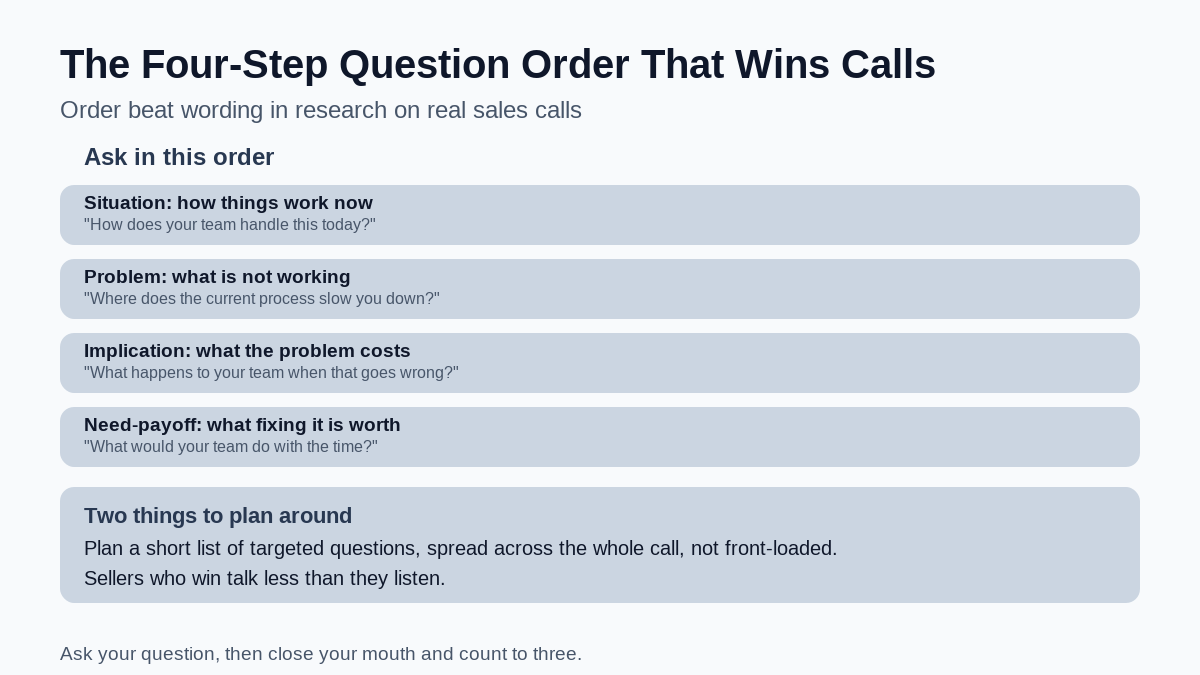
What Rackham's team trained was the order of the questions. Rackham's team trained sellers on a four-step sequence: Situation questions (how things work now), Problem questions (what is not working), Implication questions (what the problem costs), and Need-payoff questions (what fixing it would be worth). Among the first thousand sellers trained, at companies including Xerox, IBM and Motorola, the trained group achieved 17% higher sales volume than an untrained control group.
For a non-native speaker this is good news. You do not need clever grammar. You need a simple order, and a simple order is easy to hold in your head when you are nervous.
How many questions should you ask on a sales call?
Between 11 and 14, spread across the whole call.
That number comes from Gong, a company that records and analyzes sales calls. Its research found that the discovery calls most likely to lead to a sale asked roughly 11 to 14 targeted questions. Past that, results fall back to average. The call stops being a conversation and becomes an interview.
Where you put the questions matters as much as the count. Top performers spread their questions evenly through the call. Average performers ask most of theirs at the start.
Decide this in advance. Prepare shorter structures, not longer scripts. Before the call, write down three things: What is my opening question? What is the one thing I must learn before this call ends? What is my closing question about the next step? The other eight to eleven questions come from listening to the answers.
What are 10 open-ended questions to ask customers?
These are written for a seller whose English is good but not native. Short words. One idea per question. They follow the order Rackham's research supports.
To learn the situation:
- How does your team handle this today?
- Who is involved when a decision like this is made?
- What changed recently that made you look at this now?
To find the problem:
- Where does the current process slow you down?
- What goes wrong most often?
- What have you already tried?
To understand what it costs:
- What happens to your team when that goes wrong?
- How does that show up for your own customers?
To hear the value in the customer's words:
- If this were fixed, what would your team do with the time?
- What would make this an easy decision for your boss?
Question 9 feels slow, so it is easy to skip. It is the one that does the selling. The customer describes the benefit in the customer's own words, and you did not have to claim anything.
What the customer hears: five small changes
A good question can still land badly. Here are five common ones, what the customer on the other side hears, and the small change that fixes each.
You ask: Why did you choose your current supplier? The customer hears: defend that decision. The small change: "What made your current supplier the right choice at the time?" The customer gets to be right, and you still learn how they decide.
You ask: Do you have any problems with your current process? The customer hears an easy exit. "No, we're fine," and the topic is closed. The small change: "Where does the current process slow your team down?" The question assumes there is a place, and most customers will name one.
You ask: What is your budget? The customer hears: how much can this person charge me? The small change: "How does your team usually decide what to spend on something like this?" You learn the process first. The number usually follows without being asked for.
You ask: Does that make sense? The customer hears: are you keeping up? The small change: "Which part would you like me to explain in a different way?" This one matters when English is your second language. "Does that make sense?" is the question we reach for when we are worried about our own English. To the listener, it sounds like we doubt theirs.
You ask: What do you want? The customer hears impatience. The small change: What would you like this to look like when it is done? In many languages the direct form is polite. In an English sales call it lands hard, and the fix is a few extra words.
None of these are stupid mistakes. Each one is a reasonable sentence. The customer simply hears something you did not mean, and in sales you rarely get a chance to explain what you meant.
The five W questions, and the problem with Why
What, Who, When, Where, Why. Add How, and you have the six words most open-ended questions begin with.
What and How do most of the work in a sales call. They ask for a description, and a description gives you something to build on.
Why is different. In many languages, why is a neutral word. In English, at the front of a question, said to a customer, it often sounds like an accusation. "Why did you do that?" is what a parent says. The same information is available without the risk: move the reason into the middle of the sentence. "What was behind the decision to change suppliers last year?" asks why, and lets the customer stay comfortable.
If you change one word in your next call, change this one.
Listen more than you talk: the 57 percent line
Sellers who win talk less. Gong measured this across 326,000 sales calls of at least ten minutes each. On deals that closed, the seller talked for 57 percent of the call. On deals that were lost, 62 percent. Five points, and they point in one direction.
Dan Morgese, Gong's Director of Content Strategy and Research when he wrote up that analysis, put it plainly: "Listen more than you talk, and importantly, stay consistent in how you execute your sales process."
I used to think being a native English speaker was my edge in global business. I do not think that anymore. I see non-native speakers lead meetings better than the native speakers in the room. The natives speak quickly. They interrupt. They assume they were understood.
If English is your second language, you already speak more slowly and use fewer words. On a sales call, that is the winning ratio. Your job is to protect it, especially in the seconds right after you ask a question, when the silence feels longest.
A drill for that moment. Ask your question. Close your mouth. Breathe out slowly through your nose and count to three before you say anything else. This takes less than five seconds, and the customer usually fills the silence with the thing you needed to hear.
How to talk to customers in sales: a worked example
Here is a made-up call that shows the sequence. The customer runs operations at a delivery company. The seller sells route-planning software and keeps every sentence short.
Seller: How does your team plan the week's routes today?
Customer: Two planners, one spreadsheet, every Friday afternoon.
Seller: What goes wrong most often?
Customer: The changes come in over the weekend. They plan the week on Friday and replan it on Monday.
Seller: What happens to the drivers when the Monday replan is late?
Customer: They wait. Some leave without a plan and we call them on the road.
Seller: How does that show up for your customers?
Customer: Late deliveries on Mondays. We hear about it.
Seller: If Monday looked like Wednesday, what would the two planners do with the time?
Customer: They could handle the two new depots without us hiring.
Five questions in, the customer has told the seller what the product is worth: two new depots without a new hire. The seller has not described a single feature.
Now it is the seller's turn to speak. A client from China once asked me when to say *I would like to tell you about…" and when to say "I would love to tell you about…". The answer is small. Like signals structure. Love signals enthusiasm. After a customer has just described a Monday problem, structure is the better choice: "I would like to show you the two parts of this that deal with Monday changes." Two parts, not the whole product.
That is what we did in the proposal role-play at the top of this post: the same call a second time, after going through what the customer heard.
The 3-3-3 habit
You will see a "3-3-3 rule" for sales described in more than one way. Here is a version small enough to survive pressure.
Three questions before you describe anything you sell. Three seconds of silence after every answer. Three sentences, at most, each time it is your turn to talk.
That is all of it. It fits on a sticky note beside the camera, which is where I want it.
Nobody trained you to ask questions, and that is fixable
Two Harvard Business School professors, Alison Wood Brooks and Leslie K. John, wrote in 2018 that asking questions well "spurs learning and the exchange of ideas, it fuels innovation and performance improvement, it builds rapport." They also wrote that, unlike litigators, journalists and doctors, few executives think of questioning as a skill that can be honed.
My clients do not need a grammar lesson. They need someone sitting across from them, playing the customer, telling them what a question sounded like.
Rackham made the same point about his own results: "it wasn't the four little questions. It was the whole coaching process, which was also the research process."
So here is what to say in tomorrow's call. Open with: How does your team handle this today? When the answer ends, close your mouth and count to three. When it is finally time to describe your product, begin with: "I would like to show you the two parts of this that deal with what you just described."
If you have an important sales call, meeting, or negotiation coming up in English, send me a message. I'd be happy to help you prepare.
Frequently asked questions
What are three open-ended questions to ask customers?
Use one from each stage of the call: "How does your team handle this today?" to learn the situation, "Where does that slow you down?" to find the problem, and "If this were fixed, what would your team do with the time?" to hear the value in the customer's own words.
What are the 5 W questions in sales?
What, Who, When, Where and Why, usually with How added as a sixth. What and How produce the most useful answers in a sales call, while Why at the front of a question can sound like an accusation in English, so ask "What was behind that decision?" instead of "Why did you decide that?"
What is the 3-3-3 rule in sales?
The rule is described in more than one way, so treat it as a habit rather than a law: ask three questions before you describe your product, wait three seconds after each answer, and keep each of your own turns to three sentences.
Sources reviewed
- Huthwaite International — SPIN Selling research overview
- Huthwaite International blog — Neil Rackham on the SPIN research
- Huthwaite International blog — Neil Rackham on the SPIN research (quote)
- Gong Labs — Data-driven tips on sales discovery calls
- Gong Labs — Data-driven tips on sales discovery calls
- Gong — Mastering the talk-to-listen ratio in sales calls
- Gong — Mastering the talk-to-listen ratio in sales calls (quote)
- Harvard Business Review — "The Surprising Power of Questions"