
Negotiation examples are real or realistic situations where two sides want different things and talk until they agree on one. The most common are a salary offer, a vendor's price, a project deadline, a customer asking for a discount, and a car purchase. In each one, the words you choose decide what the other side hears, and that shapes the outcome as much as the numbers do.
Here is one from a session. In a proposal role-play, a client of mine said to the other side: "You are not our only client." Every word was true. But what the other side hears is: You're not that important to us. So we made a small change: "We have other clients who deal with similar issues." Same basic idea, completely different message.
That three-beat shape (what you said, what they heard, the small change) is how every example in this post is built. The numbers in a negotiation matter. The sentence you wrap the numbers in matters more, because the sentence is the part the other person reacts to.
What is negotiation, and what does an example look like?
Negotiation is a conversation between people who need each other's yes and do not yet agree on the terms. That is the whole definition. It does not need a table or a contract.
A plain example: your manager wants the demo on the 15th. You need two more weeks to finish testing. The conversation where you find the version both of you can accept ("the two core screens on the 15th, the full build on the 29th") is a negotiation. Nobody called it one. Most negotiation at work looks exactly like this.
Examples help because most people avoid the conversation entirely. In a survey of 1,000 full-time U.S. workers, fielded in late 2024 and analyzed in 2025, 55% said they did not negotiate their starting salary. Of the workers in that survey who did negotiate, 78% ended up with a better offer. A separate Glassdoor survey of nearly 6,700 professionals found 54% did not negotiate the salary for their most recent job. And two field experiments with more than 3,100 U.S. tech-sector job seekers found that a short encouragement message increased both the number who tried to negotiate and the pay they gained.
Read that last one again. A light nudge was enough to change behavior and money. Most of the barrier is permission: knowing you are allowed to ask, and having a first sentence ready.
For a non-native speaker, the first sentence is the whole barrier. You know what you want. You are not sure how to say it without sounding rude or unsure. So you say nothing, and the 55% grows by one.
Everyday negotiation examples, in the said-heard-change shape
Each example below is a work moment my readers face: managers and sales professionals doing their jobs in English as a second or third language. The situations are ordinary. The small change is the lesson.
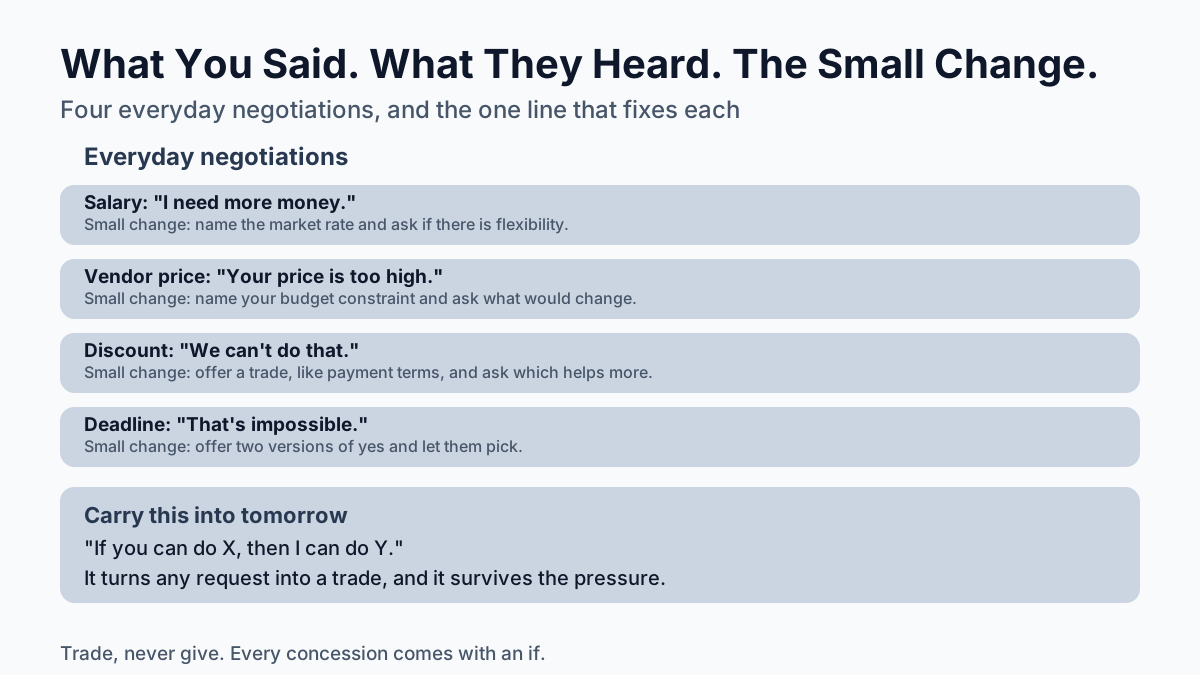
The salary offer
You said: "I need more money."
What they hear: a demand with no reason attached. The recruiter now has to defend the number, so they do.
The small change: "Thank you for the offer. Based on the market for this role and the scope we discussed, I was expecting a base closer to 95,000. Is there flexibility there?"
Same request. Now it has a reason (the market, the scope), a number, and a question that invites the other side to move without losing face. If you hold another offer, name it plainly and once: "I have a second offer at 92,000. I'd prefer to join you. Can you match it?"
The vendor's price, when you are buying
You said: "Your price is too high."
What they hear: "I do not value your work." The seller stops listening and starts defending.
The small change: "The price is above the budget I have approved. What would need to change in the scope to bring it closer to 40,000?"
You have moved the conversation from their worth to your constraint. A constraint is something the other side can work with. An insult is something they have to survive.
The customer asks for a discount, when you are selling
You said: "We can't do that."
What they hear: a door closing. Also, faintly, the same message as "you are not our only client."
The small change: "I can't move on price for this scope. I can move on the payment terms, or on the start date. Which helps you more?"
This is the trade. Every time you give something, you get something. If you have nothing left to trade, offer a choice. A choice feels like movement even when the price stands still.
The project deadline
You said: "That's impossible."
What they hear: a refusal. Possibly: not a team player.
The small change: "I can deliver the full scope on the 20th, or the first two modules on the 10th and the rest on the 20th. Which is more useful to you?"
You never said no. You offered two versions of yes and let the other person choose. If they need the full scope on the 10th, the trade is resources: "For the 10th, I would need one more tester from the 1st."
The raise
You said: "I've been here three years."
What they hear: a claim based on time, and time alone.
The small change: "Since January my team has taken on the two accounts that used to sit with the regional office. I'd like to talk about adjusting my compensation to match the role I'm doing now."
Tenure is a fact. The change in scope is the argument.
Buying a car, and the other everyday cases
The same shape works outside the office. A buyer who asks "What's your best price?" will get a high number, because the question tells the salesperson there is no figure in your head yet. "I'm ready to sign today at 28,500 drive-away, including the trade-in" gives them a number to work toward. If the price will not move, trade for something that costs them less: "Keep the price, and include the first two services." A hotel that overbooked, a landlord raising the rent, a contractor whose quote came in high, a freelancer whose scope grew: the same three beats every time.
Negotiating situations at work that nobody calls negotiations
The internal ones. With your manager about scope. With another team about a shared developer. With a colleague about who presents. These are negotiations too, and they are the ones most managers walk into with no sentence prepared.
| Situation | What you want | What they want | A sentence that opens it well |
|---|---|---|---|
| A shared developer for two weeks | Their time | Their own deadline protected | "If you can give me one developer for two weeks, I can take the QA work off your team in March." |
| A client adds scope with no extra budget | To be paid for the extra work | The extra work | "I'd love to include that. It sits outside the current scope, so I'll send a short estimate for it today." |
| A candidate holds another offer | Them, at your number | The best package | "I can't match the base. I can move the start bonus and the review date. Would that work?" |
| A supplier's delivery date slips | The original date | Not to be blamed | "What would need to be true on your side to hold the 15th?" |
| Meeting times across time zones | Your evening free | Their evening free | "Can we alternate? You take the early slot this week, I take it next week." |
| A customer who pays late every month | Cash on time | Flexibility | "I can extend terms to 45 days if we move to direct debit." |
Every sentence in that last column is short. That is on purpose. Under pressure, a long sentence in a second language breaks in the middle. A short one arrives whole.
Negotiation techniques, with the words to use
People search for techniques. I teach sentences, because a technique you cannot say under pressure is a technique you do not have. These are the ones that hold up in a second language.
Anchor first, with a reason. The first number in the room pulls every later number toward it. "Based on the volume you described, I'm proposing 12 per unit." The reason is what stops the anchor from sounding like a wish.
Trade, never give. The conditional sentence is the most useful sentence in negotiation: "If you can do X, then I can do Y." Practice it until it is automatic. "If you can commit to twelve months, then I can hold this year's price."
Ask instead of refusing. A no ends the conversation. A question keeps it open and hands the work back. "Help me understand what is driving the deadline." "What would make this work on your side?"
Use the pause. In a second language you feel pressure to fill silence, because silence feels like a failure to understand. It is not. "Give me a moment to think about that" is a complete, professional sentence. Say it, then think.
Summarize before you close. Openings and closings are remembered; the middle is not. "So far we agree on the price and the start date. The open point is the payment terms. I'll send a proposal on that by Thursday." The other side leaves the call with your summary in their head.
Choose like or love on purpose. A client from China once asked me when to say "I would like to tell you about…" and when to say "I would love to tell you about…". Like is structure. Love is enthusiasm. In a negotiation, "I would like to propose one change" is structure. "I would love to find a way to make this work" is warmth, and it is the sentence to use right before you ask for something hard.
What should you not do when negotiating?
Most negotiation mistakes are sentences. Here are the common ones, in the same shape.
You said: "We'd like 10%. But 5% would also be fine." What they hear: 5%. You negotiated against yourself in one breath. Say the number, then stop talking.
You said: "Sorry to ask, but maybe, if it's possible, could we perhaps…" What they hear: this request is optional. Drop the cushion. "I'd like to propose one change."
You said "Yes, okay" because the silence was uncomfortable. What they hear: agreement. If you need time, take it out loud: "I'll confirm by 3 p.m. tomorrow." Buying time is a normal move, and nobody respects you less for it.
You answered a question you did not fully understand. What they hear: an answer, which they will hold you to. Ask again: "Could you say that again more slowly? I want to be sure I answer the right question." That sentence costs you nothing and saves you from agreeing to the wrong thing.
You matched the speed of the fastest speaker in the room. I used to think being a native speaker was my edge in global business. I don't think that anymore. The native speaker who talks fast, interrupts, uses idioms and assumes everyone followed is often the weakest communicator on the call. Speak at your own pace. Slower sounds like control.
You made a threat. "If you don't accept this, we'll go elsewhere" is heard as an ultimatum, and people fight ultimatums even when they should accept them. How to show a strong alternative without a threat, and whether to reveal it at all, belongs to the separate post on BATNA examples (your best alternative if this deal falls through).
The seven rules people ask for, and the one that matters most
Searchers ask for the seven basic rules of negotiating. There is no official seven. These are the seven I would defend for anyone negotiating in a second language:
- Decide your opening sentence and your number before the call, never during it.
- Give the first number, with a reason attached.
- Trade, never give. Every concession comes with an "if."
- Ask a question before you say no.
- Speak at your own pace. Silence is allowed.
- Summarize before you close, in one sentence they can repeat.
- Keep the relationship warmer than the disagreement.
If I had to keep one, it is the first. William Ury, co-founder of Harvard's Program on Negotiation and co-author of Getting to Yes, put it this way: "Sometimes the most difficult opponent is the person staring back at you in the mirror." He is describing self-management, and self-management is prepared, never improvised. Under pressure, you will not rise to your level of knowledge. You will fall to your level of training.
So train the small things until they are automatic. Preparation is three questions, decided in advance:
- What is my opening sentence?
- What is my key message?
- What is my closing decision or action?
Write the three answers on one line each. Say them out loud twice. That is the whole preparation for most work negotiations, and it is more than most people on the call have done. In WorldView Training sessions the role-play is exactly this: you say your three sentences, the other side pushes, and we find the small change together before the real call.
One more thing, in the sixty seconds before you join. Tension in the jaw and the breath makes your English worse before your brain is even involved. So:
- Massage the corners of your jaw.
- Open and close your mouth slowly.
- Take two slow breaths through your nose.
It takes less than one minute, and your first sentence comes out at your normal pitch instead of a tight one.
Big negotiations follow the same rule at a larger scale. Bob Iger, Disney's CEO at the time, said he and George Lucas negotiated personally for more than two years before Disney bought Lucasfilm for $4.05 billion. Your Thursday call with a supplier will be shorter. The preparation rule is the same.
One sentence to carry into tomorrow's meeting
If you take one line from this post, take the conditional: "If you can do X, then I can do Y." It turns every request into a trade, and it is short enough to survive the pressure.
If you have an important presentation, meeting, or negotiation coming up in English, send me a message. I'd be happy to help you prepare.
Frequently asked questions
What is negotiation and its example?
Negotiation is a conversation between people who need each other's agreement and do not yet agree on the terms. A manager who wants a demo on the 15th and an engineer who needs two more weeks, settling on two core screens by the 15th and the full build on the 29th, is a complete example.
What are the 7 basic rules of negotiating?
There is no official list of seven. A defensible set for anyone negotiating in a second language: decide your opening sentence and your number in advance, give the first number with a reason, trade instead of giving, ask a question before saying no, speak at your own pace, summarize before you close, and keep the relationship warmer than the disagreement.
What not to do when negotiating?
Do not offer a second, lower number before the other side has answered, do not apologize for asking, do not say yes to end an uncomfortable silence, do not answer a question you did not fully understand, and do not make threats. Ask for a moment, or for the question again, instead.
Sources reviewed
- NBER Working Paper w33903 — 'Pushing the Envelope: The Effects of Salary Negotiations' (Cullen, Pakzad-Hurson, Perez-Truglia)
- Harvard Law School Program on Negotiation — '10 Real-World Negotiation Examples' (Samantha Burke)
- Harvard Law School Program on Negotiation — '10 Real-World Negotiation Examples' (Samantha Burke)
- Harvard Law School Program on Negotiation — Q&A with William Ury, author of 'Getting to Yes With Yourself' (Lara SanPietro, June 25, 2021)