
An office telephone conversation in English runs in five stages: open with your company and your name, give the reason for the call in one sentence, confirm what you heard by saying it back, agree the next action, and close with thanks. Practiced phrases for those five moments beat a bigger vocabulary, because the phone removes every visual cue and leaves only your words and your voice.
The phone is the hardest place to speak a second language.
Your listener cannot see your face. You cannot see theirs. The nod, the raised eyebrow, the small smile that carries a meeting along, all of it is gone. What is left is a voice on a line, and the listener decides in a few seconds whether that voice sounds calm and in control.
So the job on a call is smaller and sharper than in a meeting. Below are the phrases for each moment, and the small changes that stop a polite sentence from landing as a rude one.
Why the phone changes the rules
You have probably heard that words are only 7 percent of communication, tone of voice is 38 percent, and body language is 55. The numbers come from Albert Mehrabian's research, and they are narrower than the way most people repeat them. Mehrabian's own site says the formula applies only to communicating feelings and attitudes, such as whether you like or dislike the person in front of you. It was never a rule for communication in general. When you tell a colleague the shipment is late, the words carry the meaning.
Now look at that narrow finding again. Feelings and attitudes. That is exactly what your listener is trying to read on a call. Are you friendly? Are you confident? Are you annoyed with me?
In a meeting they read your face for that. On the phone, the face is gone, and everything they conclude about your attitude comes from the words you choose and the way your voice carries them.
This is why a small set of practiced phrases does more for you on the phone than a large vocabulary. The right phrase, said in a steady voice, tells the listener you are calm. A long, uncertain sentence tells them the opposite, even when every word is correct.
How do you answer an office phone in English?
Three pieces, in this order. A greeting, the company or department, your name. Then an offer to help.
"Good morning, [company name], this is Ana speaking. How can I help you?"
Inside the company, two words do: "Accounts, Tomas speaking."
The common mistake is speed. A nervous speaker picks up, says "Hello? Yes?" and waits. On the other end, that sounds like: you have interrupted me. The small change: slow down and give the three pieces. "Good afternoon, this is Tomas in accounts. How can I help?"
"Who is this?" sounds like suspicion, even when you only need a name for the message. The small change: "May I ask who's calling?"
Then one of these:
- "One moment, please. I'll put you through."
- "I'm afraid she's in a meeting. Can I take a message, or would you like her to call you back?"
- "He's out of the office today. Could I have your name and number?"
Say the caller's name back once. "Thank you, Mr. Okafor. I'll pass that on." It tells the person they were heard.
Making the call: decide three things before you dial
Preparation for a call is three questions.
What is my opening sentence? What is my key message? What is the decision or action I want at the end?
Write the answers on one line each. That is the whole plan. People who write a full script sound like they are reading, and lose their place the moment the other person says something unexpected. Prepare shorter structures, not longer scripts.
Then give your body one minute. Tension in the jaw and the breath makes English worse before the brain is even involved.
- Massage the corners of your jaw.
- Take two slow breaths through your nose.
- Say your opening sentence out loud, once.
This takes less than one minute.
The opening sentence has three parts: name and company, the reason for the call, and a check that this is a good time.
"Hello, this is Mei Lin from [company]. I'm calling about the March invoice. Is this a good time?"
"I want to talk about the invoice" sounds like a demand, and to some ears like the start of a complaint. The small change: "I'm calling about the March invoice. There's one line I'd like to check with you." Same purpose, and the listener is no longer braced for a fight.
A client from China once asked me when to say "I would like to tell you about" and when to say "I would love to tell you about." The answer is short. Like signals structure. Love signals enthusiasm. On a call about a late invoice, use like. On a call to hear how the first month went, use love.
"Is this a good time?" matters more across time zones. If you dial from the US East Coast at nine in the morning, a colleague in Frankfurt is already past lunch and a supplier in Taipei is finishing dinner. One short question shows you know that.
Confirming what you heard: the sentence that saves the call
The most useful sentence on any office call is the one where you say the key point back in your own words.
"So, just to confirm, you need the revised quote by Thursday, and it goes to Priya, not to you. Is that right?"
That one sentence catches most of the mistakes a call can produce, and it tells the other person you were listening.
Two habits get in the way.
The first is "Yes, yes, okay." A worried speaker agrees quickly to keep the call moving. On the other end, fast agreement sounds like: you are not listening, or you agree without understanding. The small change: "Let me say that back to you."
The second is "I don't understand." It is honest, but it points the problem at your English. The fix turns it into a question about the detail: "Sorry, I want to be sure I have this right. Did you say the fifteenth or the fiftieth?"
Numbers are where calls go wrong. Fifteen and fifty. Thirteen and thirty. When a number matters, say it twice in two ways: "That's fifteen, one five." Do the same with names: "Could you spell that for me?" then confirm each letter with a word, "B as in Berlin?"
Two more for a bad line. "What?" sounds like impatience. The small change: "Sorry, I missed that. Could you say it again?" And "Repeat, please" sounds like an order. The change: "The line broke up for a second. Could you repeat the last part?"
Holding, transferring, and saying no without sounding cold
The difference between "Wait" and "Could you hold?" is the difference between an order and a request.
- "Could you hold for a moment? I'll check that for you."
- "Thank you for holding."
- "I'll put you through to Maria in shipping now."
- "Could I have your number, in case we get cut off?"
Saying no is harder on the phone, because there is no friendly face to soften it.
During a proposal role-play, a client of mine said, "You are not our only client." True. But on the line it can easily sound like: you are not that important to us. So we made a small change: "We have other clients who deal with similar issues." Same basic idea, but a completely different message.
The pattern works for any refusal. "I can't do that today" sounds like a closed door. The small change shows the door that is open: "I can have that to you by Wednesday. Does that work?"
Calls with a refusal or a difficult number in them are among the moments I prepare people for at WorldView Training. The fix is usually one sentence.
Closing the call so you are remembered well
People remember how a call opened and how it closed. The middle fades. So the last twenty seconds deserve as much care as the first twenty: signal the end, state the next action, thank the person.
"Before I let you go, is there anything else you need from me?"
"Thanks for your time. I'll send the summary by five today. Speak soon."
"Okay. Bye." sounds like you wanted the call to end. The small change adds one line of substance before the goodbye: "Thanks, this was useful. I'll send you the dates this afternoon. Goodbye."
When a call runs long, a native speaker will often say "I'll let you go." It sounds like permission. It is a polite exit, and you can use it too.
The phrases, by moment
Twenty-five phrases, one per moment.
| Moment | Say this |
|---|---|
| Answering an outside call | "Good morning, [company], this is [name] speaking. How can I help you?" |
| Answering an internal call | "Accounts, Tomas speaking." |
| Asking who is calling | "May I ask who's calling?" |
| Transferring | "One moment, please. I'll put you through." |
| Person unavailable | "I'm afraid she's in a meeting. Can I take a message?" |
| Taking a number | "Could I have your number, in case we get cut off?" |
| Opening your own call | "Hello, this is [name] from [company]. I'm calling about [topic]." |
| Checking timing | "Is this a good time?" |
| Asking for a person | "Could I speak to Priya Nair, please?" |
| Leaving a message | "Could you ask her to call me back? My number is..." |
| Saying the reason | "There's one line on the invoice I'd like to check with you." |
| Asking a question | "Could you tell me when the shipment left?" |
| Confirming | "So, just to confirm, you need it by Thursday. Is that right?" |
| Checking a number | "That's fifteen, one five?" |
| Spelling a name | "Could you spell that for me? B as in Berlin?" |
| Missed something | "Sorry, I missed that. Could you say it again?" |
| Bad line | "You're breaking up a little. Can I call you back?" |
| Asking to hold | "Could you hold for a moment? I'll check." |
| Back from hold | "Thank you for holding." |
| Refusing gently | "I can't do today, but I can have it to you by Wednesday." |
| Agreeing the next step | "I'll send the revised quote this afternoon." |
| Signaling the end | "Before I let you go, is there anything else you need?" |
| Ending politely | "I'll let you go. Thanks for your time." |
| Closing | "Thanks, this was useful. Speak soon." |
| Voicemail | "This is [name] from [company]. Please call me back on [number]. Again, that's [number]." |
Say them out loud. Speaking is a muscle. A phrase you have said fifty times in an empty room is the one that comes out when the line is bad.
What do you talk about before the business starts?
Small talk on a work call is one exchange, then the reason for the call.
Safe topics are the ones tied to the moment: the time of day where they are, the weather where they are, a shared work event. "How's your week going?" "I hear it's been hot in Madrid." "How did the launch go on Tuesday?" Answer in one sentence, ask one back, then move: "Anyway, the reason I'm calling..."
Leave politics, religion, salary, and health alone.
If you do not know whether the person wants small talk at all, offer one line and watch whether they take it. If they answer in one word, say "I know you're busy, so I'll be quick" and move on.
Decoding the phrases native speakers use on the phone
Native speakers are often the hardest people to understand on a call.
They speak quickly.
They interrupt.
They assume understanding.
I used to think being a native speaker was my edge in global business. I don't think that anymore. The people who run calls best are the ones who slow down and check, and many of them learned English as adults.
Until the native speakers slow down, it helps to know what their phone idioms mean:
- "Hang on" means wait a moment. "Hang up" means end the call. Two short words, opposite meanings.
- "I'll give you a buzz" or "a ring" means I will call you.
- "I'll ping you" means I will send you a message, usually by email or chat.
- "Let's touch base" means let's have a short conversation.
- "I'll circle back" means I will return to this later.
- "Let me loop in Sam" means I will include Sam in the conversation.
- "You're breaking up" means the line is bad. It says nothing about your mood.
You do not need to use these. Plain English is clearer on a bad line than any idiom. You only need to recognize them.
What are the seven P's of telephone etiquette?
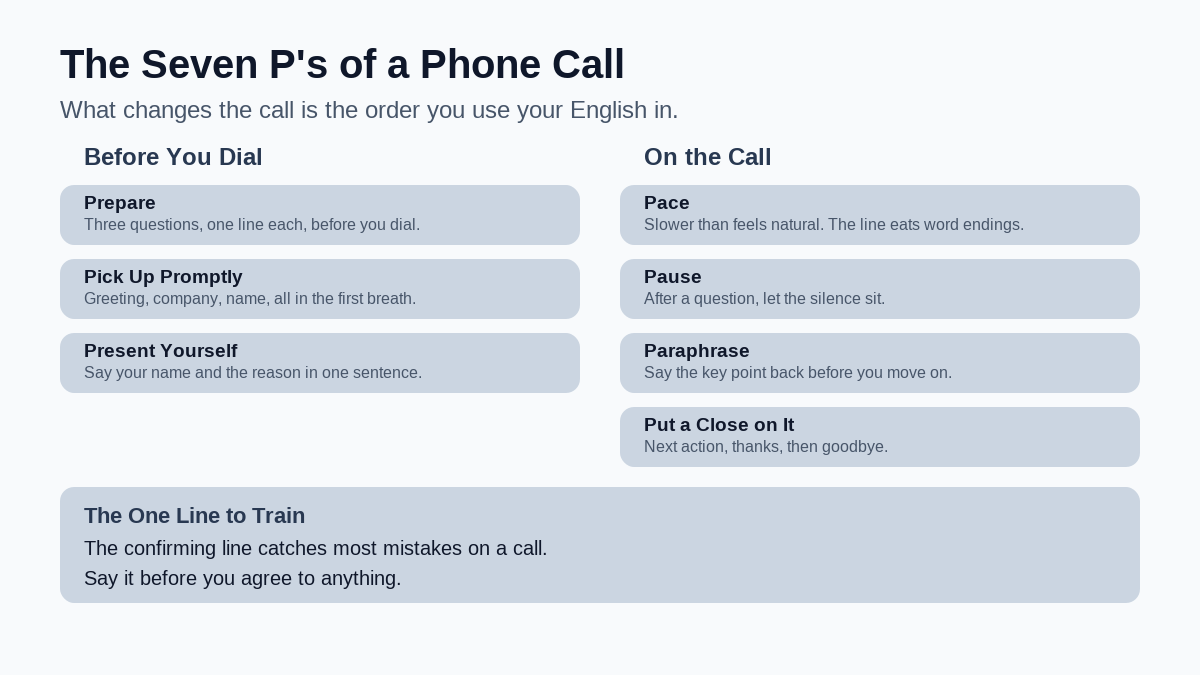
Here is a set of seven that fits an office call in English, in the order they happen.
- Prepare. Three questions, one line each, before you dial.
- Pick up promptly, with the three pieces: greeting, company, name.
- Present yourself. Name and reason in the first sentence.
- Pace. Slower than feels natural. The line eats the ends of words.
- Pause. After a question, let the silence sit.
- Paraphrase. Say the key point back before you move on.
- Put a close on it. Next action, thanks, goodbye.
Six of the seven are about structure. The English you already know is enough for almost every office call. What changes the call is the order you use it in, and the steadiness of the voice carrying it.
The one line to carry into tomorrow's call
Under pressure, you will not rise to your level of knowledge. You will fall to your level of training.
So train one line until it is automatic. My suggestion is the confirming sentence, because it does the most work: "So, just to confirm..." Say it on your next call, before you agree to anything. It will catch a mistake, or it will show the other person you were listening.
If you have an important call, meeting, or negotiation coming up in English, send me a message. I'd be happy to help you prepare.
Frequently asked questions
What are some examples of telephone conversations in an office?
The four most common are answering an outside call ("Good morning, [company], this is Ana speaking. How can I help you?"), making a call ("This is Mei Lin from [company]. I'm calling about the March invoice. Is this a good time?"), taking a message when someone is unavailable, and confirming a detail before the call ends ("So, just to confirm, you need it by Thursday. Is that right?").
What are the seven P's of telephone etiquette?
One workable set, in call order: prepare, pick up promptly, present yourself, pace, pause, paraphrase, and put a close on it. Six of the seven are about structure rather than vocabulary, which is why the English you already know is enough for most office calls.
What are good conversation topics for a work phone call?
Keep small talk to one exchange tied to the moment: the time of day or weather where the other person is, or a shared work event such as a recent launch. Avoid politics, religion, salary, and health, then move on with "Anyway, the reason I'm calling..."
What are the most common phrases in telephone communication?
"How can I help you?", "May I ask who's calling?", "Could you hold for a moment?", "I'll put you through", "Sorry, I missed that, could you say it again?", "So, just to confirm...", and "Thanks for your time, speak soon" cover most office calls in English.