
English for online meetings is the set of phrases and habits that keep a video call clear when nobody can read the room: check the sound, name what you are doing on screen, ask short direct questions, pass the turn to a person by name, and confirm what you heard before you move on. The English you already know is enough. The screen changes how you use it.
Five virtual meetings a week. That is the average now, alongside five more in person, so half of a working week's meetings arrive through a camera and a microphone. Five times a week, the room is a grid of small faces, some cameras off, one person frozen mid-sentence. On those same calls, 77% of the workers surveyed say they have lost time to technical difficulties.
A manager who gives a clean update in a conference room can give a flat, hurried version of the same update on a call. The grammar did not change. The room stopped answering back.
The phrases for each stage of a meeting (opening and stating the purpose, giving an update, holding a decision, closing) have their own post on this blog. This post is about what the screen changes, and what to say because of it.
Why the same meeting is harder through a camera
Stanford researcher Jeremy Bailenson argued in a 2021 paper that a video call costs more mental effort than the same conversation in a room, for physical reasons that have nothing to do with language: close-up eye contact for the whole call, watching your own face, and sitting still inside a small frame. He called it nonverbal overload.
For a non-native speaker there is a fourth cost. In a room, you get the nod. Someone leans forward, someone frowns, and you adjust your next sentence before you finish this one. On a call, 75% of the workers surveyed say they miss visual cues because they cannot see people's faces, and 70% say they feel disengaged.
The nod is gone. So your English has to carry what the faces used to carry.
That is the whole idea of this post. Every phrase below does a job a face used to do: it shows you are present, and it shows where the turn is.
The phrases that do the work of a face
Take the sound check. Most calls begin with one.
What the speaker says: "Hello? Hello? Can you hear me? Hello? Is it working?"
What the listener hears: the meeting is starting with a problem, and the person running it is not sure of the tools.
The small change: "Quick sound check. Can everyone hear me clearly?" Then wait. Two nods or two "yes" lines in the chat, and you say "Good," and you begin. One sentence, one pause, done. Almost the same words as the first version, in a different order, with a full stop where the panic was.
Now the silence after your update. In a room, your last sentence lands and you see it land. On a call, it lands on a grid of muted squares.
What the speaker says: "...so that is my update. Sorry, is that okay? I am not sure if that makes sense."
What the listener hears: the person giving the update is not sure of their own update.
The small change: "That is my update. Priya, anything to add from your side?" Pass the turn to a name. Silence on a call usually means lag and eleven mute buttons. It rarely means disagreement.
Then the moment your connection drops.
What the speaker says: "Sorry, sorry, my internet is very bad, sorry, what did you say?"
What the listener hears: this person is not in control of the call, and now we have to guess where to restart.
The small change: "I lost you for about ten seconds. I heard up to the budget number. Could you pick it up from there?" Say what you heard. The other person now knows exactly where to begin again, and no apology is needed, because you handled it.
Screen sharing has its own version of this.
What the speaker says: "One second... where is it... can you see it? No? Now? What about now?"
What the listener hears: not prepared.
The small change: "I am going to share my screen. Give me one moment." Then: "You should see a slide with a blue chart. Can everyone see it?" Name what they should be looking at. The question almost answers itself.
The pattern is the same each time. Say the thing once, in one plain sentence, and move. A lot of what sounds like weak English on a call is a strong speaker filling silence with apologies.
The four buttons and the sentence for each
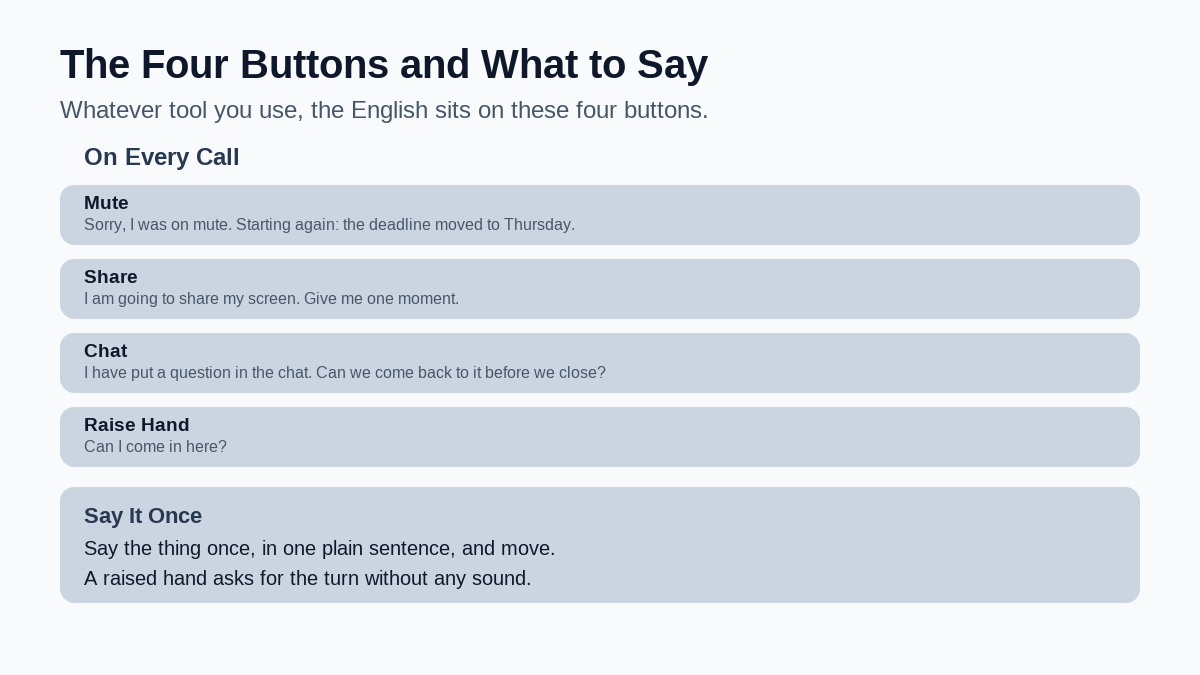
Whatever tool your company uses, the English you need on a call sits on four buttons: mute, share, chat, and raise hand. Here is the sentence for each moment.
| The moment | Say this |
|---|---|
| You were talking on mute | "Sorry, I was on mute. Starting again: the deadline moved to Thursday." |
| Someone else is on mute | "Marco, I think you are on mute." |
| You want to speak and cannot find a gap | Raise your hand on screen, then: "Can I come in here?" |
| You put a question in the chat | "I have put a question in the chat. Can we come back to it before we close?" |
| You are about to share | "I am going to share my screen. Give me one moment." |
| You are finishing your share | "I will stop sharing now so we can see each other." |
| You have to leave early | "I have to drop at 2:30. I will read the notes and reply by tomorrow morning, your time." |
| Two people started at once | "Go ahead, Lena. I will come in after you." |
Interrupting politely has a post of its own on this blog. The extra problem online is the half-second delay: by the time your unmuted voice arrives, someone else has started. The raised hand fixes that, because it asks for the turn without sound.
The first minute, when nobody has warmed up yet
A call does not warm up by itself. In a room, people talk while they find a chair. Online, everyone joins into silence and stares at the grid.
So the first minute is yours to shape, and it needs two short things: a sound check, then a purpose. "Quick sound check. Can everyone hear me clearly? Good. Let's get started. Two things today: the Q3 numbers and the hiring plan." Five short sentences, and the room knows where it is.
If you want the call to feel less flat, do not ask the whole grid how their weekend was. Ask one person one specific question, and keep the answer to a sentence. "Ana, you were out last week. One sentence: where did you go?" One person answers, two people smile, and you have a room. That is the whole icebreaker. It takes twenty seconds and it works in any language.
The full set of opening lines, including how to state the purpose and set the agenda, lives in the stage-by-stage post. The point here is that online, you have to build the warmth on purpose.
Time zones and mixed English: the ground every online call sits on
The grid is almost never one country. Tsedal Neeley, a Harvard Business School professor, wrote in 2012 that "English is now the global language of business," with Airbus, Daimler-Chrysler, Fast Retailing, Nokia, Renault, Samsung, SAP, Technicolor, and Microsoft's Beijing office among the multinationals mandating it as their common corporate language. And the English levels in that grid are mixed.
That changes two things about your English.
First, name the time zone every time you name a deadline.
What the speaker says: "Send it by end of day."
What the listener in Singapore hears: which day?
The small change: "Send it by 5 p.m. Thursday, Berlin time." Four extra words, and nobody spends the night guessing.
Second, respect the clock out loud. "I know it is 9 p.m. for the Singapore team. I will keep us to twenty minutes." That one sentence earns you more patience than anything else you say on the call.
The native speaker in the grid
I used to think being a native speaker was my edge in global business. I don't think that anymore.
Native speakers are often the hardest people to follow on a call.
They speak quickly.
They interrupt.
They assume understanding.
Add a half-second delay and a slang phrase, and the person from Seoul who says one clear sentence is leading the meeting, while a fast talker from Ohio is losing half his words to the delay.
So when a fast speaker loses you, ask, and ask in a way that does not accuse.
What the speaker says: "Sorry, you speak too fast for me."
What the listener hears: an accusation, and a request to slow down for one person.
The small change: "Could you give me that last part once more? I want to write it down." Same request. Now it is about the information, and the other person is helping you get it.
One more thing about connections. Where I live, summer afternoon thunderstorms are routine, and one can drop a home connection at three o'clock, right when a European team is closing its day. The sentence for that moment is the same as for every technical problem: say it once, plainly, and pick up where you were.
What not to do in a virtual meeting
Six things cost more on a screen than they do in a room.
- Do not apologize for your English before you begin. "Sorry for my English" is heard as "get ready for something bad." Say your first sentence instead. If it is clear, nobody is thinking about your English.
- Do not read from a script. A script read into a camera sounds like a script. Prepare shorter structures, not longer scripts: an opening sentence, a key message, a closing action. The rest can be normal speech.
- Do not watch your own face. Bailenson's paper names seeing yourself on screen as one of the sources of overload. If your tool lets you hide your own video tile, hide it. You will speak more to the person and less to the mirror.
- Do not ask the whole grid "Any questions?" and wait. Online, that question gets silence almost every time. Ask one person: "Marco, from the finance side, does this timeline work?"
- Do not stay quiet about a technical problem. Technical difficulties have already cost 77% of the workers surveyed time, as noted above. Silence about them costs more. One sentence, then continue.
- Do not multitask on mute. Seventy percent of the workers surveyed already report feeling disengaged. The person half-reading email with the camera off is the person who has to say "sorry, can you repeat the question?" when their name is called.
Decide in advance: three questions before you unmute
Prep for a call is three questions, not a script. What is my opening sentence? What is my key message? What is my closing decision or action?
I worked with a client who was preparing a promotion presentation. The middle was excellent. The opening and the closing were an afterthought. And openings and closings are what people remember. The middle is not.
Online, that is doubled. People join late and miss your opening, then leave early and miss your close, so the two sentences you prepare have to stand on their own. "I am going to ask for one decision today: the Thursday date." And at the end: "So the decision is Thursday. I will confirm it by email at 5 p.m. Berlin time."
This is where I start with clients at WorldView Training before a high-stakes call: three sentences, said out loud, until they come out without thinking. Under pressure, the rest of your English will follow those three.
A one-minute reset before you join
Tension in the jaw and in the breath makes English worse before the brain is even involved. On a call day, you have been sitting still and staring at a screen for hours already, which is exactly the posture Bailenson describes. So, sixty seconds before you join:
- Massage the corners of your jaw.
- Open and close your mouth slowly, five times.
- Take two slow breaths through your nose.
- Hide your own video tile.
Then join, and say your opening sentence to one face on the grid, not to the grid.
How to practice English for online meetings for free
You do not need a course to practice this. You need the same tool your company uses, and sixty seconds.
Open a meeting with only yourself in it. Press record. Say your opening sentence and your closing action for tomorrow's call. Watch it twice: once with the sound off, so you see what your face and hands are doing, and once with the picture off, so you hear the pace. Then say it again. Three takes, five minutes, free.
If your company records its calls, listen to only your own turns from the last one. Skip everyone else. You are listening for one thing: where you filled silence with "sorry" or "I don't know if that makes sense." Those are the places for the small change.
Speaking is a muscle. The conversation muscle weakens without use, and reading about phrases does not exercise it. Ten minutes out loud beats an hour of reading.
And compare yourself to where you were, not to the other people in the grid. A client from Taiwan hosted a Vietnamese customer in English and, for the first time, did not compare herself to her colleagues. That was the win, and it had nothing to do with grammar.
Under pressure, you will not rise to your level of knowledge. You will fall to your level of training. So train the three sentences, the sound check, and the sentence for when you cut out, until they are automatic. The rest of the call is just talking.
If you have an important presentation, meeting, or negotiation coming up in English, send me a message. I'd be happy to help you prepare.
Frequently asked questions
How to practice English online for free?
Open an empty meeting in the video tool your company already uses, record yourself saying your opening sentence and closing action, then watch it once with the sound off and once with the picture off. Three takes take about five minutes and cost nothing.
What to use for online meetings?
Use whatever video tool your company already uses. For your English, the tool matters less than knowing the sentence for its four buttons: mute, share, chat, and raise hand.
How to make online team meetings fun?
Ask one named person one specific question in the first minute and keep the answer to a sentence. One person answers, others react, and the call has a room in it before the agenda starts.