
A professional rejection email thanks the person for their time, states the decision plainly in one sentence, gives one short and honest reason, and closes with a next step that is true. Send it within days of the decision, and put the company name and the role in the subject line. Anyone who reached the interview stage deserves a phone call first, then the email.
Picture a hiring manager in Frankfurt at 6:40 on a Thursday evening. She has one offer to send and eleven people to turn down. English is her second language. The offer took her four minutes. The eleven rejections are still open on her screen.
This is normal. Erin Stevens, SHRM-CP, then a senior talent acquisition specialist at Fortune Brands Innovations, told SHRM in May 2025 that turning candidates down is "one of the hardest parts of the job." Hard is fine. Slow is the part that does the damage.
A rejection email is one of the moments in English that carry weight, and it is also a small piece of writing with a fixed shape. Once you know the shape, the eleven emails can take twenty minutes.
Why silence is the worst rejection email
Most rejected candidates never get one at all. In Talent Board's 2022 global survey of about 200,000 candidates at 150 organizations, only 7% of candidates said they had been told they did not get the job. In the same survey, 34% said they still had not heard anything two months after applying. Both figures come from SHRM's April 2023 report on that survey.
Two months, from the other side:
They refresh their inbox.
They reread the job post.
They decide what kind of company you are.
Younger candidates say so out loud. In Handshake's own pulse survey of 1,109 students in the third quarter of 2024, 98% said it is important that an employer stays in touch and gives updates during hiring. A clear no counts as an update. Silence does not.
So the first rule is timing. Send the email the same week you make the decision. If the search is still open and you are holding someone as a backup, tell them that, with a date: "We expect to decide by the 14th, and I will write to you either way." A date turns a maybe into something the person can plan around.
Should you reject by email or by phone?
It depends on how far the person got. Candidates who reached an in-person interview should hear the no by phone, not by email alone, according to the recruiters SHRM interviewed for its May 2025 guide. Nicole Belyna, SHRM-SCP, who was SHRM's director of talent acquisition and inclusion when the guide was published, put it simply: "Picking up the phone or sending a personalized message is the respectful thing to do."
Earlier in the process, a template is fine. Nobody can write a personal note to every one of 300 applicants, and a well-written email is a reasonable way to close an application-stage rejection. Anna Cowell, a recruiting management consultant at Helios HR in that same guide, said: "The email can be thoughtful and warm and reflect your employer brand."
My own rule sits between those two. I treat a final video round the same as an in-person interview. The person prepared for hours. Give them three minutes of your voice, then send a short email so they have it in writing.
| Where the candidate stopped | How to tell them | How long it should be |
|---|---|---|
| Resume or application screen | A warm email. A template is fine. | 4 to 6 sentences |
| First phone or video screen | An email written for that person, with one detail from the conversation | 5 to 7 sentences |
| Final round, in person or on video | A phone call, then an email confirming what you said | Call: about 3 minutes. Email: 4 sentences |
The phone call is the harder one in a second language, because a call has no delete key. Prepare it the way you would prepare the opening of a presentation. Not a script. Three questions: what is my first sentence, what is the decision, and what is the one true thing I can offer?
Take a made-up example. Jonas at Halvorsen Freight has to call Marta about the Regional Sales Manager role. His answers: "Hello Marta, this is Jonas from Halvorsen. I am calling about the Regional Sales Manager role. We have chosen another candidate, and I wanted you to hear that from me rather than read it. The deciding factor was field-team experience. Your second-round presentation was clear and well prepared, and I mean that." Under a minute. Everything after that is her questions.
What to write, line by line
The subject line names the company and the role, so the person knows what the email is before they open it: "Your application for Regional Sales Manager at Halvorsen Freight." Do not write "Update" alone. That is a hard subject line to open.
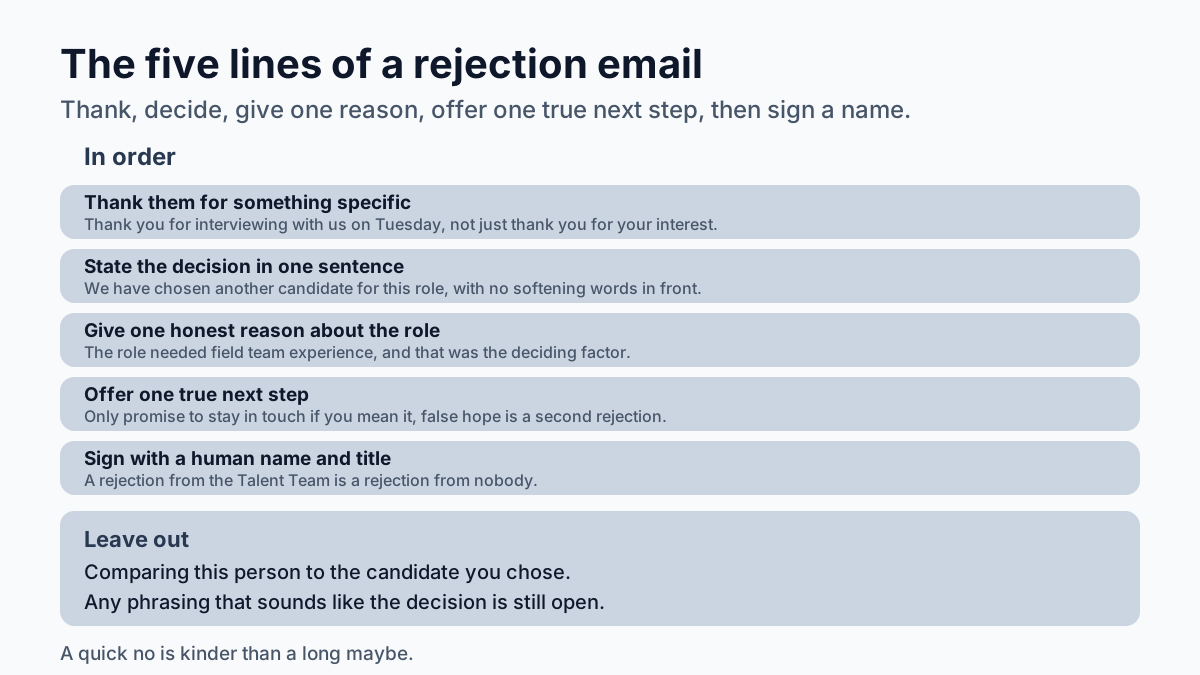
Then five lines, in order.
First, thank them for something specific. "Thank you for interviewing with us on Tuesday" is better than "Thank you for your interest," because it proves a person wrote it.
Second, the decision, in one sentence, with no softening words in front of it. "We have chosen another candidate for this role." That sentence is complete.
Third, one reason, and make it about the role, not about the person. "The role needs someone who has already managed a field team, and that was the deciding factor." One reason is enough. Two reasons start to sound like a case against them.
Fourth, one true door. If you would call them for a future role, say so, and say when: "If a sales role opens in the next six months that matches your experience, I will contact you." If you would not, do not write it. Offering hope is kind. Offering false hope is a second rejection, delivered later. Then invite a question in a form that is easy to say yes to: "If you want to know more about the deciding factor, reply to this email and I will tell you."
Fifth, sign it with a human name and a title. A rejection from "The Talent Team" is a rejection from nobody.
Two things I would leave out. Do not compare the person to the candidate you chose. And do not use phrasing that sounds like the decision is still open, because someone will read it that way and write back to negotiate.
The sentence you wrote and the sentence they read
The mistakes in rejection emails are rarely grammar mistakes. They are gaps between what you meant and what the reader hears.
I saw this clearly in a proposal role-play with a client. The client said to the customer, "You are not our only client." The idea behind it was reasonable. But that sentence can easily sound like: you are not that important to us. So we made a small change: "We have other clients who deal with similar issues." Same basic idea, but a completely different message.
Rejection emails are full of these gaps. These are the ones I would fix first.
You wrote: "We felt other candidates were a stronger fit."
They hear: You are weak, and we ranked you.
The small change: "We have chosen another candidate for this role."
You wrote: "Unfortunately, at this time, we are unable to move forward with your application."
They hear: This is a form letter, and "at this time" means I should ask again next month.
The small change: "We will not be moving forward with your application for the Regional Sales Manager role."
You wrote: "You were a very strong candidate, but we went in a different direction."
They hear: Everything before "but" was a warm-up for the no, and "a different direction" explains nothing.
The small change: Put the decision first, then the compliment, so the compliment can be believed. "We have chosen another candidate. Your presentation in the second round was clear and well prepared, and I mean that."
You wrote: "We will keep your resume on file."
They hear: Goodbye, politely, forever.
The small change: If it is true, give it a shape. "If a role opens in the next six months that matches your experience, I will contact you." If it is not true, cut the line.
You wrote: "Please do not hesitate to reach out should you have any questions."
They hear: A phrase copied from another email. Nobody says "should you have."
The small change: "If you want to know what the deciding factor was, reply to this email and I will tell you."
Two templates you can send tomorrow
For the application stage, four to six sentences:
Subject: Your application for [role] at [company]
>
Dear [first name],
>
Thank you for applying for the [role] position and for the time you put into your application. We have chosen to move forward with other candidates for this role. We received a large number of applications and selected the people whose experience was closest to the requirements in the posting. If you want to apply for a future role with us, I would welcome that. Thank you again for your interest in [company].
>
[Your name], [title]
For after the interview, four sentences, sent the same day as the call:
Subject: Your interview for [role] at [company]
>
Dear [first name],
>
Thank you for speaking with me this morning, and for the two rounds of interviews before it. As I said on the call, we have chosen another candidate for the [role] position. The deciding factor was [one reason about the role]. If you have a question I did not answer on the phone, reply to this email and I will answer it.
>
[Your name], [title]
Both templates are short on purpose. The person will read the second sentence three times. Make it the clearest one.
How do I politely decline a job offer by email?
Same shape, from the candidate's side. Thank them for something specific, decline in one sentence, give one honest reason if you have one, and leave a door open only if you mean it.
You wrote: "After careful consideration, I have decided to pursue other opportunities."
They hear: You took a better offer and you will not say so. Also, "careful consideration" took four days and you never called.
The small change: "I have accepted another role that is a closer match for the direction I want. Thank you for the offer, and for the time your team gave me over three interviews."
Send it within two days of receiving the offer, or within a day of deciding. Email is acceptable here. But if the hiring manager spent hours with you, call first, then send the email.
Subject: [Role] offer at [company]
>
Dear [first name],
>
Thank you for offering me the [role] position, and for the time you and your team gave me. I have decided to decline the offer. I have accepted a role that is a closer match for the [kind of work / location / team size] I want at this stage. I enjoyed our conversations, and I would like to stay in contact. Thank you again.
>
[Your name]
Do not list what the other company pays. Do not apologize three times. One thank-you at the start and one at the end is enough.
How to decline gracefully after you already accepted
This is the hardest no, because the company has stopped looking. Someone told the other finalists no on your behalf.
So the rule changes in one way. Call first, the same day you decide. Then send the email as a record.
You wrote: "Due to unforeseen circumstances, I will not be able to start on the 3rd."
They hear: Something is wrong and you are hiding it. Also, "will not be able to start" leaves them guessing whether you mean never or later.
The small change: "I am withdrawing my acceptance of the [role] offer. I know this creates a problem for your team, and I am sorry for it. The reason is [one sentence: a counteroffer I decided to take, a family situation that changed, a role closer to home]."
Own the cost in one sentence, give the reason in one sentence, and stop. A long explanation reads as an argument, and there is nothing to argue about. The email is that same paragraph with "Thank you for the call today. As I said," in front of it, and one line of thanks for how the team treated you.
When English is your second language
If you write English as a second language, the risk in a rejection email is length, because the habit is to add softeners in front of bad news. "Unfortunately" once is polite. "Unfortunately, regrettably, at this time, we are unable to" is four apologies before a single fact. "I regret to inform you" sounds like a letter from a government office. The reader of a rejection wants the fact.
The word "reject" almost never appears in the email itself. Say the decision instead. "We have chosen another candidate." "We will not be moving forward." "I have decided to decline." "I am withdrawing my acceptance." Each one is a complete sentence you can write without a dictionary, and each one is clearer than the formal phrase it replaces.
Remember that the reader may also be reading in a second language. A manager in Frankfurt writing to a candidate in Jakarta is one non-native speaker writing to another. Short sentences protect both of you.
Before you send it, do this:
- Read the email out loud, once.
- Where you run out of breath, put a period.
- Where you would not say the word in a meeting, use the word you would say.
This takes less than one minute. It is the sentence-level work I do at WorldView Training with managers who write English every day: the same message, cut down until the listener hears what you meant.
One sentence to carry into tomorrow
Sarah Green Carmichael, a former executive editor at Harvard Business Review, put the whole subject into nine words in a 2016 HBR piece: "A quick no is better than a long maybe."
Every rule above comes back to that. The subject line, the one-sentence decision, the one reason, the door you mean. They all exist so the no is quick and clear enough that the person can close the tab and move on. That is the kindness.
If you have a hard email, a difficult meeting, or a negotiation coming up in English, send me a message. I'd be happy to help you prepare.
Frequently asked questions
What should I write in a job rejection email?
Put the company and the role in the subject line, thank the person for something specific, state the decision in one sentence, give one short reason about the role, and close with a next step you mean, such as an invitation to ask a question. Sign it with a person's name and title, and send it the same week you decide.
How do you politely tell a candidate they were not selected?
Tell them within the week, and by phone if they reached an in-person or final-round interview, with a short confirming email the same day. Say the decision plainly ("We have chosen another candidate"), give one reason about the role, and never compare them to the person you hired.
How do I politely decline a job offer via email?
Thank them for the offer and for their time, decline in one sentence ("I have decided to decline the offer"), give one honest reason if you have one, and offer to stay in contact. Send it within two days of receiving the offer, and call first if the hiring manager spent hours with you.
How to gracefully decline a job offer after accepting?
Call the hiring manager the same day you decide, then confirm by email. Say you are withdrawing your acceptance, acknowledge in one sentence that it creates a problem for the team, give the reason in one sentence, and stop.
Sources reviewed
- SHRM — "A Recruiter's Guide to Turning Candidates Down the Right Way" (Roy Maurer, May 6, 2025)
- SHRM — "Candidate Resentment on the Rise" (Roy Maurer, Apr 11, 2023), reporting Talent Board's 2022 global survey (~200,000 candidates, 150 organizations)
- SHRM — "Candidate Resentment on the Rise" (Roy Maurer, Apr 11, 2023), reporting Talent Board's 2022 global survey
- Harvard Business Review — "Writing a Rejection Letter (with Samples)" by Sarah Green Carmichael, Oct 3, 2016
- AIHR (Academy to Innovate HR) — "How To Write a Professional Rejection Letter (+ FREE Samples)" by Nadine von Moltke
- Indeed Career Guide — "How to Write a Rejection Letter (With an Example)"
- BambooHR blog — "Writing A Rejection Email? How To Break The Bad News"
- Handshake — employer blog citing Handshake's own Q3 2024 student pulse survey (n=1,109)